

An April AC performance test identifies weak compressors and microscopic refrigerant leaks before Florida’s 95-degree heat spikes occur. By measuring pull-down deltas and cooling fan duty cycles, Gregg Smith Automotive ensures your vehicle’s climate control can handle heavy idling and high humidity, preventing mid-summer breakdowns during local weekend outings.
In my 20 years of turning wrenches in Belleview, the hardest conversation I have is telling a customer their AC compressor is “Black Death” shredded because it ran for three months on half charge. Usually, the customer says, “But I had it checked in April and they didn’t see a leak!”
The problem isn’t the mechanic; it’s the tools. Old-school methods are failing modern cars because:
- The “Wash-Out” Effect: Molecule-sized leaks often don’t release enough fluid to carry dye to a visible spot before the wind on US-301 washes it away.
- Invisible Breaches: “Ghost leaks” in 2026 R-1234yf systems can be smaller than a pinhead, remaining invisible to the naked eye even under a blacklight.
- Predictive Failure: Standard gauges only show you what is happening now, not the “shimmers” in pressure that predict a failure in June.
That’s why we’ve integrated Agentic AI diagnostic assistants into our workflow. We don’t just look for leaks anymore; we listen for them and see them through thermal signatures.
Why UV Dye Fails to Find Modern Ghost Leaks
Traditional leak detection relies entirely on sight. You inject a glowing dye, run the car, and look for a yellow stain. But in the high-pressure environments of modern climate control, a leak doesn’t always behave like a dripping faucet.
We’ve moved beyond UV dye because it can’t compete with software-driven precision:
- Load-Dependent Leaks: Some seals only breach when the engine is under a specific RPM load or when the Marion County heat index hits triple digits.
- Internal Seepage: Dye can’t show us a leak buried deep inside the evaporator core without hours of expensive dashboard disassembly.
- Refrigerant Starvation: By the time a dye stain is large enough to be “visible,” you’ve already lost the critical volume of refrigerant needed to carry lubricating oil to the compressor.
At Gregg Smith Automotive, we use software to catch the leak while it’s still a $150 O-ring fix, not a $2,500 total system replacement disaster in July.
Hearing the Inaudible with Ultrasonic Acoustic Detection

When a leak is hidden behind your dashboard in the evaporator core, most shops want to tear your dash apart just to find it. I don’t have time for that, and neither do you. Instead, I reach for the Superior AccuTrak VPE.
Refrigerant escaping a pressurized line creates turbulence that generates ultrasonic sound waves between $38kHz$ and $42kHz$. You can’t hear it, but our AI-powered acoustic sensors can. As I move the probe along your AC lines, the software filters out the background noise of Abshier Blvd traffic and converts that high-frequency hiss into a distinct chirp in my headset. If there’s a leak behind your dash, the AI finds the acoustic fingerprint without removing a single screw.
Seeing Cold Gas in Real Time with Thermal Blue Blooms
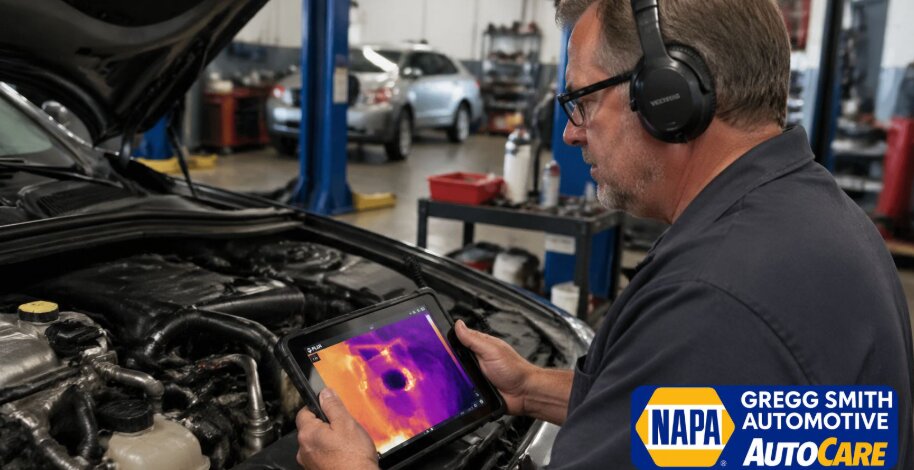
If the acoustic sensor is our ears, the FLIR ONE Edge is our eyes. Physics tells us that when a gas expands rapidly (like when it escapes a tiny hole), it absorbs heat. This creates a localized cold spot at the site of the leak.
Using our diagnostic tablets, I can scan your condenser and engine bay. The AI overlays a thermal map on the screen. A micro-leak shows up as a “blue bloom”—a freezing cold signature—against the orange and red heat of your engine. It’s an incredible “Aha!” moment for customers. I can show you the tablet screen, and you can see the exact molecule-sized breach on the backside of your condenser that no blacklight would ever find.
Catching Highway Shaft Seal Failure via Predictive Waveforms
The most elusive leak is the one that only happens at 60 mph. Your compressor shaft seal is a dynamic part; it’s spinning thousands of times per minute. Sometimes, it only leaks when it’s vibrating at highway speeds.
To catch this, I hook up a PicoScope 7 to your system’s pressure transducers. This tool captures the heartbeat of your AC system in high-resolution waveforms. Our AI software analyzes these pressure pulses for tiny irregularities that indicate a seal is intermittently failing. It’s predictive maintenance at its finest. We can see the failure starting in April, allowing us to replace a seal before the compressor seizes and leaves you stranded during a weekend trip to Lake Lillian.
Why Data-Driven Maintenance Wins the Financial Battle
At the end of every AI-powered diagnostic, I don’t just give you a “Trust me” shrug. You get a Digital Health Report texted directly to your phone. It includes the thermal images, the acoustic hit-map, and the pressure waveforms.
In 2026, refrigerant isn’t cheap, and compressors are even more expensive. Catching a micro-leak now is the difference between a quick seal replacement and a catastrophic mid-summer failure. We’re using the best tech in Belleview to make sure your AC is ready for the long haul, not just the drive home.
Gregg Smith Automotive 6202 SE Abshier Blvd, Belleview, FL 34420
Frequently Asked Questions
How does AI find a leak that a human cannot see?
It uses multi-signal correlation. By combining ultrasonic sound data, thermal temperature drops, and pressure waveform analysis, the software identifies patterns that human eyes—and traditional dyes—simply cannot detect.
Is AI-powered AC service more expensive for the driver?
The diagnostic fee is slightly higher than a basic visual check, but it saves thousands in the long run. By finding leaks early, we prevent the “Black Death” compressor shredding that requires a full $2,500 system replacement.
Why did my AC stop working if there was only a micro-leak?
Every system has a reserve of refrigerant. You can lose a tiny bit every day for months without noticing. Once you hit the critical low threshold, the safety pressure switch cuts power to the compressor to prevent it from burning up, causing cooling to vanish instantly.
Can I still get my AC serviced if I’ve already used a DIY sealant can?
No, most professional shops will refuse service if a sealant is detected. Because these chemicals contaminate refrigerant and damage expensive recovery machines like our Robinair AC1234-9, the system usually requires a complete, costly component replacement to be considered “serviceable” again by an EPA-compliant technician.
Is an AI AC diagnostic scan better than a traditional UV dye test?
Yes, because it identifies “ghost leaks” that don’t leave a visible trace. While UV dye requires the leak to be large enough to carry fluid to an visible area, AI-powered acoustic and thermal tools detect molecule-sized gas escapes in real-time, even in hidden areas like the dashboard.