

Record-breaking oak and pine pollen counts in Belleview clog cabin HEPA filters by May, creating a resinous “bio-film” that restricts intake and strains blower motors. This airflow loss often mimics low refrigerant symptoms. Upgrading to an activated carbon HEPA filter restores full CFM and eliminates the musty odors common near Smith Lake.
I’ve seen it a dozen times this week already. A customer pulls into the shop on Abshier Blvd, sweating, and tells me their AC “needs a charge” because the air just isn’t cold anymore. But when I stick my hand in front of the vents, I don’t feel a lack of cold—I feel a lack of wind.
In May, the “Yellow Dust” we’ve been living with since March undergoes a chemical change. It’s no longer just powder; it’s a physical barrier that acts like a clog in a vacuum cleaner. If your AC feels weak, you aren’t out of gas—your car is suffocating.
The 300 LFM Threshold: Is Your AC Choking to Death?
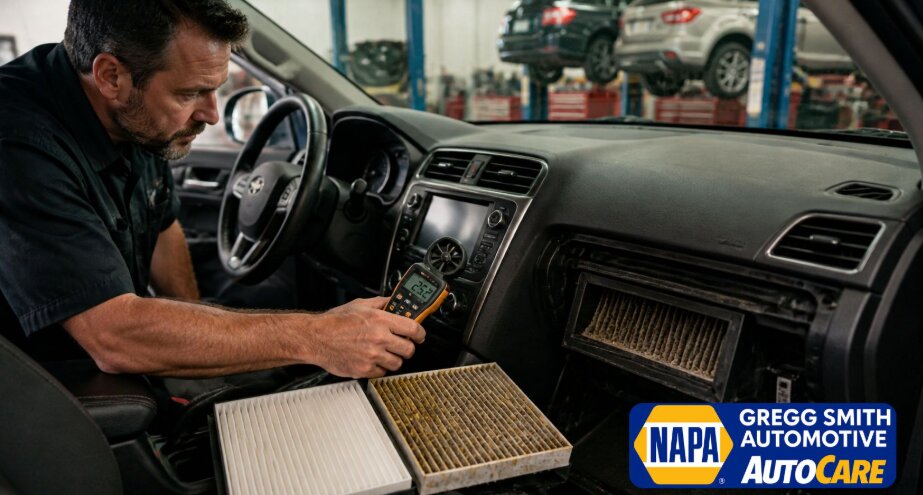
When a car comes in with weak air, I don’t start with the refrigerant gauges. I start with a digital anemometer. This tool measures CFM (Cubic Feet per Minute) and wind speed in LFM (Linear Feet per Minute).
In a healthy system, I want to see a healthy gust at the center vent. A reading below 300 LFM is the “Smoking Gun.” When I see numbers that low, I know the evaporator core is being starved of air. This is a mechanical emergency. Without enough air flowing over the evaporator, the moisture on the coils turns to a block of ice, physically “slugging” the system and eventually leading to a complete lack of cooling.
Micron Warfare: Why Standard Filters Fail the Belleview Oak Test
Most people think a cabin filter is just a piece of paper. If you’re buying the “Big Box Store” generics, that’s exactly what it is—a screen door for allergens.
The Southern Live Oak pollen we have here in Marion County is about 25μm to 30μm in size. While that sounds small, it’s a giant compared to the 0.3-micron standard of a true HEPA H13 filter.
- The “Bio-Film” Effect: In the dry heat of April, pollen is just dust. In the 90% humidity of May, those pollen grains absorb moisture and rupture.
- The Resin Trap: Pine pollen from the Slash Pines near Smith Lake is coated in a sticky resin. This resin acts as a glue, bonding the oak dust into a waterproof sludge that seals the filter fibers shut.
You can’t “blow out” a May filter with an air compressor. Once that resin sets, the filter is a solid wall.
The High-Amperage Trap: How a $40 Filter Saves a $400 Blower Motor
This is where the repair bill gets expensive. Your blower motor is designed to pull air through a clean, porous filter. When that filter is clogged, the motor has to work twice as hard to maintain speed.
- Amperage Spikes: To overcome the resistance, the motor pulls higher electrical current (amperage).
- The “Burnt Plastic” Warning: The Blower Motor Resistor sits in the air duct because it needs that rushing air to stay cool. When the airflow drops below that 300 LFM threshold, the resistor begins to overheat.
If you’ve noticed a faint ozone-like or burnt plastic smell coming from your vents, that’s the smell of your resistor’s internal solder and thermal fuse reaching its melting point. Changing the filter now saves you from replacing a melted resistor and a burnt-out blower motor next month.
Smith Lake Saturation: The Resinous Reality of Waterfront Parking
If you live or park near Smith Lake or Lake Lillian, your filters are taking a double hit. The high concentration of pines in these areas creates a “resinous saturation” that is much heavier than what we see in the middle of town.
This isn’t just about airflow; it’s about the “Musty Blast.” Pollen is organic matter. When it’s trapped in a dark, damp filter housing in 90-degree heat, it begins to decay. That “dirty sock” smell you get when you first start the car is the smell of microbial growth. We use Activated Carbon composite filters because the charcoal layer neutralizes those odors at a molecular level, rather than just masking them with a “fresh scent” spray.
The Forensic Verdict: Restoring CFM for a Marion County Summer
When I pull a filter from a US-301 commuter’s car this time of year, it usually looks like a solid piece of yellow felt. That is the smoking gun.
At Gregg Smith Automotive, we don’t just guess. We use the data from the anemometer and the visual proof of the filter saturation to show you exactly why your system is struggling. Before you spend hundreds on a “recharge” you might not need, let’s check the lungs of your AC system. Restoring your CFM is the fastest, cheapest way to survive a Belleview summer.
Gregg Smith Automotive 6202 SE Abshier Blvd, Belleview, FL 34420
Frequently Asked Questions
Why does my AC smell like ozone or burnt plastic?
Yes, this is often a sign of electrical distress. If your cabin filter is clogged, the blower motor resistor isn’t being cooled by rushing air and is likely beginning to overheat. This smell is a warning that the resistor or its wiring harness is failing.
Can I just blow the yellow dust out of my filter with an air hose?
No. In Belleview’s high humidity, the pine resin in the pollen acts as an adhesive. While you might knock off the loose dust, the microscopic fibers remain “glued” shut by the resin. Only a full replacement with a HEPA H13 filter will restore proper airflow.
Why is my air blowing weak even when the fan is on high?
Yes, this is almost always a restriction issue. If the blower motor is spinning but the air isn’t reaching your face at a high velocity, the “invisible wall” of a clogged filter is the primary culprit. We look for a reading of at least 300 LFM to ensure your system can actually cool the cabin.
Can a clogged cabin filter cause my AC to blow hot air?
Yes, because restricted airflow often causes the evaporator core to drop below freezing. When the moisture on the coils turns to a solid block of ice, air can no longer pass through the system, causing the cabin temperature to rise and leading many drivers to mistakenly believe they are out of refrigerant.
Will a dirty filter make my blower motor louder?
Yes, as the filter becomes saturated with resinous pollen, the blower motor has to overcome higher static pressure. This often results in a high-pitched whine or a labored “whirring” sound as the motor draws more amperage to push air through the invisible wall of debris.