

Agentic AI assistants are revolutionizing 2026 automotive diagnostics by utilizing ultrasonic acoustic sensors and thermal overlay mapping to pinpoint microscopic refrigerant leaks. This software-driven approach identifies pinhole losses in R-1234yf systems that legacy UV dyes miss, ensuring faster, more accurate repairs while protecting expensive compressors from premature failure.
For decades, finding an AC leak in Belleview meant pumping your system full of glowing neon dye and hunting with a blacklight like we were in a low-budget detective movie. It was messy, it was slow, and it often failed to find the “micro-leaks” that only show up when the Florida sun hits 32°C. In 2026, we’ll retire the UV light. At Gregg Smith Automotive, we use Agentic AI assistants that can literally hear and see a leak before it ever leaves a stain.
Beyond the Dye Why UV Lights are Becoming Obsolete in 2026
UV dye had its time, but it has a major flaw: it requires the leak to be large enough for liquid to escape and travel to a visible area. In modern hybrids and late-model vehicles with cramped engine bays, the leak is often buried behind the firewall or deep inside the evaporator case.
By the time you see the dye, you’ve already lost enough R-1234yf to starve your compressor of oil. We’ve shifted to Digital Forensics. Instead of waiting for a mess, we use data. Our AI assistants analyze pressure decay over a specific timeline, calculating exactly how many grams per year your system is losing. If your system is losing even 4 grams a year, the AI flags it before your vents even start blowing warm.
Listening for Leaks The Power of Ultrasonic AI Assistants
Refrigerant escaping under high pressure creates a specific acoustic signature—a high-pitched frequency that human ears can’t register. In the old days, a noisy shop made acoustic detection impossible.
Our 2026 Ultrasonic Leak Detectors use Agentic AI to filter out the background noise of Abshier Blvd. It ignores the sound of air tools, passing trucks, and cooling fans, focusing exclusively on the 38–42 kHz frequency of escaping gas.
- Precision: It identifies the exact O-ring or fitting that has failed.
- Speed: We can find a microscopic leak in minutes that used to take a two-day “dye and wait” cycle.
- Reliability: The AI confirms the signature, removing the human element of “I think I hear something.”
The Thermal Smoking Gun Seeing the Leak Your Eyes Miss
When refrigerant leaks, it creates a localized “cold spot” as the gas expands. Our FLIR Thermal Integration software allows us to see this thermal footprint in real-time.
In April, as Marion County temperatures fluctuate, aluminum AC lines expand and contract. This causes “intermittent” leaks—the kind that disappear the moment you pull into a shop. Our AI-driven thermal mapping tracks these “Heat Soak” patterns. We can see the “ghostly blue” plume of a failing evaporator core or a pitted condenser fin near Smith Lake, even if the leak is currently “sealed” by the cooler morning air.
Saving the R-1234yf Why Speed Equals Savings for Belleview Drivers
If you’re driving from Oxford to the Belleview Sports Complex and notice your air is cold at the start but warm by the time you arrive, you have the “Invisible Drain.” Refrigerant (R-1234yf) is significantly more expensive in 2026 than the old R-134a. Every gram that leaks out is money out of your pocket. By using AI to find the “Thermal Smoking Gun” early, we prevent Evaporator Slugging and Compressor Desiccation. We find the $2 O-ring failure today so you don’t have to pay for a $1,200 compressor replacement in July.
The Expert Verdict Digital Forensics for a Frosty Summer
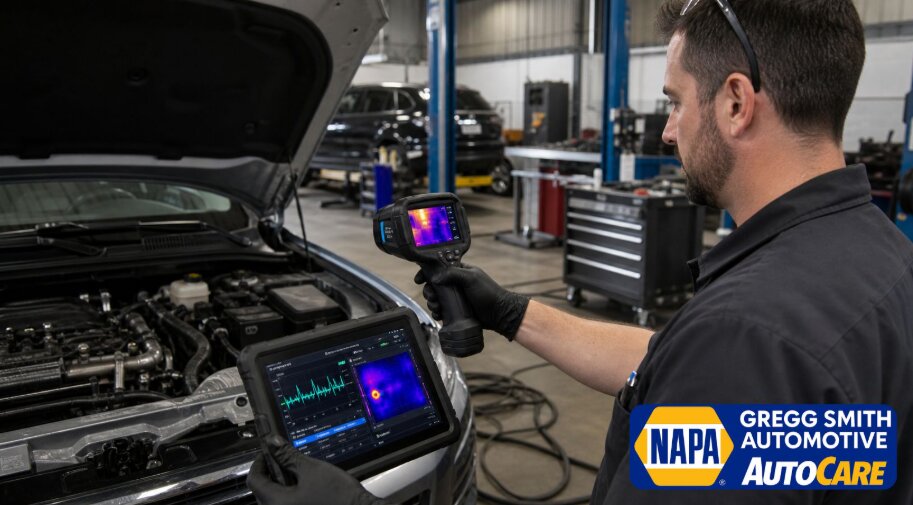
The most important part of our 2026 workflow is Closed-Loop Verification. Once the AI identifies the leak and we perform the repair, we don’t just send you on your way.
We engage the Agentic Assistant for a final “Digital Sweep.” It “listens” to the repaired fitting and “looks” at the thermal signature again. Once the AI confirms the acoustic signature is flatlined and the thermal spot is normalized, we issue your digital “Certificate of Purity.” This is our proof to you that the leak is 100% gone and your system is ready for the Florida summer.
Gregg Smith Automotive 6202 SE Abshier Blvd, Belleview, FL 34420
Frequently Asked Questions
Why is my AC blowing warm in the afternoon but cold in the morning?
This is a classic sign of a microscopic leak and “Heat Soak.” As the afternoon heat expands your AC components, a pinhole leak can open up. Our AI assistants are designed to find these intermittent leaks by simulating those thermal loads in the bay.
What is acoustic leak detection?
It is a method of using sensors to “hear” the ultrasonic frequency of escaping refrigerant. In 2026, we use Agentic AI to filter out shop noise, allowing us to find leaks that are totally invisible to the naked eye.
Is AI AC repair more expensive than the old way?
Actually, it usually saves you money. Because we find the exact leak faster, you pay for less diagnostic labor and you don’t waste expensive R-1234yf refrigerant on “guess and check” refills.
Can UV dye damage my AC system?
While dye itself is generally safe, adding too much or using it as a “crutch” for poor diagnostics can lead to system contamination. Our 2026 digital methods are “non-invasive,” meaning we don’t have to add anything to your system to find the problem.
Can Agentic AI find a leak before I even notice the air getting warm?
Yes. In 2026, many modern vehicles are equipped with sensors that allow our AI assistants to perform a “Predictive Pressure Analysis.” We can often detect a microscopic loss of refrigerant—sometimes as little as 2 or 3 grams—long before your cabin temperature begins to rise. By catching these “pre-leaks” during a routine April checkup, we can replace a drying O-ring or a loose service port valve for a fraction of the cost of a full system recharge later in the summer.