

Variable Displacement Compressors (VDC) revolutionize automotive cooling by utilizing an internal swash-plate mechanism to modulate refrigerant flow. Unlike traditional systems that “clutch on and off,” VDCs provide constant cooling and a rock-steady engine idle, eliminating the RPM surges and vent temperature fluctuations commonly felt at long Florida traffic lights.
If you’ve lived in Marion County long enough, you know the “Belleview Shudder.” You’re sitting at the long light at Abshier Blvd and US-441 in May, and every thirty seconds, you feel the engine dip, the steering wheel vibrate, and you hear a loud clack from under the hood. That’s a traditional electromagnetic clutch engaging a fixed-displacement compressor. It’s old technology, and in 2026, we’re helping drivers move past it.
The Swash Plate Secret on How Your AC Adjusts on the Fly
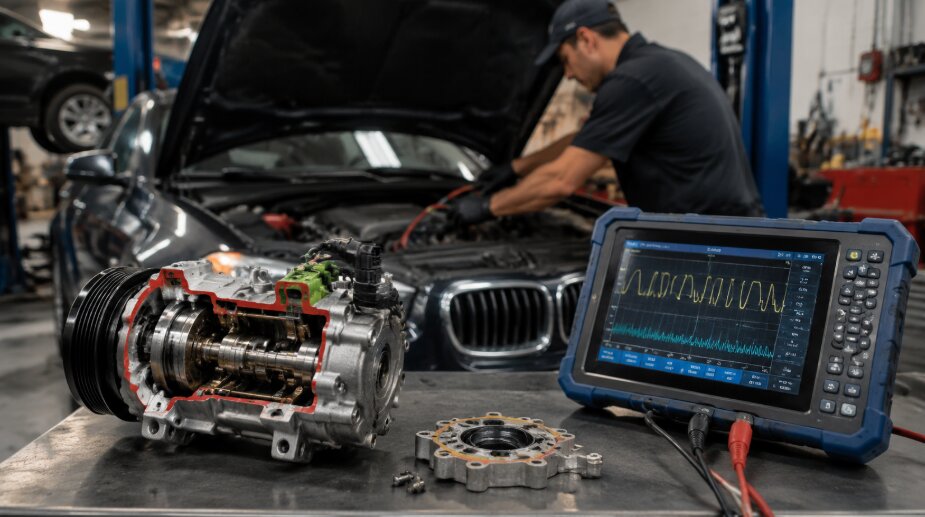
Traditional compressors are binary: they are either 100% on or 100% off. To keep you cool without freezing the system, they have to cycle on and off constantly. A Variable Displacement Compressor (VDC), found in most Audi and BMW models, works on an entirely different principle of physics.
Inside the compressor is a rotating component called a swash plate. Instead of a fixed stroke, the angle of this plate can tilt.
- At a Stoplight: The plate tilts to a steep angle, increasing the piston stroke to maintain high refrigerant flow even though the engine is at low RPM.
- On the Highway: The plate flattens out, reducing the stroke because the high engine speed provides plenty of cooling capacity.
This allows the compressor to stay “on” 100% of the time, adjusting its output from 1% to 100% based exactly on what the cabin sensors demand.
Why Your BMW Doesn’t Shudder at the Stoplight
The shudder you feel in older vehicles is a step-load. The engine is idling peacefully when suddenly it has to instantly provide 10-15 horsepower to turn a heavy compressor.
Because a VDC never truly turns off, it provides a ramp-load. The swash plate adjusts smoothly, meaning the parasitic draw on your engine is a flat, predictable line. When you’re idling at that long light near the Belleview Sports Complex, your RPM needle stays rock-steady. You get icy air without the mechanical drama.
Managing the May Humidity with Constant Flow Cooling
May in Florida isn’t just about heat; it’s about the rising dew point. Traditional cycling compressors have a flaw: when the clutch cycles off, the evaporator temperature begins to rise immediately. In high humidity, this leads to a “muggy” feeling in the cabin before the compressor kicks back in.
With Constant Flow Cooling, the evaporator stays at a precise, freezing temperature. By never stopping the flow of refrigerant, the system acts as a permanent dehumidifier. You don’t get those waves of humidity between cycles; you just get a crisp, dry environment regardless of how long the light stays red.
The Electronic Brain Behind the Cold Pulse Width Modulation Control
In the bay, we don’t just check for “Freon.” To diagnose a VDC system, we have to look at the Pulse Width Modulation (PWM) signal. The car’s computer sends an electronic heartbeat to a control valve on the back of the compressor.
We use an Oscilloscope to track this signal. If your Audi isn’t cooling, it might not be a mechanical failure; it could be a “lazy” solenoid or a corrupted signal from the cabin ambient temperature sensor. This is precision electronics, and it requires a different level of diagnostic forensics than a 1995 pickup truck.
The Master Tech Verdict on Precision Performance for the Florida Summer
Variable displacement technology is the “secret sauce” behind the luxury driving experience. It preserves your motor mounts by eliminating vibration, saves fuel by never over-compressing, and provides the most consistent cabin temperatures possible in the Marion County climate.
If you’re feeling a shudder, or if your “icy” air seems to come and go, you might have a control valve issue or a swash plate that’s beginning to bind. At Gregg Smith Automotive, we have the digital manifold gauges and the logic-testing tools to ensure your high-end system performs exactly as the engineers intended.
Gregg Smith Automotive 6202 SE Abshier Blvd, Belleview, FL 34420
Frequently Asked Questions
Why don’t I hear my AC “click” on and off like my old car?
Most modern European and high-end domestic cars use VDCs that stay engaged. Instead of a mechanical clutch “clicking,” an internal valve silently adjusts the cooling power. If you don’t hear a click, that’s actually a sign of a more advanced, smoother system.
Why does my engine RPM stay so steady when the AC is on?
That is the “ramp-load” of variable displacement. Since the system doesn’t hit the engine with a sudden 100% load, the engine computer can maintain a much smoother idle, which is better for your motor mounts and fuel economy.
Is a Variable Displacement Compressor harder to repair?
They are more complex because they are electronically controlled. Rather than just checking pressure, we have to test the PWM signal from the car’s computer. It requires specialized diagnostic equipment, but it results in a much more precise repair.
Can a VDC system help with that “musty” Florida smell?
Yes. Because the compressor provides constant cooling, the evaporator stays consistently cold and drains moisture more effectively. This prevents the “warm-up” periods where moisture can sit and contribute to mold growth.
How does a variable compressor improve my gas mileage?
By modulating the piston stroke, a VDC only draws the exact amount of power needed to maintain your cabin’s temperature. While a traditional compressor is either “all or nothing,” a variable system might only operate at 20% capacity on a mild morning. This drastically reduces the parasitic drag on your engine, allowing you to save significantly on fuel during long Belleview commutes without ever sacrificing your comfort or cooling performance.