

Maintaining your vehicle’s AC system is a critical safety measure for Belleview families. High thermal loads during May practices can strain auxiliary cooling fans, leading to voltage drops that interfere with Toyota’s Parking Support Brake (PKSB) and sonar sensors. Professional AC service ensures both cabin comfort and safety system reliability.
Sitting in the pickup line or at the Belleview Sports Complex in 95°F heat is the ultimate stress test for a modern family vehicle like the Toyota Sienna. Most parents don’t realize that while they are idling, waiting for practice to end, their car is fighting a silent battle against “Stationary Soak.” If your AC system is struggling, it isn’t just your comfort at risk—it’s the electrical stability of your entire safety system.
The Auxiliary Fan and Why It Is the Hero of the Belleview Sports Complex
When you’re cruising down Abshier Blvd, the wind does the work of cooling your AC condenser. But when you’re parked on the asphalt at the sports complex, that “ram air” disappears. This is where the auxiliary cooling fan becomes the hero:
- Primary Defense: It acts as the lungs of your AC system when there is zero forward motion.
- Pressure Management: It prevents high-side pressure spikes that would otherwise force the compressor to shut down.
- Component Protection: By shedding heat quickly, it prevents the AC clutch from slipping and “blueing” due to excessive thermal loads.
Voltage Stability and Why Your Toyota PKSB System Needs Healthy AC
Modern Toyotas are equipped with Parking Support Brake (PKSB) and sonar sensors designed to detect children or obstacles behind you. These systems are incredibly sensitive to electrical health. If your AC system is struggling, it creates a chain reaction:
- Amperage Spike: A failing auxiliary fan or a clogged blower motor pulls massive amounts of current to stay operational.
- Voltage Sag: This heavy draw can pull system voltage below 12.5V, even while the engine is running.
- Sensor “Blindness”: When voltage dips, the PKSB computer may throw a “ghost error,” temporarily disabling your safety sensors right when you’re backing out of a crowded parking lot.
The Performance Gap on Healthy vs. Struggling AC Systems
To help you understand if your van is winning the battle against the Florida sun, we look at specific technical benchmarks in the bay.
AC System Stability Benchmarks
| Component | Healthy Status | Warning Signs | Safety Impact |
| Auxiliary Fan | High-speed “whoosh” when idling | Silent or grinding noise | High-pressure AC shutdown |
| System Voltage | Stable 13.8V – 14.2V | Dips below 12.5V under load | ADAS/PKSB sensor errors |
| Pull-Down Speed | 40°C to 22°C in <5 mins | 10+ mins to feel “cool” | Driver fatigue and distraction |
| Condenser Delta-T | 20°F – 30°F temp drop | Less than 10°F drop | Engine overheating risk |
The Five Minute Pull Down for Keeping Families Cool in the 95 Degree Sun
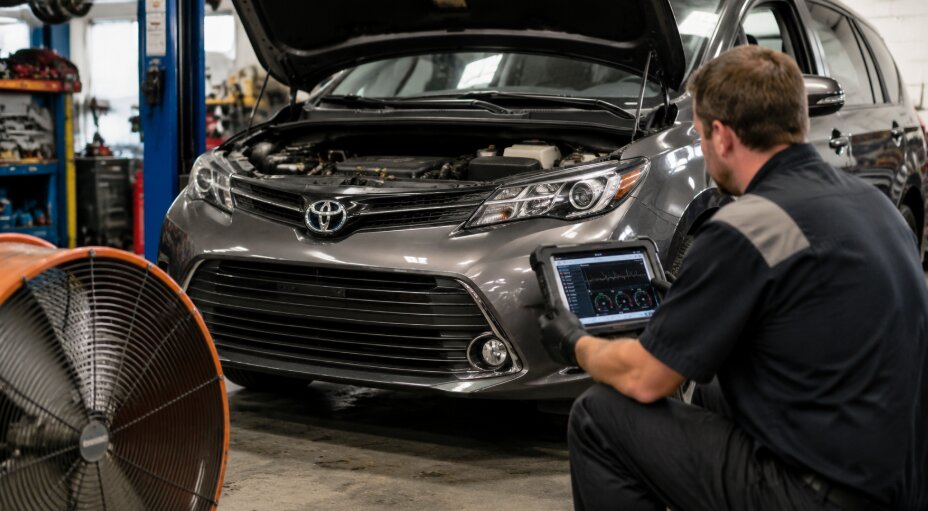
At Gregg Smith Automotive, we use the “Five Minute Pull-Down” test. We simulate a Belleview afternoon by heat-soaking the cabin to 104°F (40°C). A healthy system should be able to drop that temperature to a crisp 72°F (22°C) in five minutes or less while stationary. If it takes longer, your system is inefficient, your engine is working too hard, and your battery is being drained by a blower motor trying to compensate for a lack of refrigerant.
How Excessive Heat and Electrical Strain Affect Sonar Safety Sensors
High heat doesn’t just affect the passengers; it affects the sensors. Sonar sensors located in your bumpers can blind themselves if they overheat or if the electrical “noise” from a failing fan motor interferes with their signal. When we perform an AC service, we aren’t just looking at the Freon; we are performing a Safety Scan to ensure your alternator is handling the AC load without starving your safety modules of the clean power they need to stay alert.
The Master Tech Verdict on Proper Cooling for a Safer School Zone
A cool driver is a focused driver. When you’re sweating in a hot cabin, your reaction times slow down, and your frustration levels rise—neither of which you want in a Belleview school zone. By ensuring your auxiliary fans are healthy and your pull-down speeds are sharp, we ensure that your Sienna’s safety tech remains 100% active.
Don’t let a weak AC fan turn into a safety failure. Let us put your van through the “Stationary Soak” test before the peak May heat turns your parking lot wait into a mechanical emergency.
Gregg Smith Automotive 6202 SE Abshier Blvd, Belleview, FL 34420
Frequently Asked Questions
Why does my AC seem to work better when I’m actually driving?
When the car is moving, air is forced through the condenser naturally. When you stop, you rely entirely on the auxiliary fans. If your AC gets warm at red lights or in the parking lot, your auxiliary fan is likely failing or your condenser is clogged with debris.
What is Toyota PKSB and how does the AC affect it?
PKSB stands for Parking Support Brake. It uses sonar to stop the car if it detects an object while parking. This system requires very stable voltage. If a struggling AC system causes a “voltage sag,” the PKSB system may disable itself right when you need it most.
What is a “Pull-Down” test?
It’s a master-tech benchmark where we measure how fast your AC can lower the cabin temperature from extreme heat to a comfortable level while idling. It’s the best way to see if your system is ready for a Florida summer.
How can I tell if my auxiliary fan is working?
You should hear a distinct “whoosh” or a loud fan sound from the front of your car when the AC is on and you are parked. If it sounds like a grinding noise, or if you hear nothing at all while the vents are blowing warm, the fan is likely dead.
Can a bad AC blower motor cause dashboard warning lights?
Yes. In modern vehicles, a failing blower motor can pull so much amperage that it starves other electronic modules, potentially triggering “low voltage” codes or warning lights for safety systems like Traction Control or PKSB.