

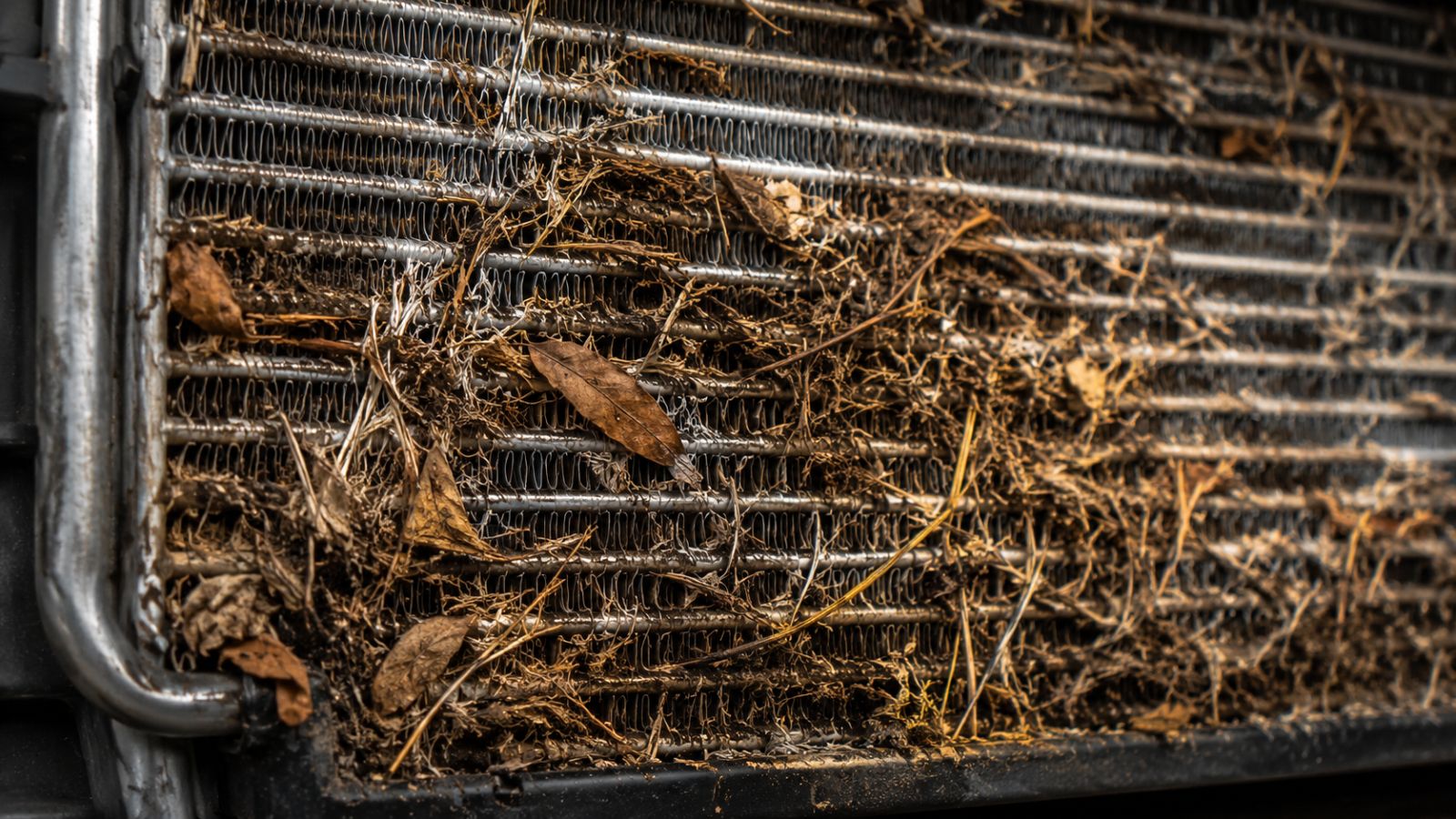
Modern automotive climate controls require unrestricted condenser airflow to prevent extreme high-side pressure spikes at idle. While highway driving forces natural ram air through the radiator cooling stack, organic debris accumulation causes systems to fail while stationary. Gregg Smith Automotive clears hidden fin blockages to ensure stationary cooling performance.
While cooling perfectly down Abshier Blvd, an air conditioner that shifts into a humid blast at an idle isn’t low on refrigerant. It is suffering from a blocked condenser. Without highway ram air, zero-speed idling forces catastrophic high-side pressure spikes, triggering a computer safety shutdown to prevent an explosive component blowout.
The Highway Airflow Illusion and Why Your Vents Lie at Speed
High speeds create ram air, a powerful force that masks a clogged cooling matrix by slamming through the grille to override debris and maintain cabin cooling. This creates a false impression of system health that disappears once the vehicle stops and aerodynamic airflow ceases.
- Ram Air Masking: At 60 MPH, dense natural airflow forces heat out of a partially choked condenser, hiding underlying structural blockages.
- The System Health Illusion: Drivers incorrectly assume their air conditioner is completely healthy simply because it performs well at higher highway RPMs.
- The Idle Reality: Stopping the vehicle instantly eliminates free aerodynamic force, transforming the cooling loop into a high-stress thermal battleground.
The Fluid Dynamics of Static Idle Heat Rejection vs Ram Air Flow
Understanding stationary AC failure requires analyzing vehicle thermal energy transfer. Systems extract cabin heat and expel it through the Aluminum Condenser Fin Matrix located in front of the radiator. The compressor pumps pressurized, superheated refrigerant gas into the condenser. For interior cooling, this gas must release enough latent heat to condense into a sub-cooled liquid before reaching the dashboard.
- The Idle Airflow Shift: At a static zero-speed idle, your car is entirely dependent on its Auxiliary Cooling Fan Clutches or electric brushless fan modules to pull air through the cooling fins.
- The Saturated Thermal Trap: If the tight air pathways between the aluminum fins are physically blocked, the fan cannot pull sufficient ambient air through the core.
- The Liquefaction Failure: The Liquefaction Failure: Insufficient airflow halts latent heat removal, keeping refrigerant as a superheated gas. This thermal bottleneck prevents liquid from reaching the interior expansion valve, causing cabin cooling to fail instantly.
How Lake Lillian Organic Debris Suffocates Your Front Grille Assembly
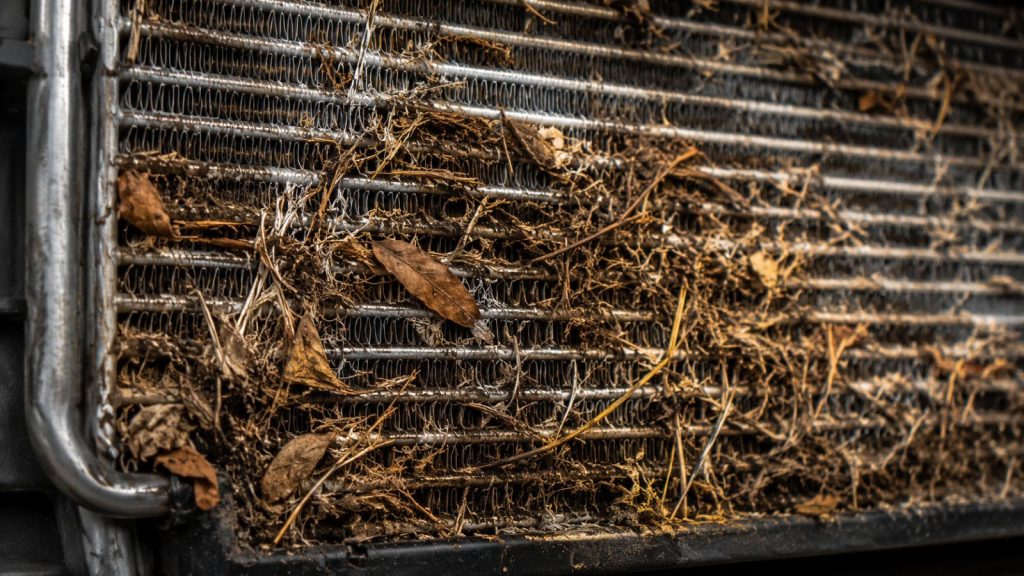
Parking near southern Marion County’s dense tree canopies exposes vehicles to significant atmospheric debris. As auxiliary fans work to combat summer humidity at idle, they pull Spanish moss, pine needles, and seed pods against the condenser core.
Under intense engine heat, this organic matter mats into a dense carpet that seals off vital cooling micro-channels. This blockage is most severe during static idling, where pre-heated air from asphalt further stresses the system, causing cooling performance to vanish.
The High Side Pressure Trap and the Dangerous DIY Refrigerant Mistake
Drivers facing idle-only cooling failures often mistakenly assume a leak exists and attempt DIY refrigerant top-offs. In systems with blocked condenser fins, this is a dangerous error. Superheated gas already causes internal pressures to skyrocket toward 400 PSI within minutes of idling.
Exceeding these pressure limits triggers safety switches that cut compressor power to prevent line explosions. Adding retail refrigerant to a loop already at maximum pressure causes catastrophic overcharging. This extreme head pressure can instantly snap internal reed valves, turning a simple cleaning into an expensive compressor replacement.
Operational Telemetry on Road Speed vs. Blocked Idle Performance
To safely isolate an airflow block from an electrical or mechanical fault, our service bay analyzes live operational data parameters across both driving conditions. The diagnostic profile below contrasts how a caked condenser distorts vehicle data streams when shifting from road speeds to a stationary park position:
Automotive Climate Control Airflow Disruption Matrix
| System Diagnostic Marker | Highway Speed Operation (Ram Air) | Blocked Stationary Idle (Static Fan) |
| High-Side Line Pressure | Stable; hovering within 150–220 PSI | Dangerous spike climbing past 380–420 PSI |
| Low-Side Feed Pressure | Normal range within 30–35 PSI | Equalizes higher or spikes to safety cutoff limits |
| Liquid-Line Service Port Temp | Warm to the touch; showing proper heat dump | Superheated; matching internal block temperatures |
| Center Vent Output Temperature | Maintained at a crisp 40°F–44°F | Spikes rapidly above 70°F within 90 seconds |
| Compressor Clutch Status | Continuously engaged and cycling normally | Short-cycling or completely locked out by computer |
The Master Tech Restoration Verdict on Structural Cleaning Processes
Resolving a severe stationary cooling failure requires a methodical, physical restoration of the cooling stack rather than throwing unnecessary new parts at the vehicle. At Gregg Smith Automotive, we permanently fix these issues by safely accessing the hidden core assemblies and clearing out the root aerodynamic restrictions.
- Core Separation: Technicians split the radiator and condenser assembly to fully expose and clean the trapped debris layer sandwiched between the units.
- Chemical Decontamination: We apply a professional, non-acidic foaming cleanser that expands outward to safely dissolve and push embedded organic sludge from the matrix.
- Fin Alignment Calibration: A specialized aluminum fin comb is used to meticulously straighten collapsed metal rows and restore optimal factory-engineered airflow spacing.
- Pressure Safety Focus: Our team avoids high-pressure power washers entirely to protect the delicate aluminum tubing from becoming permanently flattened or damaged.
Restore Your Stationary Cooling Comfort with Professional Precision
Don’t let a hidden fin blockage ruin your summer family outings or endanger your compressor hardware. Our certified master technicians at Gregg Smith Automotive have the specialized chemical flushes, fin-comb calibration tools, and mechanical testing infrastructure required to clear out underlying blockages safely and accurately.
Keep your cooling loop running safely within factory guidelines all summer long.
Gregg Smith Automotive, 6202 SE Abshier Blvd, Belleview, FL 34420
Frequently Asked Questions
Why does washing my radiator with a garden hose at home fail to fix my idle-only AC problem?
Standard hoses cannot dissolve baked-on sludge, and external spraying often pushes debris deeper. In modern vehicles, the primary blockage usually hides within a two-inch gap between the AC condenser and the engine radiator.
Can a failing auxiliary cooling fan cause the exact same symptoms as a blocked condenser fin matrix?
Certainly. An electric auxiliary cooling fan with a failing control module or burned-out motor winding will not spin fast enough at a stop. This creates the same lack of condenser airflow as a physical fin blockage, leading to identical pressure spikes and system shutdowns.
Will running my vehicle with high-side pressures over 400 PSI cause permanent engine damage?
Yes, this can cause significant collateral damage. Extreme high-side AC pressure spikes create heavy mechanical loads on the compressor clutch and drive belt, raising underhood temperatures. This heat transfers to the radiator, potentially pushing engine coolant temperatures into dangerous levels.
How often should a driver in Marion County have their AC condenser fins inspected and cleaned?
For vehicles exposed to local environmental factors, we suggest an annual professional inspection of the front cooling stack before summer. Systems accumulate debris more rapidly if you often drive on rural dirt roads or park under heavy oak and pine trees.
What is the purpose of the liquid-line service port during an airflow diagnosis?
The liquid-line service port enables technicians to connect mechanical gauges to the climate control loop’s high-pressure side. By monitoring liquid-line temperatures against high-side pressure spikes via a digital thermocouple, we can determine if refrigerant is condensing properly or if an airflow blockage is trapping heat.