

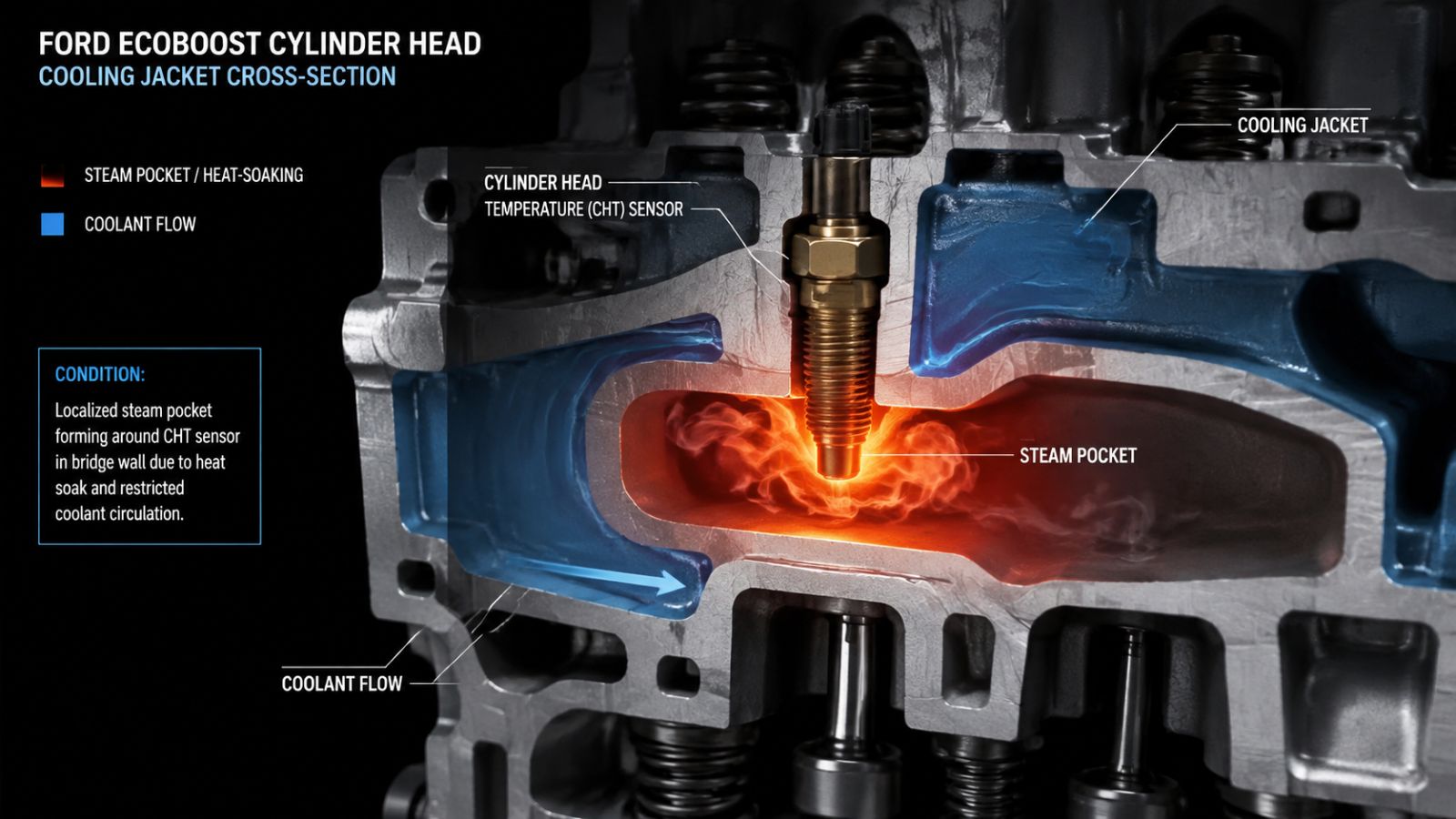
Ford EcoBoost engines frequently suffer severe cylinder head heat-soaking and coolant loss before dashboard temperature gauges register an anomaly. Closed-deck wall erosion and blind Cylinder Head Temperature sensor placement allow localized boiling to occur without triggering immediate fault codes. Belleview drivers navigating extreme summer humidity face undetected thermal degradation and costly repairs.
Ford EcoBoost Silent Overheating on Belleview Roads
Cracked block decks and internal coolant intrusion on Ford 1.5L, 2.0L, and 3.5L EcoBoost engines cause rapid localized cylinder head overheating without triggering a dashboard warning light or fault code. Midday stop-and-go traffic along SE Abshier Blvd combined with high ambient humidity forces the cooling system past its thermal dissipation limit, causing coolant to boil away into steam pockets. Because Ford utilizes a dry-well Cylinder Head Temperature (CHT) sensor rather than a submerged coolant temperature probe, localized air pockets isolate the sensor from liquid heat transfer, sending false normal readings to the Powertrain Control Module (PCM) while the engine warps.
EcoBoost Heat-Soak Technical Breakdown
| Field | Technical Specification |
| Primary Symptom | Intermittent rough idle on cold start, white tailpipe steam, silent coolant consumption without visible external leaks. |
| Target Component | Open-deck cylinder bridge wall, blind-well Cylinder Head Temperature (CHT) sensor, integrated exhaust manifold. |
| Specialized Tooling | FORScan PID logger, motorized video borescope, cooling system vacuum drawdown pressure transducer. |
| Local/Environmental Stressor | Central Florida ambient temperatures exceeding 95°F with 85% relative humidity causing severe condenser heat-soaking. |
| High-Risk Profile | 2014-2019 Ford Escape/Fusion 1.5L/2.0L and 2.0L/3.5L F-150 engines hauling heavy loads or idling in traffic. |
How Open-Deck Erosion Destroys Ford Cylinder Heads
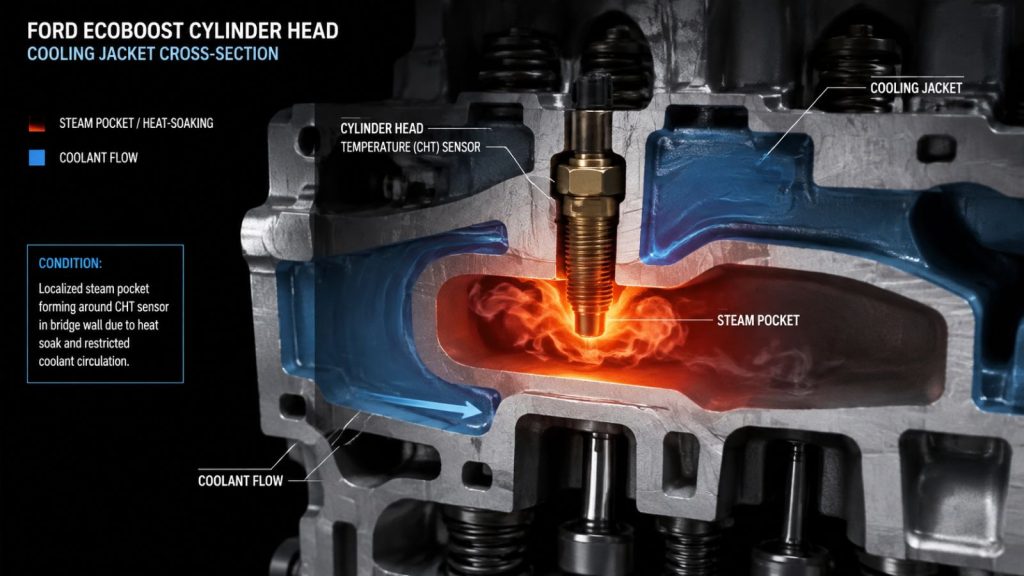
Standard Thermal Circulation Under normal operation, liquid coolant flows through precision-milled jacket channels to absorb combustion heat before dissipating it through the radiator.
- Direct Temperature Tracking: The PCM monitors heat via a dry-well CHT sensor threaded into the aluminum casting between cylinders two and three.
- Conductive Sensing: Heat moves directly through the metal into the sensor tip, driving fuel timing and cooling fan duty cycles.
Environmental Stress and Gas Injection High ambient humidity along SR 44 reduces radiator dissipation, while integrated exhaust manifolds dump extreme heat back into the head jackets.
- Deck Erosion: Microscopic stress fractures between cylinder bores allow high-pressure combustion gases to penetrate the cooling circuit.
- Coolant Displacement: Pressurized gas displaces liquid antifreeze at the top of the head casting, forming a steam pocket around the sensor well.
The Thermal Isolation Trap Air and steam lack the thermal conductivity of liquid coolant, creating a blind spot for the engine management system.
- False Normal Readings: The dry CHT sensor measures steam vapor instead of metal, reporting a safe 210°F to the computer.
- Severe Metal Warping: Surrounding aluminum surfaces exceed 280°F, causing head deck delamination and valve seat distortion without a dashboard warning light.
Master Tech Warning: Never rely solely on the dashboard temperature needle in a Ford EcoBoost. If your coolant expansion tank drops without visible ground drips, steam pockets are actively isolating your temperature sensor right now.
Advanced Diagnostic Protocols for Silent Coolant Loss
Catching silent EcoBoost thermal degradation requires bypass of standard PCM sensor logic through direct physical and pneumatic testing. Standard OBD-II code scanners miss early thermal creep because no diagnostic trouble code (DTC) trips until the sensor registers an out-of-spec voltage drop over a sustained period. Our shop utilizes a multi-stage diagnostic routine to isolate cylinder bridge fatigue before head deck warping occurs.
- Cold System Vacuum Drawdown and Pressure Hold: Connect a pneumatic pressure tester to the coolant degas bottle with the engine completely cold. Pump the system up to exactly 20 PSI and monitor the analog gauge for 45 minutes; any pressure drop exceeding 0.5 PSI indicates an internal leak path.
- Borescope Combustion Chamber Inspection: Remove all spark plugs and thread a motorized 5.5mm video borescope down into each cylinder cavity. Inspect cylinder wall cross-hatching and piston crowns for witness marks, specifically looking for abnormally clean “steam-washed” piston tops caused by burning coolant.
- FORScan Thermal Drift Logging: Connect FORScan software via OBD-II interface and start a live data log comparing raw CHT voltage against simulated Engine Coolant Temperature (ECT). Under load, any sudden divergence exceeding 15°F between physical head temp and calculated coolant temp confirms localized steam pocketing.
Stop Engine Catastrophe at Gregg Smith Automotive
Driving a Ford EcoBoost with undetected coolant loss leads directly to catastrophic block deck cracking and complete engine replacement costs exceeding $8,000. Dealership service centers in Marion County face weeks-long repair backlogs, leaving commuters stuck without reliable transportation. Independent agile shops resolve these cooling system failures rapidly using updated short-block casting designs and precision diagnostic gear. Schedule an accurate thermal isolation inspection today with Gregg Smith Automotive located at 6202 SE Abshier Blvd, Belleview, FL 34420.
Frequently Asked Questions
Why is my Ford EcoBoost losing coolant with no visible external leak?
Coolant is leaking internally through cylinder bridge micro-cracks or head gasket channels. High combustion pressure forces antifreeze directly into the exhaust stream as invisible steam, bypassing external hoses and leaving no ground drips underneath the vehicle.
Can a bad Cylinder Head Temperature sensor prevent the overheat light from coming on?
Yes, a dry-well CHT sensor trapped inside an isolated steam pocket reads ambient air vapor rather than metal temperature. This false low reading deceives the Powertrain Control Module, preventing warning lights from triggering while the cylinder head warps.
Will a blown EcoBoost head gasket always cause white smoke from the exhaust?
No, microscopic deck fractures only weep coolant during specific thermal expansion cycles or overnight cold-soak periods. Small amounts of burned coolant pass through the catalytic converter cleanly, producing zero visible white tailpipe smoke during normal operation.
Does thermal heat-soaking cause permanent cylinder block damage?
Yes, sustained thermal heat-soaking alters the metallurgy of open-deck aluminum cylinder walls. Once deck surfaces warp beyond factory tolerances, the block loses its head gasket clamping force, requiring a complete short-block replacement to restore compression.
Can running the air conditioner in Florida traffic cause silent EcoBoost overheating?
Yes, running the A/C dumps extreme condenser heat onto the radiator core during low-airflow idling. On humid Belleview roads, this added thermal load accelerates localized boiling in the cylinder head if steam pockets or low coolant levels already exist.