

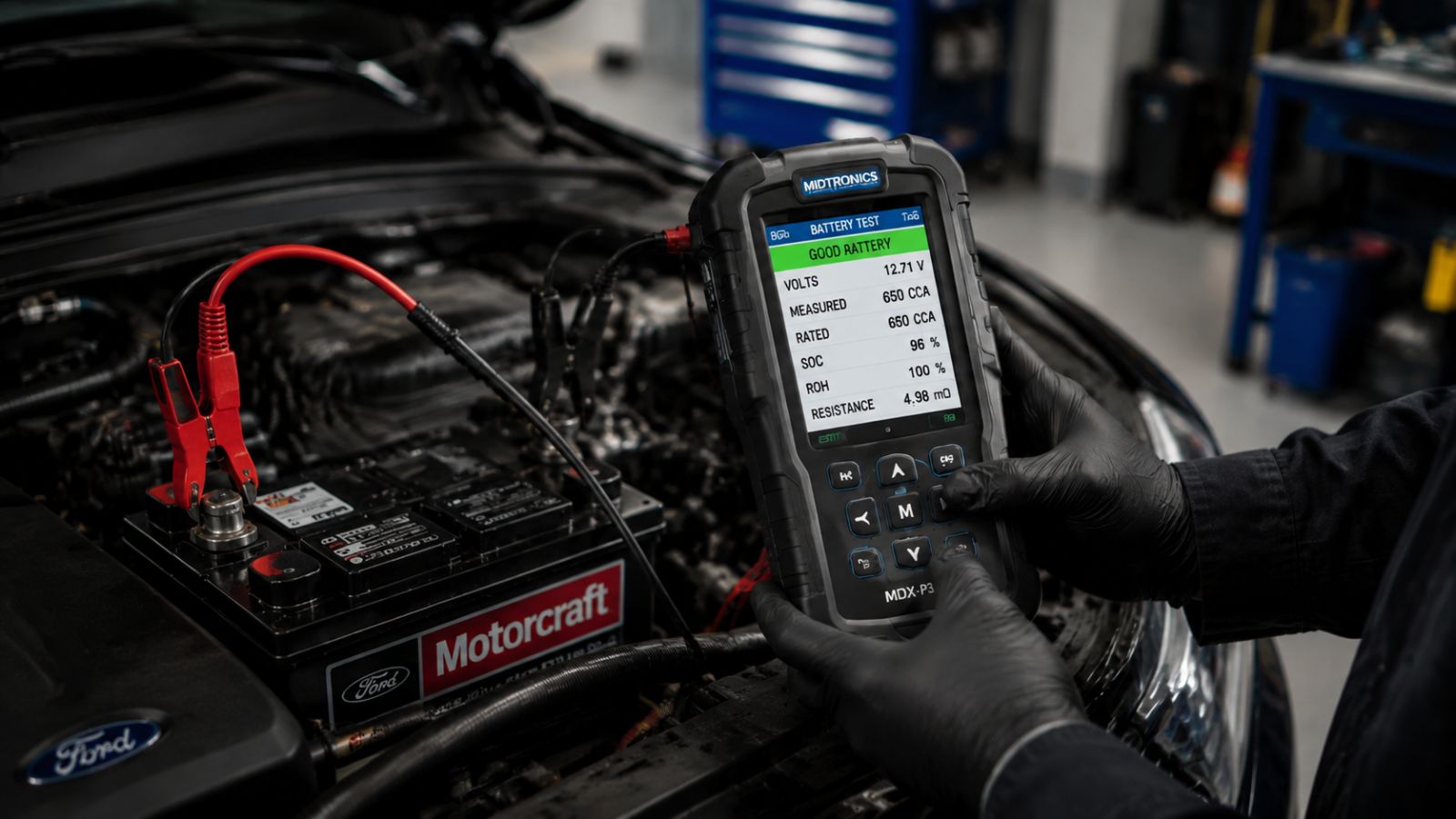
Central Florida summer heat accelerates internal grid corrosion and electrolyte evaporation in Ford batteries, cutting operational lifespan by up to 50 percent. Under-hood heat-soaking damages lead-dioxide plates and glass separators, triggering sudden starting failure. Professional conductance testing and Battery Management System calibration prevent premature battery collapse in Belleview.
Florida Heat Exposure and Accelerated Ford Battery Degradation
When you’re cruising down SE Abshier Blvd on a typical summer day in Central Florida, the air temperature is already pushing past 95°F. But that’s just the start of the problem for your Ford. Once you’re driving, the heat trapped under your hood can easily soar past 160°F. Think of your battery sitting in that intense, trapped heat—it’s essentially being ‘baked’ from the inside out. This kind of extreme environment does way more than just make the engine hot; it wreaks havoc on the sensitive chemistry inside your lead-acid or AGM battery. That excessive heat causes a process called ‘positive grid oxidation,’ which is just a fancy way of saying the internal metal plates are breaking down and rusting prematurely. This extreme stress leads to what we call ‘thermal runaway,’ where the internal chemical reaction spirals out of control. Essentially, your battery’s life is being drained much faster than normal because it’s constantly struggling against that blistering Florida heat, which can turn a reliable battery into a dead one before you even realize there’s a problem.
Ford Electrical System Heat-Soak Technical Matrix
| Diagnostic Metric | Technical Benchmark |
| Primary Symptom | Slow engine crank, momentary dashboard display flickers during start, disabled Auto Start-Stop system, rapid click noise from starter solenoid. |
| Target Component | Positive lead-alloy grid plates, AGM glass mat separators, Battery Junction Box (BJB) main fuses, Battery Monitoring System (BMS) Hall-effect sensor. |
| Specialized Tooling | Midtronics conductance battery analyzer, Midtronics DCA-8000 amp-load tester, Ford IDS / FORScan BMS reset software, digital multimeter for voltage drop testing. |
| Local Stressor | Severe 95°F+ ambient heat combined with high engine bay heat-soaking during extended stop-and-go driving along SE Abshier Blvd. |
| High-Risk Profile | 2015–2024 Ford F-150, Explorer, and Edge models using Group 48/H6 or Group 94R/H7 AGM batteries subjected to short trip driving cycles. |
The Electrochemistry of Thermal Battery Failure in Ford Vehicles
Normal Lead-Acid and AGM Chemical Balance
Under standard operating conditions, lead-dioxide (PbO2) on the positive plate and spongy lead (Pb) on the negative plate react with sulfuric acid electrolyte (H2SO4) to produce electrical current, discharging lead sulfate (PbSO4) and water (H2O).
- Electrolyte Function: Sulfuric acid facilitates ion movement between plates while maintaining stable internal resistance across the cells.
- Controlled BMS Charging: The Ford Powertrain Control Module (PCM) regulates alternator field current to maintain a floating charge state near 13.8 to 14.4 volts.
Thermal Oxidation and Grid Corrosion Mechanics
High heat accelerates chemical reactions inside the battery casing according to the Arrhenius rate law, doubling grid corrosion rates for every 15°F rise in temperature over 77°F.
- Positive Plate Oxidation: Continuous exposure to 140°F+ under-hood heat converts the structural lead-alloy positive grid into brittle lead dioxide, causing physical expansion, warping, and shedding of active paste materials.
- Electrolyte Evaporation: In flooded cells, liquid water electrolyzes into hydrogen and oxygen gas and escapes through pressure vents. In AGM units, high heat opens recombining safety valves, permanently drying out the micro-glass fiber separators.
Internal Shorting and BMS High-Current Thermal Overcharge
As active plate material sheds and settles at the bottom of the casing, internal resistance spikes and cell capacity collapses.
- Cell Shorting: Loose lead sediment bridges the gap between adjacent positive and negative plates, dropping individual cell voltage from 2.1V to 0V instantly.
- Overcharging Thermal Feedback Loop: The BMS Hall-effect sensor detects a low state of charge (SOC) and commands the alternator to output maximum amperage. This constant high-current charging into a thermally degraded battery boils remaining electrolyte, warps internal plates, and triggers sudden total battery collapse without warning.
Master Tech Warning: Installing a new battery in a modern Ford without resetting the Battery Management System (BMS) with diagnostic software will destroy the new battery in less than 12 months. The PCM will continue applying high-amperage charging profiles calibrated for the old, degraded battery, overcharging and cooking the fresh cell structure.
Advanced Diagnostic Protocols for Ford Battery and Charging Systems
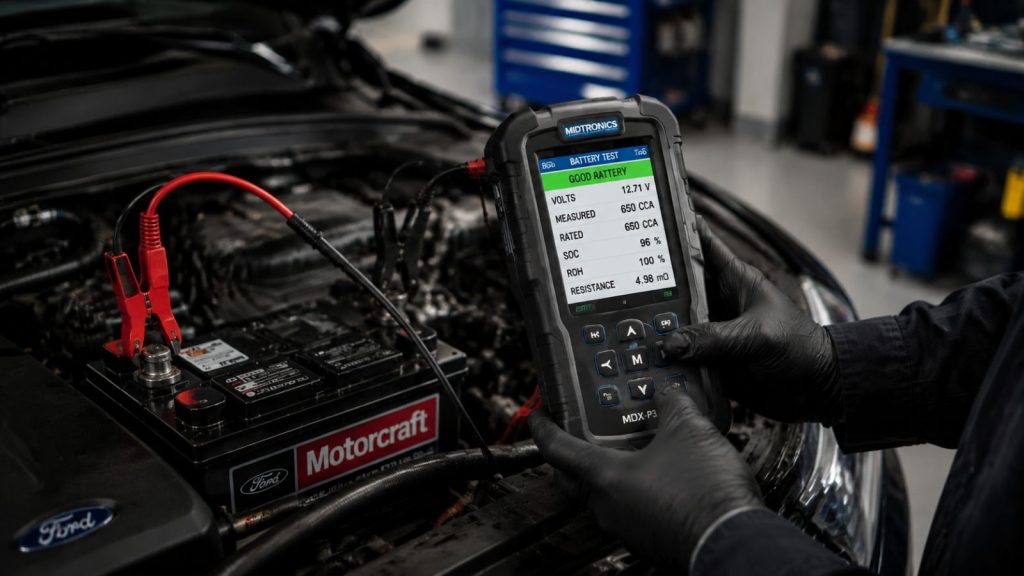
Accurately evaluating Ford battery health requires bypassing simple static surface voltage checks. A resting battery can read 12.6 volts while possessing zero cranking amp capacity due to grid sulfation and plate shedding. Our technicians execute a comprehensive conductance, load, and voltage drop diagnostic procedure to verify starting system health before advising replacement.
- Digital Conductance and Internal Resistance Analysis: Connect a Midtronics digital conductance analyzer directly to the raw battery posts, bypassing dirty terminal clamps. Measure internal resistance in milliohms and compare calculated Cold Cranking Amps against the battery’s factory rating; internal resistance exceeding 12 milliohms indicates severe grid oxidation or plate sulfation.
- Automated Carbon Pile Amperage Load Testing: Apply a physical electrical load equal to 50 percent of the battery’s rated CCA for 15 seconds using a heavy-duty carbon pile load tester. Monitor voltage drop throughout the load cycle; if terminal voltage falls below 9.6 volts at 70°F (or 9.3 volts at 90°F ambient), internal cell structure has failed.
- Starter Current Draw and Ground Circuit Voltage Drop Testing: Attach a high-amperage clamp meter around the main starter cable while measuring voltage drop across the positive cable and engine ground connections during engine cranking. A voltage drop exceeding 0.2 volts on the positive side or 0.1 volts on the ground side pinpoints corroded terminal leads, loose engine block grounds, or a dragging starter motor rather than a failed battery.
Stop Engine Catastrophe at Gregg Smith Automotive
Ignoring early signs of thermal battery degradation leads directly to stranded vehicles, burned-out starter motors, and damaged alternator diodes caused by continuous high-current demand. A dead battery can leave you stranded in dangerous summer heat along busy Marion County corridors. Protect your vehicle’s complex electronics and ensure reliable starting by scheduling a professional battery and charging system evaluation with Gregg Smith Automotive located at 6202 SE Abshier Blvd, Belleview, FL 34420.
Frequently Asked Questions
Can Florida summer heat shorten my Ford battery life?
Yes, high ambient heat combined with under-hood temperatures exceeding 160°F accelerates internal grid plate corrosion and electrolyte evaporation. This thermal degradation reduces battery life in Central Florida to 2–3 years compared to 5 years in cooler climates.
Why did my Ford battery die without any warning lights?
Ford vehicles use a smart-charging system that compensates for battery degradation by increasing alternator output. The vehicle continues starting normally until internal plate corrosion or cell shorting causes a sudden structural drop in cranking capacity, bypassing dashboard warnings.
Do I need to reset the Ford BMS after installing a new battery?
Yes, replacing a Ford battery requires resetting the Battery Management System using diagnostic software. Without a BMS reset, the computer continues overcharging the new battery using the aging profile calculated for the old unit, drastically shortening its life.
What causes a Ford Auto Start-Stop system to stop working?
The Ford PCM automatically disables Auto Start-Stop when battery state of charge drops below approximately 70 percent or when internal resistance rises. High summer temperatures degrade cell chemistry, causing the computer to turn off start-stop to preserve starting power.
How do I know if my Ford needs a battery or an alternator?
A failed battery causes slow cranking, rapid clicking, or low-voltage module codes, while terminal voltage drops rapidly under load. A failing alternator allows system voltage to fall below 13.5 volts while the engine runs, illuminating the battery dashboard icon.