

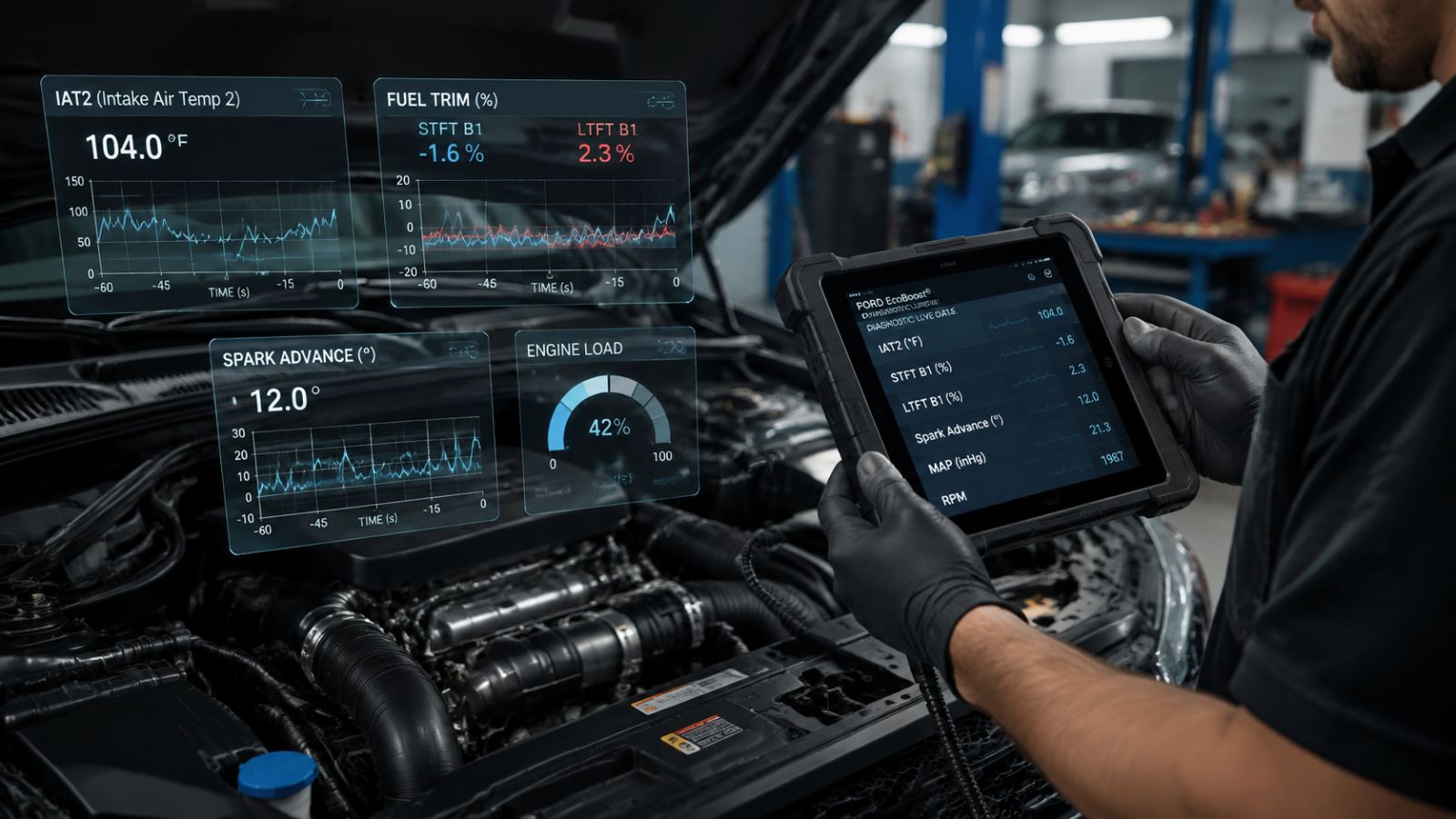
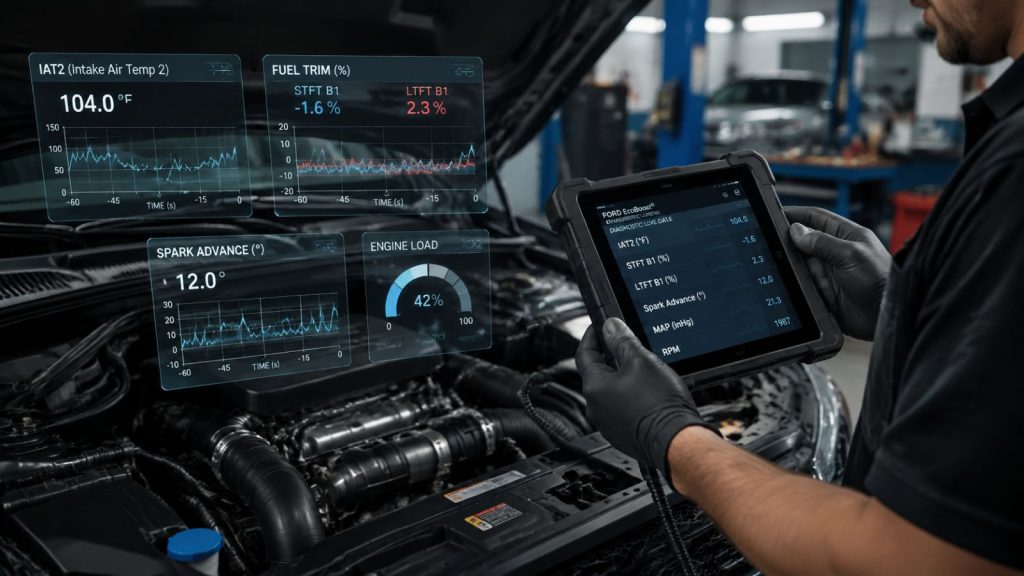
Don’t let Florida’s brutal heat destroy your Ford’s engine. Dashboard gauges often mask serious thermal stress until it’s too late. At Gregg Smith Automotive, we monitor real-time engine data to catch hidden issues like heat-soak and sensor drift, protecting your vehicle from costly damage before mechanical failure strikes.
Ford engines operating under intense Belleview summer heat frequently suffer silent thermal stress long before dashboard warning lights illuminate. When ambient temperatures surge past 95°F, PCM telemetry data streams expose rapid spark timing retard, elevated charge air temperatures, and severe fuel trim adjustments across EcoBoost and Coyote platforms. Our master technicians monitor these live parameter IDs along SE Abshier Blvd to catch heat-soak anomalies, unmetered air leaks, and sensor drifts before permanent mechanical component destruction occurs.
Thermal Data Metrics & Diagnostic Parameters
| Diagnostic Metric | Baseline Operational Threshold | Heat-Wave Stress Value | Failure Mode Identified |
| Intake Air Temp 2 (IAT2) | 10°F–20°F above ambient air | 150°F–180°F+ downstream | Intercooler heat-soak / Boost timing retard |
| Long-Term Fuel Trim (LTFT) | ±5% stoichiometric balance | Exceeding +15% to +25% | Heat-expanded vacuum leaks / Fuel vapor lock |
| Knock Sensor Retard | 0° to -2° advance correction | -6° to -10° continuous pull | Detonation danger / Low-octane thermal ignition |
| Coolant vs CHT Delta | Less than 10°F variation | Exceeding 25°F split | Air pocket isolation / Water pump cavitation |
| Target Engine Platforms | Standard 87-octane daily profiles | Extended idling along US-441 | Ford F-150, Explorer, Expedition (2015–2024) |
PCM Sensor Behavior Under Extreme Thermal Loads
Modern Ford EcoBoost and Coyote engines utilize advanced feedback loops where the PCM continuously recalculates ignition timing, direct-injection pulse widths, and electronic wastegate duty cycles based on manifold air density. During extended idling in traffic around Belleview, ambient air inside the engine bay rapidly heat-soaks the aluminum intake manifold and charge air cooler (CAC). When IAT2 readings cross 140°F, the PCM enters a thermal protection strategy, aggressively pulling spark timing to prevent pre-ignition.
Excessive heat causes plastic intake manifold seals and rubber vacuum lines to expand, creating transient air leaks that inflate Long-Term Fuel Trims. As the PCM adds unmetered fuel to correct a perceived lean condition, combustion temperatures rise further.
Shop Warning: Relying on the dashboard temperature needle is dangerous; Ford programs the cluster gauge with software dampening to stay dead-center across a wide range of 180°F to 230°F, masking severe engine heat until cylinder head temperatures exceed 245°F.
This feedback loop causes severe knock sensor activity as the computer detects micro-detonation events inside the combustion chambers. The physical reaction includes scorched spark plug ceramic insulators, pitted piston crowns, and accelerated breakdown of engine oil viscosity. Without active cooling intervention, high cylinder pressures under thermal stress shear oil films, leading to rod bearing scoring and turbocharger shaft failure.
Telemetry-Driven Troubleshooting Protocol
We decode live engine telemetry through a structured four-stage evaluation path to isolate thermal vulnerabilities before physical components degrade.
Shop Floor Verdict: A 2018 F-150 3.5L EcoBoost arrived at our shop misfiring only when towing along US-441 while the dash gauge read normal. Live PID logging showed IAT2 spiking to 168°F and LTFT hitting +22%; a 5 PSI induction smoke test revealed a heat-warped lower intake manifold gasket letting unmetered air in once engine bay temps hit 190°F.
- Baseline PID Logging: We connect high-speed diagnostic software to record Parameter IDs (PIDs) for CHT, ECT, IAT2, and Knock Retard while the engine is cold, establishing a clean reference voltage baseline.
- Live Thermal Load Testing: We drive the vehicle under real-world load conditions along US-441, monitoring sensor response curves as operating temperatures reach thermal equilibrium.
- Evaporative & Induction Smoke Testing: If LTFT readings exceed +10%, we introduce high-density smoke into the intake tract at 5 PSI to highlight heat-expanded vacuum leaks around intake runners and boost pipes.
- Bidirectional Actuator Testing: We command the PCM to cycle the variable-speed electric cooling fans from 10% to 100% duty cycle, verifying real-time fan speed RPM against voltage draws to detect failing fan modules.
Our shop relies on exact telemetry data rather than trial-and-error parts replacement. Isolating out-of-spec sensor signals early prevents premature structural engine degradation.
Prevent Severe Thermal Damage to Your Ford
Ignoring sluggish acceleration, subtle engine pinging, or dropping fuel economy during Florida summer months invites severe internal engine damage. Operating a heat-soaked Ford with elevated fuel trims accelerates catalytic converter failure and warps critical cylinder head mating surfaces.
Dealership service bays across Marion County often remain backed up for weeks during peak summer heat waves. Our independent facility provides rapid, precise live data diagnostics using advanced PCM scanning tools to resolve complex thermal concerns without delay.
Visit Gregg Smith Automotive at 6202 SE Abshier Blvd, Belleview, FL 34420 or call our shop directly to reserve your comprehensive live engine data diagnostic check.
Frequently Asked Questions
Do Ford EcoBoost engines pull timing automatically during Florida heat waves?
Yes, Ford EcoBoost engines automatically pull ignition timing up to 10 degrees when Intake Air Temperature 2 (IAT2) readings exceed 140°F. This PCM thermal management strategy prevents destructive engine knock but causes noticeable power loss during summer acceleration.
Can live engine data detect a failing water pump before it leaks?
Yes, monitoring the precise temperature delta between the Cylinder Head Temperature (CHT) sensor and Engine Coolant Temperature (ECT) sensor reveals reduced coolant circulation. A widening gap indicates impeller cavitation or slipping internal pump drives before external fluid leaks appear.
Does high long-term fuel trim indicate an engine heat issue?
Yes, high long-term fuel trim (LTFT) readings above +12% during summer heat often point to heat-expanded intake manifold gaskets or vacuum lines. Extreme engine bay heat allows unmetered air to enter the intake, forcing the PCM to inject extra fuel.
Will low-octane fuel increase engine knock sensor activity in hot weather?
Yes, using 87-octane fuel during 95°F+ heat causes higher combustion stability risks in turbocharged Ford engines. The PCM detects pre-ignition through the knock sensors and retards timing continuously, reducing fuel efficiency and throttle response.
Is the dashboard temperature gauge accurate on modern Ford trucks?
No, the dashboard temperature gauge on modern Ford vehicles uses normalized software dampening that keeps the needle stationary at center from 180°F to 230°F. Drivers must view live CHT PID data through a diagnostic scanner to see real-time temperature spikes.