

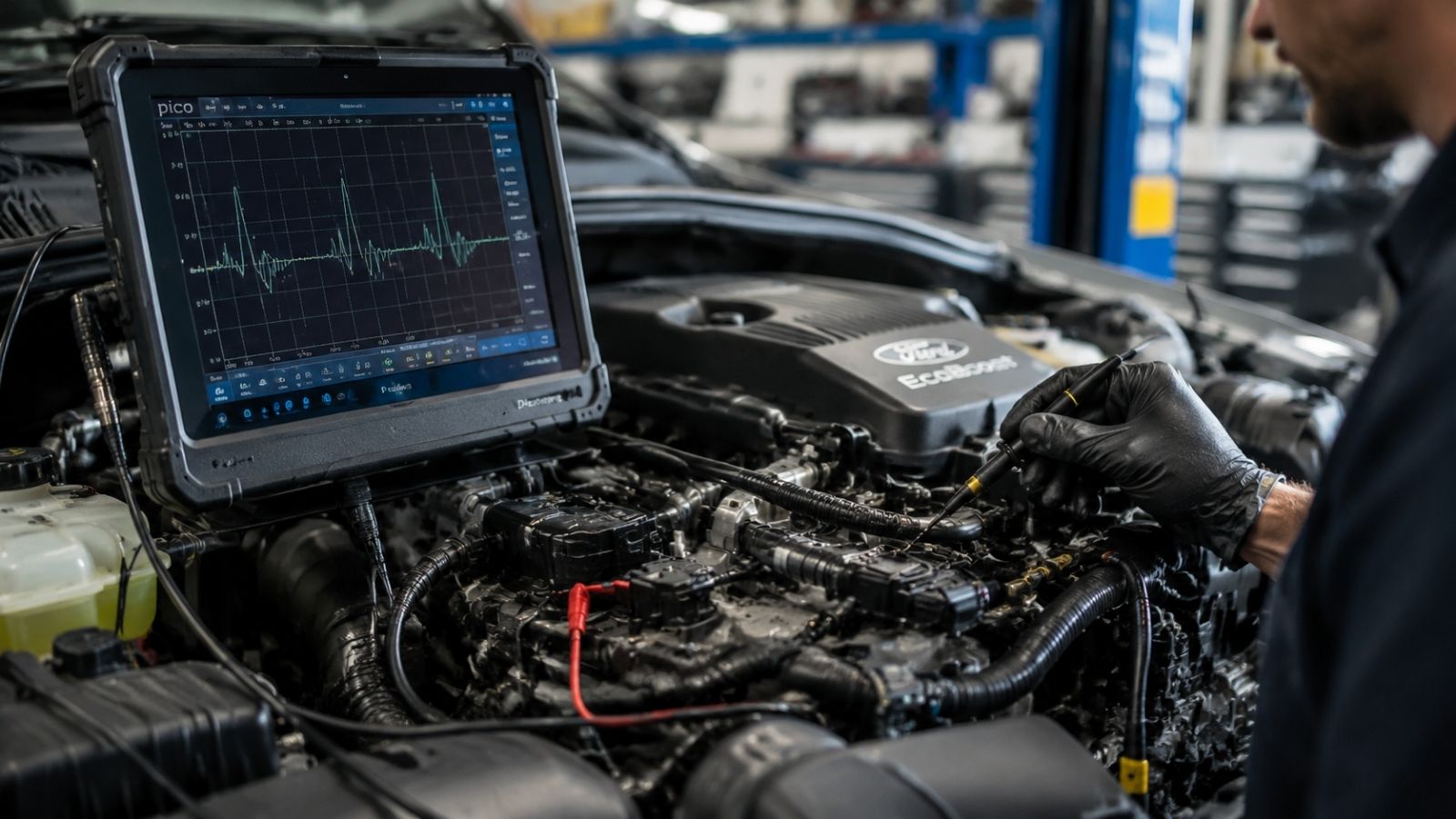
Ford misfire diagnostics confirms the cause of engine misfires by testing ignition output, fuel delivery, air balance, and cylinder compression before replacing components. Gregg Smith Automotive in Belleview uses scan data, electrical testing, and mechanical verification to identify failed systems accurately and prevent unnecessary repairs on Ford vehicles.
At Gregg Smith Automotive in Belleview, we systematically evaluate ignition, fuel delivery, and mechanical compression to identify the exact cause of a Ford misfire prior to installing replacement parts. Florida heat and constant driving often wear down parts that look fine to the naked eye. Even so, a blinking check engine light might point to something other than a broken ignition coil. Because trouble codes merely indicate which cylinder experienced incomplete combustion rather than what caused it, we perform comprehensive diagnostics across the entire combustion process.
Diagnostic Overview & Key Technical Parameters
Accurately diagnosing a Ford engine misfire requires analyzing specific symptoms, identifying vulnerable components, and applying specialized diagnostic tools to handle common local environmental stresses. The technical overview below outlines the core diagnostic parameters used to isolate the root cause before replacing any parts.
| Diagnostic Category | Technical Details |
| Primary Symptom | Rough idle, shaking under acceleration, flashing check engine light, hesitation, reduced engine power |
| Target Component | Ignition coil, spark plug, fuel injector, wiring circuit, intake system, cylinder sealing |
| Specialized Tooling | OEM-level scan equipment, ignition waveform testing, fuel pressure testing, compression and leak-down equipment |
| Local/Environmental Stressor | Florida heat soak, humidity, repeated short trips, extended idling around Belleview and Marion County roads |
| High-Risk Run / High-Risk Profile | Ford EcoBoost engines, high-mileage F-150 trucks, SUVs, towing vehicles, vehicles exposed to repeated heat cycles |
The Misfire Problem Starts Inside The Combustion Chamber
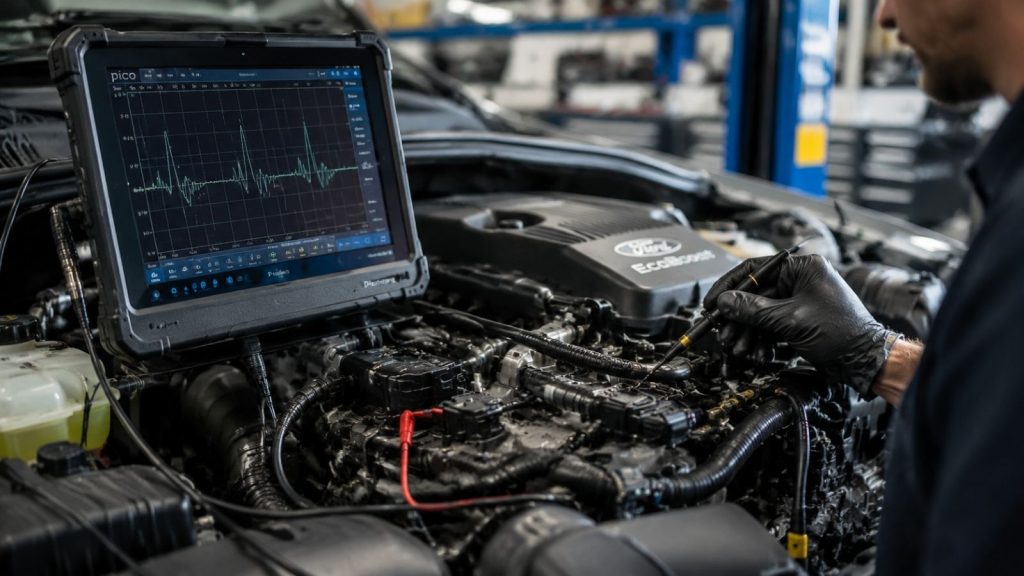
A Ford engine generates power when air, fuel, and ignition energy ignite inside the combustion chamber at the exact correct crankshaft position. The ignition coil transforms low battery voltage into the thousands of volts needed to jump the spark plug gap under pressure. When any variable in this tri-fold combustion equation fails, the engine control module registers a misfire event.
1. Ignition Voltage Demands & Load Stress
- Voltage spikes under load: A degraded ignition coil may deliver sufficient spark during light cruising, but fail as cylinder pressure surges during acceleration. Higher chamber pressure raises electrical resistance across the plug gap, requiring maximum output from the coil.
- Thermal breakdown in Belleview: Extreme Florida heat and constant stop-and-go driving along SE Abshier Blvd accelerate dielectric failure. Continuous heat cycles expand and contract plastic housings, internal windings, and electrical connections—altering resistance or allowing high-voltage output to arc to ground before reaching the plug.
2. Fuel Delivery & Mixture Dynamics
A misfire trouble code pinpoints combustion loss in a specific cylinder, but it cannot identify the root failure point. Fuel-side faults follow distinct operational patterns:
- Injector & pressure faults: A clogged injector, weak PCM driver signal, or inadequate rail pressure alters fuel volume entering the chamber.
- Fuel trim compensation: The powertrain control module attempts to balance the air-fuel ratio by stretching injector pulse width, temporarily hiding the failure.
- Lean-condition damage: Operating with insufficient fuel elevates combustion temperatures, which can warp valves, score piston crowns, or ruin downstream oxygen sensors over time.
3. Mechanical Compression Loss
Even with precise fuel delivery and strong spark output, a cylinder cannot produce power without physical pressure containment:
- Sealing failures: Worn piston rings, leaking valves, or head gasket breaches prevent the air-fuel charge from reaching target compression.
- Timing misalignments: Jumped timing chains or worn phasers disrupt valve overlap, dropping dynamic chamber pressure.
- Hidden mechanical faults: In these scenarios, ignition waveforms and fuel trims may appear completely healthy despite the cylinder failing to contribute power.
How We Separate A Real Ignition Failure From A Misfire Code
Our Ford misfire diagnostics process begins with evidence collection. We do not replace coils because a scan tool displays a cylinder number.
Electronic Data Review
We connect professional scan equipment and examine live engine information:
- Misfire counters by cylinder
- Short-term and long-term fuel trim
- Oxygen sensor response
- Engine load percentage
- RPM changes during cylinder contribution testing
- Ignition timing corrections
Fuel trim numbers outside normal ranges point toward mixture problems rather than ignition failures. A vacuum leak creates a lean condition affecting multiple cylinders, while a weak coil usually creates a cylinder-specific event.
Ignition Waveform Testing
When ignition operation remains uncertain, we use an oscilloscope to examine coil performance. An ignition waveform reveals:
- Abnormal firing voltage
- Weak spark duration
- Coil saturation problems
- Intermittent electrical breakdown under load
The waveform shows what happens electrically in real time, not just what the computer recorded afterward.
Fuel System Verification
We confirm that the fuel injector receives the correct electrical command from the engine computer before condemning the component. Testing includes injector balance evaluation, electrical resistance checks, and fuel pressure measurements compared against Ford factory specifications.
Mechanical Confirmation
If ignition and fuel systems test correctly, we move to mechanical evaluation. Compression testing and cylinder leak testing reveal whether the cylinder can physically maintain combustion pressure. A significant pressure difference between cylinders changes the direction of the repair entirely.
Diagnostic Process Overview
1.Scan Codes & Review Freeze-Frame Data:Verify environmental conditions during failure.
Retrieve stored DTCs, engine load percentage, coolant temperature, and misfire counters by cylinder.
2.Ignition Waveform & Stress Testing:Evaluate primary and secondary voltage.
Measure spark duration, peak firing voltage, and dielectric breakdown under simulated load.
3.Fuel Delivery & Injection Signal Verification:Check mixture dynamics.
Evaluate short-term/long-term fuel trims, pulse width modulation, and perform an injector balance test.
4.Mechanical Compression & Cylinder Leak-Down:Confirm combustion chamber integrity.
Measure dynamic cylinder sealing pressure to rule out worn rings, head gasket failure, or burnt valves.
Why Guessing At Ignition Parts Creates Bigger Problems
Replacing ignition components without testing creates unnecessary costs and delays the actual repair. A new coil cannot correct a restricted fuel injector or a cylinder that has lost compression.
The larger concern is secondary catalytic converter damage. A continuous misfire sends unburned fuel into the exhaust system. Excess fuel ignites inside the catalytic converter, causing internal catalyst melting and leading to thousands of dollars in secondary repairs.
The fastest repair is not the first part installed—it is the first part proven to have failed.
Schedule Ford Misfire Testing In Belleview
Visit Gregg Smith Automotive at 6202 SE Abshier Blvd, Belleview, FL 34420 for professional Ford misfire diagnostics in Belleview based on measured results, not assumptions. We inspect the complete system and recommend repairs only when physical evidence supports them.
Frequently Asked Questions
Can a Ford misfire code mean the ignition coil is not the problem?
Yes. A Ford misfire code only identifies a cylinder experiencing incomplete combustion. The actual cause may involve ignition coils, spark plugs, fuel injectors, air leaks, wiring faults, or mechanical compression issues requiring additional testing.
Does replacing spark plugs fix every Ford misfire?
No. Spark plugs can cause ignition problems, but many Ford misfires involve other systems. Proper testing checks ignition strength, fuel delivery, cylinder sealing, and engine data before recommending spark plug replacement.
Can Florida heat contribute to Ford ignition failures?
Yes. Florida heat increases thermal stress on ignition components, wiring, and electrical connections. Repeated heat cycles accelerate insulation breakdown and create intermittent faults that appear during higher engine loads.
How do technicians confirm a Ford misfire before replacing parts?
Technicians confirm Ford misfires by comparing scan data, ignition testing, fuel system measurements, and mechanical results. The goal is identifying the failed system instead of replacing parts based only on trouble codes.
Is driving with a Ford misfire dangerous?
Yes. A continuing misfire reduces engine efficiency and increases exhaust temperatures. Unburned fuel entering the exhaust system can rapidly destroy the catalytic converter, especially when the vehicle continues operating under heavy load.