

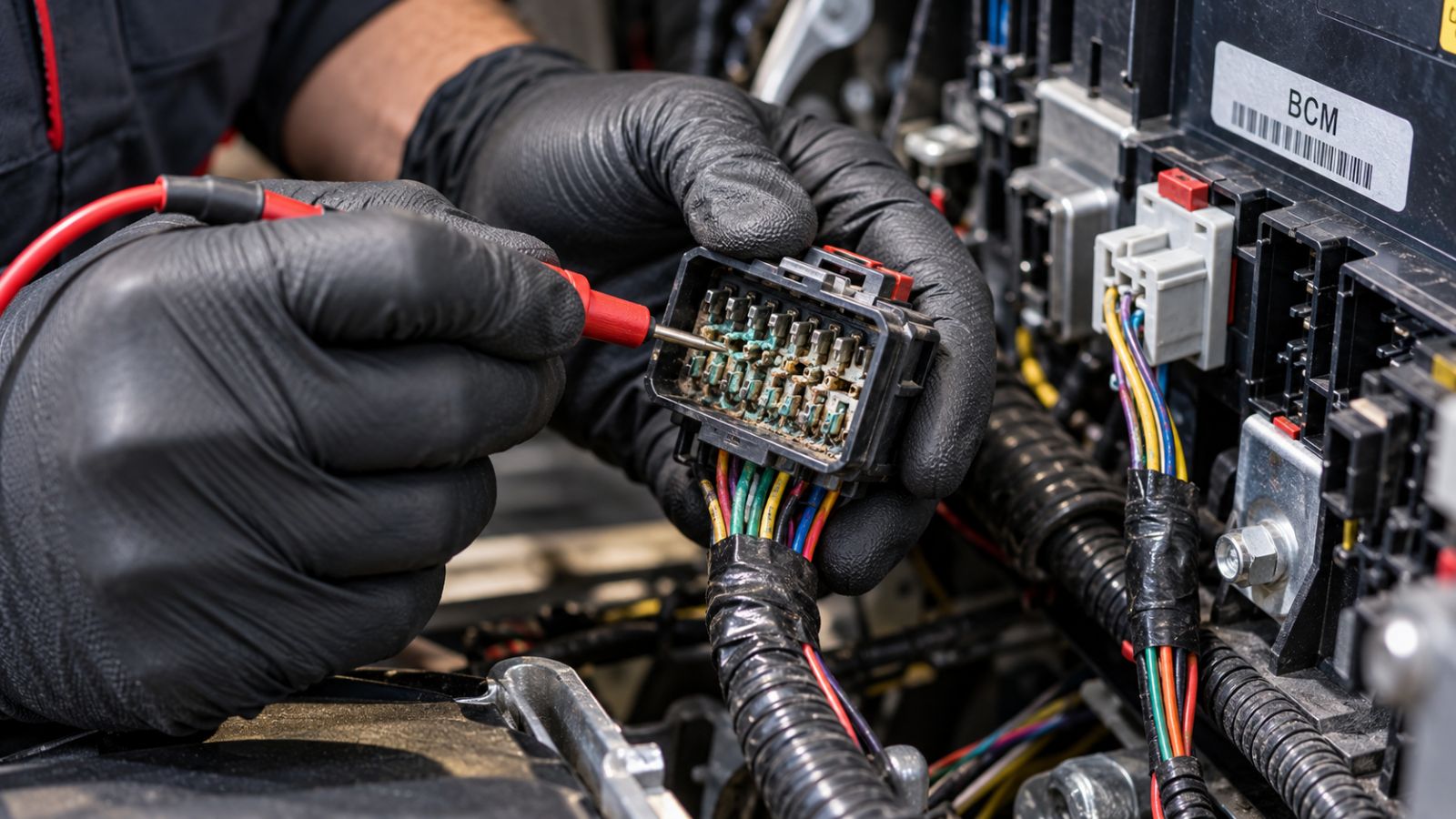
Ford trucks struggle with Belleview humidity. Water seeps into connector blocks and triggers short circuits that shut down electrical systems. Moisture accelerates galvanic corrosion, creating voltage drops and stray resistance across CAN-bus communication lines. Proper Ford electrical diagnostics require pin-out voltage drop testing and scope tracing to isolate affected circuits.
Microscopic moisture ingress in Ford Smart Junction Boxes (SJB) and Body Control Modules (BCM) triggers widespread CAN-bus communication drops across Marion County during sub-tropical rain events. On Ford F-150s and Explorers navigating humid afternoon downpours along US-301 in Belleview, ambient moisture creates high-resistance bridges between pin connections, corrupting low-voltage reference signals.
| Diagnostic Metric | Technical Specification / Field Data |
| Primary Symptom | Intermittent dash instrument flickering, phantom door-ajar warnings, engine no-crank |
| Target Component | Body Control Module (BCM) / Smart Junction Block (SJB) C2280A connector pins |
| Specialized Tooling | Oscilloscope, breakout box, high-impedance digital multimeter (10MΩ+) |
| Local Stressor | Central Florida 90%+ ambient humidity and standing water along SE Abshier Blvd |
| High-Risk Profile | 2011–2020 Ford F-150, Explorer, and Edge driven daily in high-humidity zones |
The Physical Chemistry of Harness Degradation
Under normal operating conditions, Ford’s CAN-bus network operates on low-voltage differential signaling, where CAN-High sits at 2.5V to 3.5V and CAN-Low sits between 1.5V to 2.5V. Terminal pins housed inside the BCM connector rely on a tight mechanical interference fit, sealed by silicone perimeter gaskets to maintain isolated resistance values.
Continuous heat-soaking in Central Florida expands atmospheric air inside unsealed connector housings. As temperatures cool during sudden downpours, a vacuum effect draws moist, humid air directly into the pin cavity, creating similar issues to failing air conditioning units under severe heat.
Shop Warning: A microscopic drop of trapped condensation initiates galvanic corrosion across dissimilar metals (copper pins and tin-plated terminals), forming green copper carbonate deposits.
This corrosion introduces stray resistance into the circuit. The added resistance skews reference voltages, corrupting signal waves and dropping entire control modules offline.
How We Trace Phantom Resistance Drops
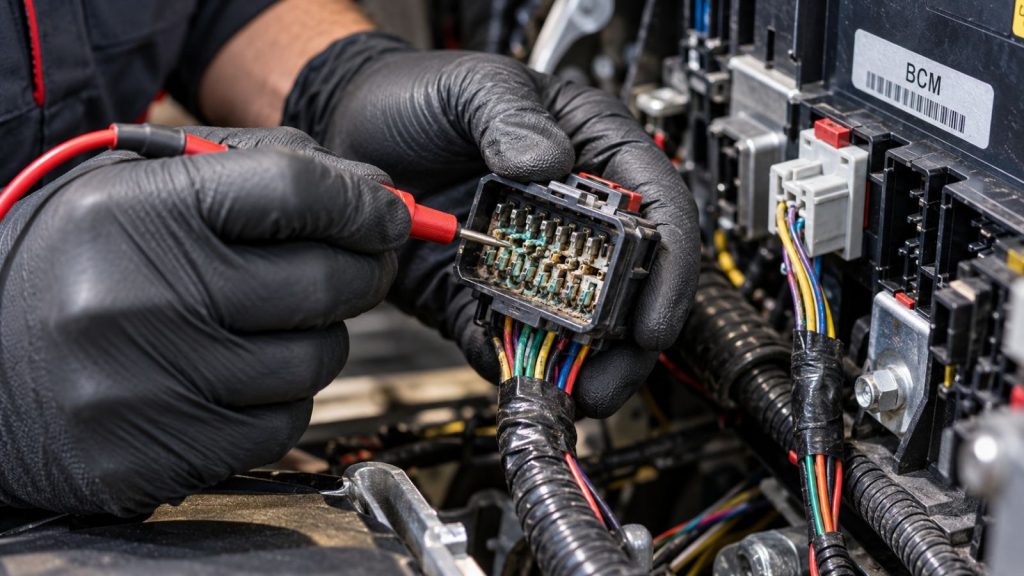
Generic OBD-II code readers only display top-level communication faults like U0140 (Lost Communication with Body Control Module). Tracking the root cause requires methodical signal tracing and comprehensive auto repair protocols.
1.Visual Pin Inspection & Resistance Check:Isolate physical corrosion before applying battery power.
Disconnect battery power and unseat connector C2280A at the BCM. Inspect terminal pins under high magnification for green copper carbonate witness marks or pitted contact points. Measure pin-to-pin resistance using a digital multimeter set to megohms to detect internal cross-bridging caused by moisture tracks.
2.Dynamic Voltage Drop Testing:Perform under load with circuit fully energized.
Reconnect the harness and back-probe the signal wire under active load. A reading exceeding 0.10V across any terminal pin indicates excessive inline resistance caused by oxidation.
3.Oscilloscope Waveform Analysis:Capture transient signal spikes and digital noise.
Hook oscilloscope channels to CAN-High and CAN-Low lines. Observe the square wave pattern while spraying a fine water mist along the firewall harness channel to trigger active moisture bridging. Flattened peak-to-peak voltages or square-wave ringing confirms dielectric failure within the wire shielding or connector housing.
Stop Guessing Parts and Fix the Root Cause
Ignoring early electrical gremlins risks permanently frying expensive BCM logic boards or leaving you stranded when a low-voltage fault prevents the starter relay from energizing. Dealership backlogs often drag on for weeks while technicians replace parts by process of elimination instead of offering targeted special deals or flexible financing options.
Instead, leverage true diagnostic precision at Gregg Smith Automotive. We isolate harness failures at the pin level, saving you time and money. Visit our shop at 6202 SE Abshier Blvd, Belleview, FL 34420
Frequently Asked Questions
Can humidity alone cause Ford electrical glitches without direct water leaks?
Yes. Ambient humidity regularly penetrates unsealed connector housings, creating microscopic moisture paths that bridge adjacent low-voltage reference pins. This stray resistance skews signal voltages, corrupting CAN-bus network communications and triggering random dash errors without standing liquid present.
Will an OBD-II scanner tell me which wire is shorted by moisture?
No. Standard OBD-II code readers only display top-level communication faults showing module offline status. Finding the exact corroded wire pin or moisture path requires back-probe voltage drop testing with a high-impedance digital multimeter and an oscilloscope to trace corrupted signal waves.
Is it safe to clear electrical codes and keep driving if the fault disappears?
No. Intermittent moisture faults always return because atmospheric humidity continuously accelerates galvanic corrosion across copper terminal pins. Ignoring early warning signs leads to severe voltage drops that can permanently damage module logic boards or leave you stranded with a no-start condition.
Does dielectric grease protect Ford wire connections from humidity damage?
Yes. Dielectric grease creates a hydrophobic barrier that seals clean terminal pins against ambient moisture and prevents future galvanic oxidation. However, existing corrosion must be completely removed mechanically or chemically before applying grease, as sealant cannot restore already degraded metal connections.
Can a weak Ford battery simulate moisture-induced electrical problems?
Yes. Low battery voltage forces control modules to run at minimum operating thresholds, amplifying minor resistance shifts caused by pin oxidation. When voltage drops below 9.6 volts during cranking, sensitive network nodes drop offline, mimicking the exact symptoms of a shorted harness channel.