

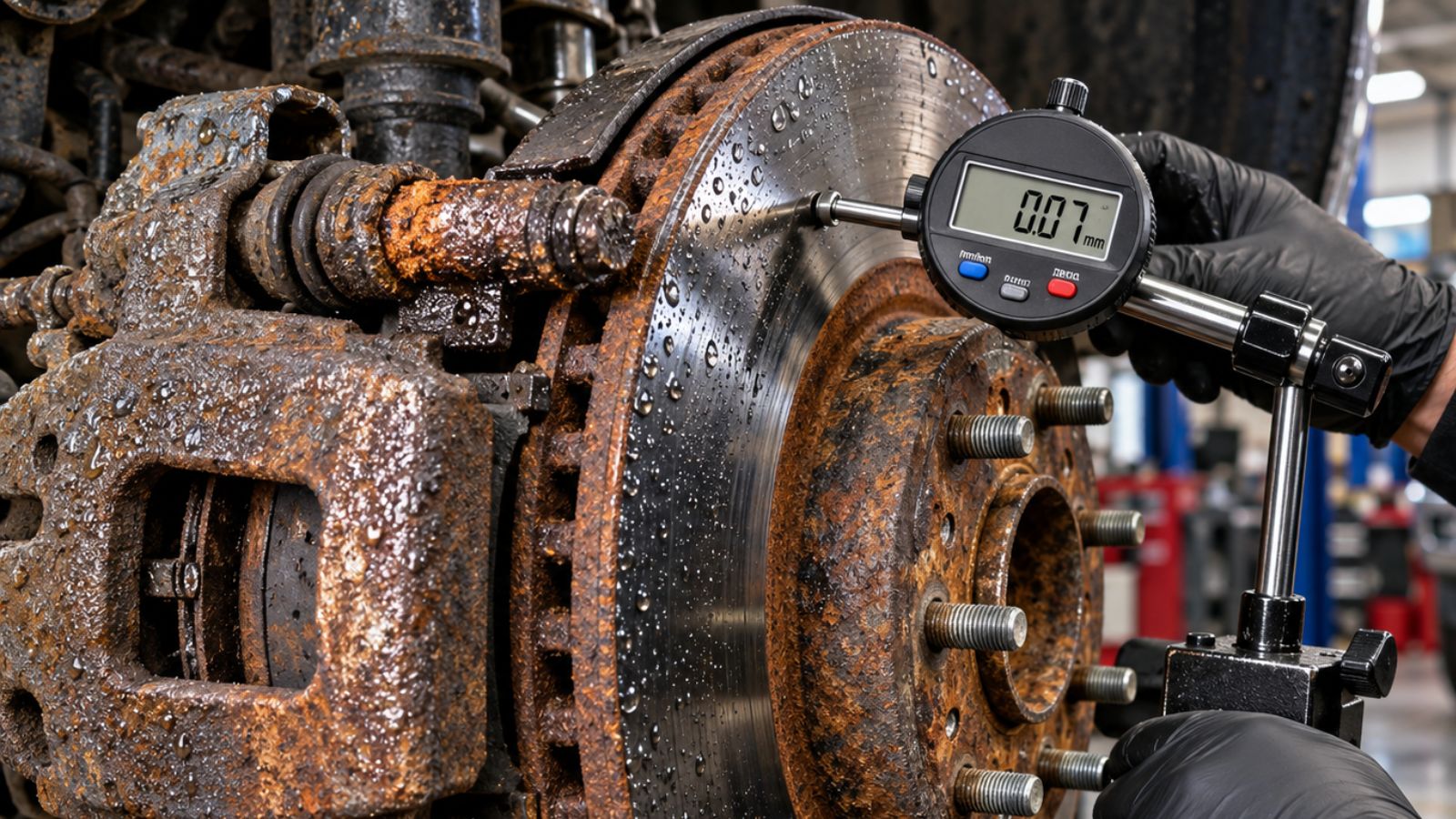
Florida downpours submerge hot Ford brake calipers along SE Abshier Blvd, drawing standing water past degraded piston seals. Cold rainwater shock causes caliper slide pin corrosion, pad glazing, and severe rotor warpage. Gregg Smith Automotive utilizes digital micrometer runout mapping and brake fluid copper testing to prevent total braking failure.
Brake caliper slide pins on Ford F-150s and Transits seize solid following repeated water exposure along flooded stretches of SE Abshier Blvd and SE 110th Street. Thermal shock during sudden summer downpours pulls standing road water past hardening rubber dust boots, washing synthetic silicone grease from the guide channels and initiating rapid iron oxide buildup in Belleview.
Key Technical Specs & Diagnostic Benchmarks
| Failure Indicator | Inspection Standard |
| Primary Symptom | Steering wheel shudder during pedal apply, severe vehicle pull toward shoulder |
| Target Component | Dual-Piston Front Caliper Guide Pins & Phenolic Pistons |
| Specialized Tooling | Mitutoyo Digital Rotor Micrometer, Brake Fluid Copper Testing Strips |
| Local Stressor | Standing rainwater runoff and humidity corrosion along Belleview thoroughfares |
| High-Risk Profile | Ford trucks routinely towing heavy utility trailers through standing rainwater pools |
Mechanical Forces Driving Component Breakdown
Brake systems convert kinetic vehicle energy directly into thermal energy, subjecting caliper assemblies to extreme temperature swings during daily operation. When hot cast iron components encounter standing Florida floodwaters, rapid cooling disrupts the physical and chemical tolerances required for normal brake release, setting off a cascade of mechanical degradation.
Thermal Shock and Vacuum Fluid Contamination
Cast iron brake calipers operate at internal temperatures exceeding 400°F during repeated city stops. Submerging these scorching friction assemblies in cool standing road water creates an immediate thermal vacuum within the slide pin bore. This sudden pressure drop degrades the assembly through three distinct phases:
- Silt Ingestion: Vacuum pressure draws standing water past degraded rubber dust boots, washing away critical silicone lubricant and depositing dissolved road minerals onto machined steel pins.
- Corrosive Seizure: Oxidation forms abrasive rust scale inside guide channels, locking floating caliper brackets and preventing even pad release.
- Hydraulic Overheating: Trapped inner pads remain pinned against the spinning rotor, generating localized friction heat that boils moisture within hydraulic lines.
Contaminated hydraulic fluid undergoes rapid thermal expansion under heavy loads, forcing pistons outward and galling rotor friction surfaces until metallurgical heat checks fracture the disc.
Mechanical & Metallurgical Degradation Modes
Extended exposure to standing rainwater and thermal stress introduces three advanced failure mechanisms across the braking assembly:
- Galvanic Binding: Dissimilar metals—the cast iron caliper housing and steel slide pins—form a galvanic cell when bridged by conductive, mineral-heavy floodwater. This triggers rapid localized oxidation that expands within the guide bore, physically crushing rubber seals and locking the assembly solid.
- Phenolic Piston Swell & Delamination: OEM Ford calipers utilize composite phenolic pistons. Exposure to extreme localized fluid heat combined with absorbed moisture causes the composite material to absorb fluid, swell beyond bore tolerance, and score the cylinder wall, preventing full retraction.
- Rotor Cementite Formation: When locked pads trap extreme friction heat (>1,200°F) against a stopped rotor, localized cast iron absorbs carbon from the friction pad binder, converting grey iron into ultra-hard, brittle cementite. These high spots generate permanent pedal pulsation that cannot be turned out on a brake lathe.
Shop Warning: Driving with a seized slide pin causes uneven pad wear that turns a routine pad replacement into a complete hub, rotor, and hydraulic line overhaul.
Comprehensive Diagnostic Procedure
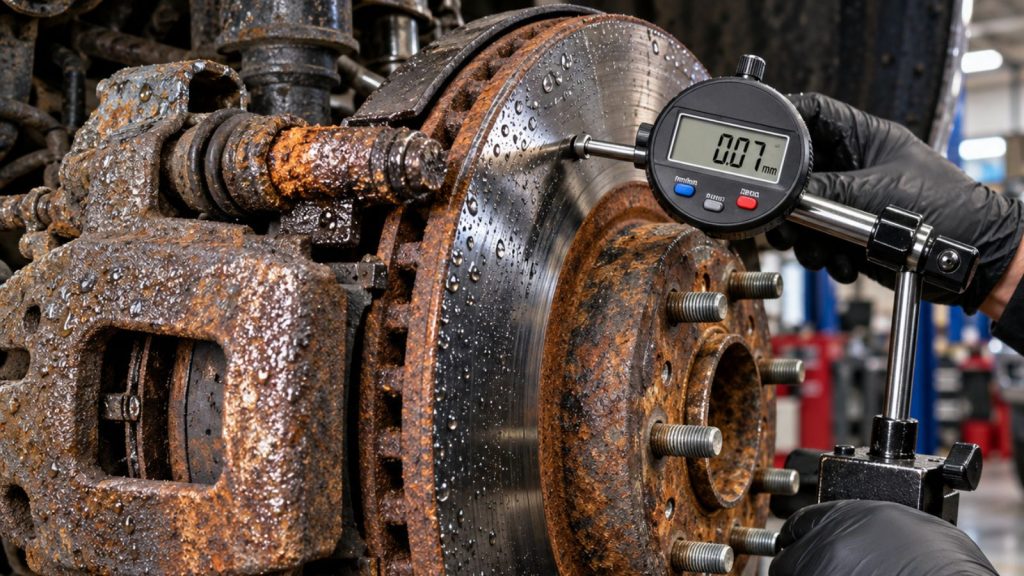
- Hydraulic & Mechanical Inspection:
Position vehicle on a two-post lift and remove wheels to inspect caliper slide pin rubber boots for tears. Verify guide pin freedom of movement by hand; any binding indicates internal galling, requiring torque verification during reassembly for slide pin bolts. - Rotor Parallelism & Runout Measurement:
Mount a digital dial indicator to the steering knuckle with a magnetic base to measure lateral runout across eight distinct rotor points. Lateral variance exceeding 0.0015 inches or thickness variation beyond 0.0005 inches requires immediate rotor replacement. - Hydraulic Moisture & Copper Testing:
Dip a chemical test strip into the master cylinder reservoir to measure dissolved copper content from corroded internal steel lines. Copper levels exceeding 200 ppm indicate depleted corrosion inhibitors and contaminated fluid that will vaporize under emergency braking loads.
Diagnostic Verdict (Shop Bay 1): A 2021 Ford F-150 pulled hard to the right after navigating standing water on SE 110th Street during a storm. Inspection revealed the outer pad had 8mm of friction material while the inner pad was worn to raw steel. Micrometer testing showed 0.004 inches of rotor runout, and the lower slide pin was completely seized with red iron rust scale.
Schedule Your Professional Service Evaluation
Ignoring caliper binding allows drag to generate excessive hydraulic heat, destroying expensive radial tires and warping rotors far beyond allowable machining tolerances. Delaying necessary repairs exposes your truck’s hydraulic lines to internal fluid contamination that risks total braking system failure on high-speed thoroughfares.
Avoid corporate main-dealer service delays and backlog queues by bringing your vehicle directly to local independent specialists who prioritize neighbor safety and precision engineering over shop volume. Our master technicians utilize digital micrometers, PicoScope NVH frequency analyzers, and chemistry-based copper testing to restore factory stopping distance and pedal feel.
Contact Gregg Smith Automotive today for comprehensive Ford brake inspection, precision rotor machining, and hydraulic fluid flush brake services. Visit our local facility located at 6202 SE Abshier Blvd, Belleview, FL 34420
Frequently Asked Questions
Can driving through deep rain puddles warp my Ford brake rotors?
Yes. Submerging scorching cast iron brake rotors in cool standing rainwater creates immediate thermal shock. This rapid, uneven surface cooling induces localized molecular stress and permanent metallurgical warping across the disc face, causing severe steering wheel shudder during high-speed pedal application.
Will high humidity cause my Ford brake pedal to feel soft or spongy?
Yes. Standard glycol brake fluid is highly hygroscopic and actively pulls moisture through rubber flex lines and reservoir seals in humid climates. Absorbed water drastically lowers the fluid’s boiling point, producing compressible steam pockets during heavy braking that cause a soft, spongy pedal feel.
Can a seized caliper pin cause my truck to pull to one side?
Yes. A frozen caliper slide pin locks the floating bracket in place, preventing the outer brake pad from retracting away from the rotor. The resulting continuous pad drag creates uneven braking force across the front axle, causing the truck to pull hard toward the seized side while driving.
Is it necessary to replace brake fluid after driving through flooded roads?
Yes. Submerging hot brake calipers creates an immediate internal cooling vacuum that sucks standing water past degraded piston seals and reservoir vents. This moisture contaminates the hydraulic fluid, accelerating internal steel line corrosion, destroying caliper seals, and compromising emergency stopping distance under heavy loads.
How does silt inside a brake assembly accelerate friction pad wear?
Silica sand suspended in floodwater enters through torn slide pin boots and embeds directly into soft brake pad friction material. This trapped grit acts as an intense abrasive compound, rapidly cutting deep circumferential grooves into the spinning rotor and destroying the pad face within a few hundred miles.
Do independent repair shops inspect Ford brakes faster than dealerships?
Yes. Local independent specialty repair shops maintain immediate access to OEM specification components and specialized diagnostic tooling without forcing retail or fleet truck owners into multi-week corporate dealership service queue backlogs, providing same-day diagnostic turnarounds and precision repairs to keep your vehicle safely on the road.