

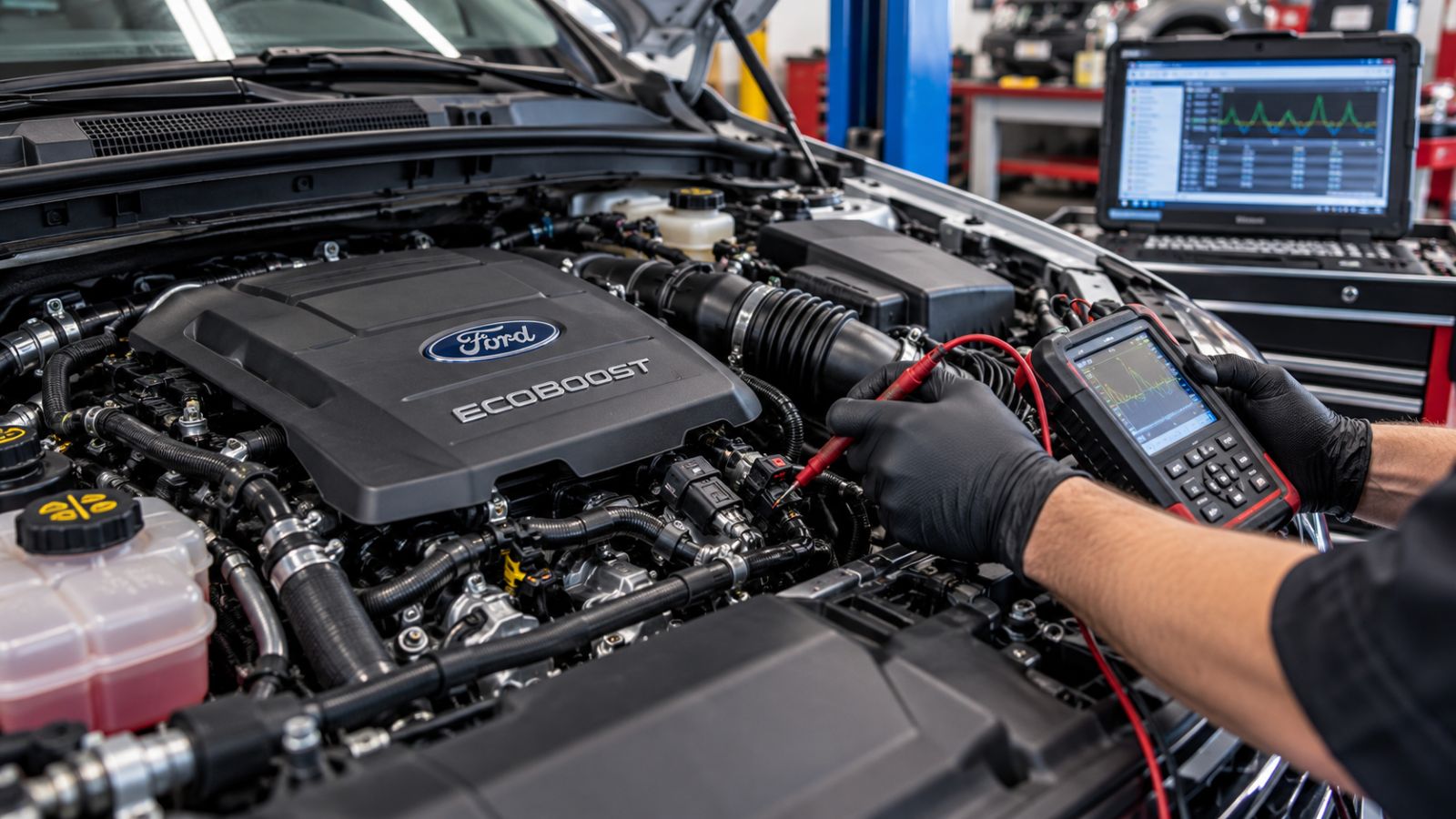
Keeping your Ford service records helps you get top dollar later. It shows buyers that your car survived the brutal Florida heat and humidity without any hidden damage. If you want top dollar near US-441, keep your maintenance logs handy. Records for fluid health and timing chain wear remove the fear of the unknown for a buyer. A documented history turns a risky used car into a premium asset that sells fast.
Direct Ground Truth on Belleview Ford Resale Security
Ford 3.5L EcoBoost cam phaser rattles and stretched timing chains instantly tank your trade-in value on local US-441 car lots. Heavy stop-and-go idling along SE Abshier Blvd overheats engine oil and creates sticky varnish that starves your camshaft actuators. Our shop generates sensor-backed maintenance logs proving exact internal tolerances to protect your truck’s cash value.
Technical Maintenance Verification Profile
| Inspection Field | Field Measurement Spec |
| Primary Symptom | Buyer price discounting due to suspected cam phaser rattle, dark fluid condition, or unknown service history |
| Target Component | VCT solenoids, timing chain tensioner pin extension, transmission fluid viscosity, and brake friction material |
| Specialized Tooling | Ford IDS/FDRS diagnostic software, optical refractometer, fluid spectrographic lab sampling |
| Local/Environmental Stressor | Severe thermal oxidation from Central Florida summer heat and high idle hours on SE Abshier Blvd |
| High-Risk Profile | High-mileage Ford F-150s, Transits, and Expedition fleets lacking physical oil analysis records |
The Mechanical Physics of Unverified Component Degradation
Standard Engine Lubrication Dynamics
Engine oil inside modern Ford EcoBoost and Ti-VCT engines acts as a hydraulic fluid and heat sink alongside its primary lubricating role. Under normal operating conditions, clean synthetic oil maintains precise kinematic viscosity (9.3to12.5cSt at 100°C), feeding pressure to hydraulic chain tensioners and variable valve timing phasers.
Thermal Breakdown & Varnish Shear
Extreme ambient humidity and stop-and-go idling near county road intersections force engine crankcases to run at elevated oil temperatures for extended durations. High heat shears down viscosity modifiers, causing fuel dilution and soot accumulation:
- Hydraulic Pressure Loss: Viscosity shear drops oil gallery pressure below nominal operating specs, delaying tensioner engagement.
- Component Abrasion: Soot particulates act as an abrasive paste, wearing down timing chain pin joints and lengthening overall chain pitch.
- Actuator Sludge: Oxidized oil deposits bake onto VCT solenoid screens, causing phaser park-pin failure and cold-start rattle.
Buyer Risk Metrics & Valuation Physics
When private buyers or used car appraisers evaluate an unmaintained engine, they calculate potential catastrophic failure probability. A timing chain showing 5 of camshaft angular displacement relative to the crankshaft indicates imminent chain jumping, forcing appraisers to subtract the full cost of a 3,500 timing system overhaul from their opening purchase offer.
Shop Warning: Undocumented oil changes void manufacturer powertrain warranties prematurely and allow invisible varnish buildup to gall hydraulic lifter bores, turning a minor maintenance gap into a major valuation loss.
The Master Verification Diagnostic Protocol
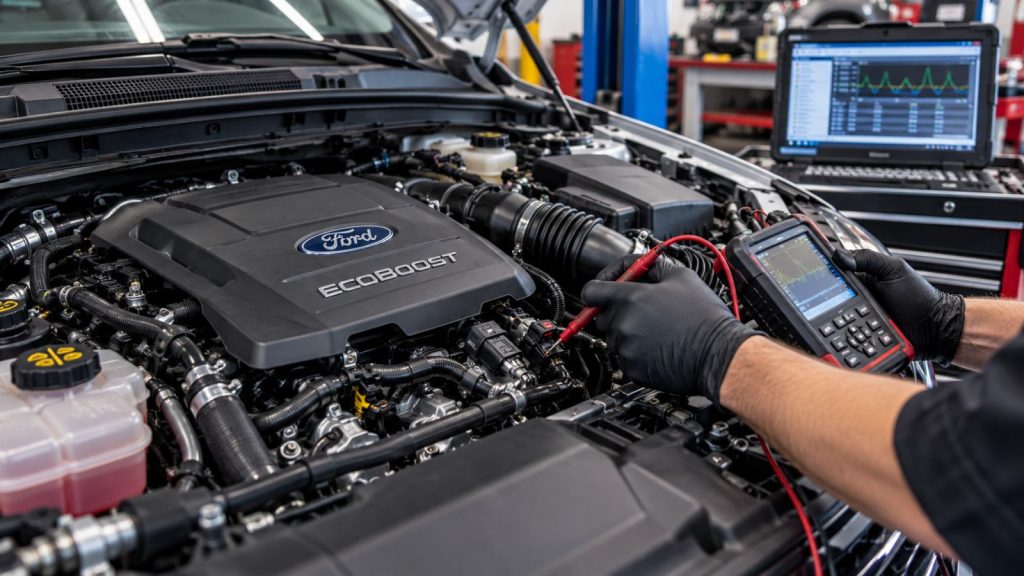
Proving vehicle health to prospective buyers requires physical and digital evidence rather than self-reported receipts. We generate a comprehensive health audit sequence that transforms maintenance logs into indisputable proof of mechanical integrity.
Step-by-Step Technical Verification Sequence
- Digital Module Health & Mode $06 Sweep: Connect Ford FDRS diagnostic software to read PCM memory banks. Extract knock sensor counts, misfire history per cylinder, and long-term fuel trim values (±5% baseline tolerance).
- Timing Chain Wear Angle Extraction: Interrogate live VCT PID data streams during a hot idle sequence. Compare actual camshaft position against target position; angular variance exceeding 3 indicates physical chain elongation.
- Spectrographic Fluid Analysis: Draw a 4-ounce oil sample from the sump. Test for fuel dilution percentage, water content, and wear metals including iron (<25ppm limit) and copper (<10ppm limit) using spectrographic testing.
- Brake & Suspension Tolerances: Measure brake rotor thickness with a micrometer and verify lower control arm bushing deflection using hydraulic pry levers. Document exact remaining lining percentages.
- Printable Audit Dossier Generation: Compile computer logs, fluid lab reports, and stamped shop inspection sheets into a digital, VIN-matched vehicle history portfolio.
Shop Case Note: Last month, a Belleview seller brought in a 2019 F-150 with 112,000 miles that buyers rejected due to feared engine wear. Our FDRS sweep showed 0.8 timing variance, and oil analysis confirmed zero iron wear particles. Armed with our stamped verification dossier, the owner sold the truck on US-441 for 2,800 above the regional KBB private party average.
Lock In Your Ford Resale Valuation
Gaps in maintenance records hand buyers total leverage to discount your vehicle price by thousands of dollars. We provide stamped, laboratory-backed maintenance logs and digital diagnostic health audits that prove exact engine and chassis integrity. Protect your vehicle investment and secure peak trade-in dollars along the local auto corridor.
Schedule a vehicle health audit at Gregg Smith Automotive today. Visit us in person at 6202 SE Abshier Blvd, Belleview, FL 34420 or call (352) 347-2222.
Frequently Asked Questions
Do maintenance records increase the resale value of a Ford truck?
Yes. Verified maintenance records prove proper lubrication history and component care, eliminating buyer uncertainty over hidden mechanical defects. Documented service logs allow sellers to command premium market prices and prevent aggressive trade-in price discounting during sales negotiations.
Can physical service logs prevent buyers from discounting for timing chain issues?
Yes. Stamped service logs accompanied by digital VCT timing variance readouts prove the timing chain has not stretched past factory limits. Showing documented oil changes every 5,000 miles reassures buyers that cam phasers and tensioners remain fully operational.
Does a clean diagnostic scan log help during a private vehicle sale?
Yes. A printed Mode $06 diagnostic sweep showing zero pending codes and balanced fuel trim values proves PCM system health. Presenting real-time sensor verification eliminates buyer fear of cleared fault codes or impending check engine lights post-purchase.
Will fluid analysis reports help prove high-mileage Ford engine health?
Yes. Spectrographic fluid lab reports confirm wear metal concentrations remain well below critical limits, proving internal bearing and piston ring integrity. Providing oil sample data gives buyers concrete proof that an engine with over 100,000 miles operates without hidden internal damage.
Does completing scheduled maintenance prevent dealership trade-in lowball offers?
Yes. Presenting a complete, VIN-matched service binder forces dealership used car managers to evaluate the vehicle at top-tier condition grades. Eliminating reconditioning risk prevents appraisers from subtracting thousands of dollars for speculative fluid flushes or suspension repairs.