

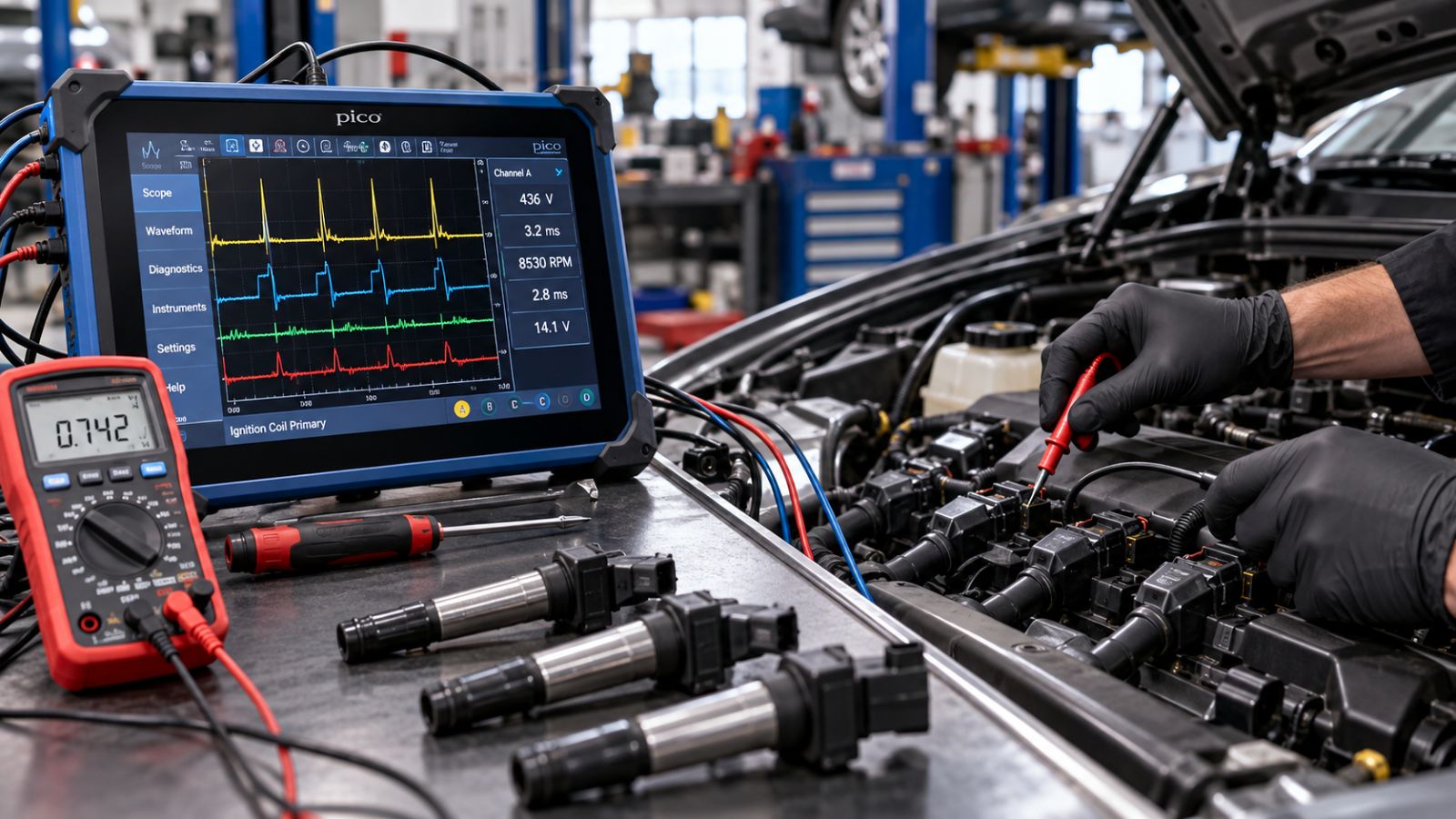
Ford diagnostic testing relies on live PID telemetry, waveform capture, and historic freeze-frame records rather than speculative code clears. Isolating transient voltage drops, pressure decay, and sensor drift under Central Florida heat prevents unneeded part replacements. True bench validation ensures Ford repairs hold permanently across Marion County haul corridors.
The Frontline Breakdown
Secondary ignition coil breakdown and high-pressure fuel pump cavitation constantly plague Ford 3.5L EcoBoost engines hauling heavy horse trailers along US-441 in Belleview. Sustained 95-degree ambient heat and stop-and-go idling at the Baseline Road intersection force heat-soaking through the coil boots, inducing sudden misfires under load. Swapping spark plugs without testing primary-to-secondary ignition ramp rates causes these trucks to return to the bay within forty-eight hours.
Bench Diagnostics at a Glance
| Field Data Profile | Real-World Benchmark |
| Driver Complaint | Severe shudder under tip-in acceleration between 45 and 60 mph on grade |
| Component in the Crosshairs | Direct-injection coil-on-plug (COP) boots and HPFP spill-valve solenoid |
| Lab-Grade Gear Deployed | Ford FDRS diagnostic suite with PicoScope 4425A 4-channel lab scope |
| Marion County Stress Factor | Extreme humidity cycles and sandy clay dust buildup off Marion County caliche paths |
| Worst-Hit Fleets and Rigs | 2017 to 2023 F-150 3.5L EcoBoost setups pulling livestock trailers down SE Abshier Blvd |
Anatomy of Component Destruction
Ford EcoBoost direct-injection setups run high cylinder pressures requiring up to 35,000 volts across the spark plug gap during peak boost. Under normal combustion conditions, the dielectric strength of the silicone boot contains this secondary voltage completely, routing current directly through the iridium core. The powertrain control module (PCM) simultaneously commands the cam-driven high-pressure fuel pump (HPFP) spill control valve, maintaining 2,150 PSI inside the common rail.
Belleview summers introduce a brutal thermal load during low-speed hauling.
Radiator airflow drops across local rural corridors, trapping radiant engine bay heat above 230 degrees Fahrenheit. The silicone boots experience thermal degradation, losing dielectric isolation while microscopic silica sand embeds into the plug well.
Secondary ignition voltage takes the path of least resistance through microscopic fissures in the degraded boot, arcing directly to the aluminum cylinder head. This electrical short creates carbon tracking down the ceramic insulator, starving the combustion chamber of ignition energy. Concurrently, boiling fuel inside the rail creates micro-cavitation pockets, eroding the mechanical check-valve face until fuel volume drops severely out of spec.
Carbon tracking leaves indelible witness marks on plug ceramic. Replacing a cracked coil pack without changing the tracking plug guarantees instant destruction of the new coil.
The Master Tech Isolation Protocol
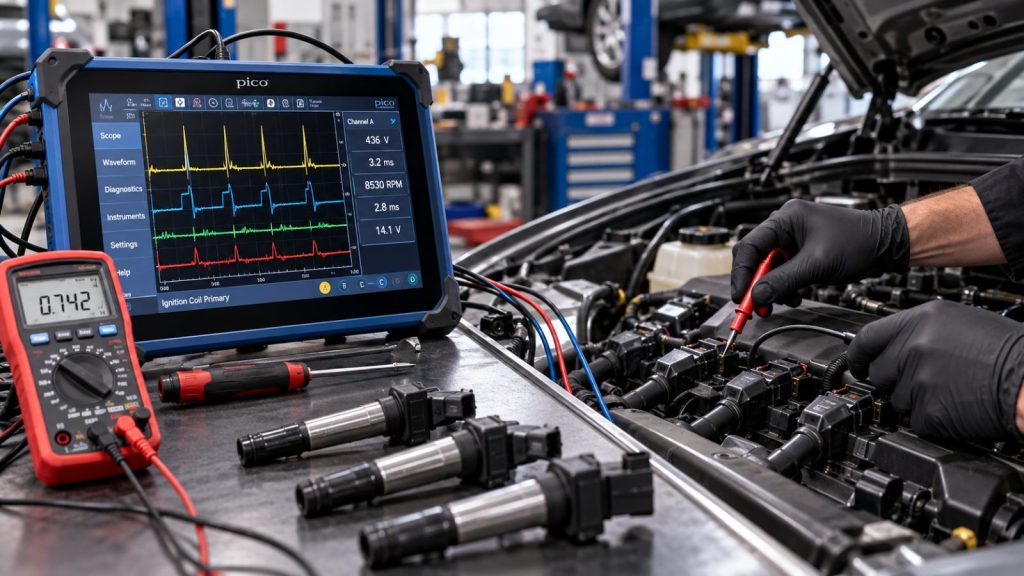
Our shop executes a strict five-step diagnostic capture before any wrench touches a bolt:
- Session Initialization and Mode $06 Interrogation. Connect the Ford Diagnostic & Repair System (FDRS) through an approved VCM 3 interface. We pull non-continuous diagnostic monitor results (Mode $06) to identify cylinders accumulating misfire events below the DTC threshold.
- Fuel Rail Pressure Drift Verification. Run dynamic data logging during a loaded test run on US-441. Commanded fuel rail pressure must track actual pressure within a 35 PSI tolerance window at 4,000 RPM wide-open throttle.
- Secondary Ignition Waveform Capture. Hook a PicoScope 4425A with a TA388 current clamp onto the coil pack primary circuit. We measure spark burn time, rejecting any cylinder exhibiting less than 1.2 milliseconds of clean combustion arc.
- In-Cylinder Pressure Transducer Analysis. Thread a WPS500X transducer into the offending spark plug port. We graph dynamic compression, valve timing symmetry, and exhaust backpressure to rule out jumped timing chains or carbon-loaded intake valves.
- Ground and Voltage Drop Verification. Measure voltage drop across the PCM engine ground strap under a 15-amp simulated draw. Resistance must remain below 0.08 volts to prevent sensor reference signal distortion.
Lock Down Root Cause Precision
Driving on intermittent ignition faults sends raw fuel down the exhaust stream, incinerating the substrate inside your catalytic converters within 500 miles. A $120 coil issue turns into a $3,400 dual-converter replacement when misdiagnosed by shops that merely clear fault codes.
Avoid three-week dealership backlogs and generic part-swapping guesses.
Visit Gregg Smith Automotive at 6202 SE Abshier Blvd, Belleview, FL 34420 for targeted Ford diagnostic testing.
Frequently Asked Questions
Can clearing Ford diagnostic trouble codes fix intermittent running issues?
No. Diagnostic trouble codes are informational records stored by the powertrain control module, not the underlying mechanical or electrical fault. Clearing codes resets learned fuel trim maps and freezes readiness monitors, masking active misfires and accelerating expensive catalytic converter failure.
Does extreme Florida heat directly cause Ford EcoBoost misfires?
Yes. Ambient temperatures exceeding 90 degrees Fahrenheit accelerate silicone boot dielectric failure and induce vapor pockets inside high-pressure direct-injection fuel rails. This causes severe secondary voltage leaks to the cylinder head and lean air-fuel mixtures under towing conditions.
Can an automotive lab scope spot a problem that Ford OBD-II scanners miss?
Yes. Handheld OBD-II scan tools only refresh serial data packet rates a few times per second, missing millisecond dropouts. An oscilloscope measures raw electrical signals up to 400 million samples per second, capturing microscopic voltage spikes and ground integrity faults instantly.
Are repeat Ford repairs usually caused by defective replacement auto parts?
No. Repeat automotive repairs almost always stem from inadequate root-cause diagnostic testing rather than failed replacement components. Replacing a failed ignition coil without resolving the underlying plug gap wear, oil intrusion, or ground circuit resistance ruins the new component within weeks.
Is dynamic fuel rail pressure testing necessary on Ford EcoBoost engines?
Yes. Static fuel pressure checks fail to expose volume delivery restrictions inside the mechanical high-pressure fuel pump. Testing fuel rail pressure under active trailer towing loads verifies whether the system maintains 2,150 PSI without pressure dropouts or internal cavitation.