

April’s fuel price surge makes AC efficiency a financial necessity for US-441 commuters. An undercharged AC system creates parasitic engine drag, forcing a 10% drop in MPG as the compressor struggles to cool. Gregg Smith Automotive restores your fuel economy through precision recharges that eliminate unnecessary engine strain.
If you’ve watched the gas prices at the Belleview Wawa lately, you know that every drop of fuel counts. Most drivers think of their car’s air conditioning as a luxury, but as a master tech, I see it as a major engine component. When that system isn’t balanced, it isn’t just “less cold”—it’s acting like a parasitic drain on your engine, stealing miles per gallon every time you head up US-441.
The Mechanical Math on How Engine Drag Steals Your Gas Money
Your AC compressor is driven directly by your engine’s serpentine belt. When the system is healthy, the compressor cycles on and off or adjusts its internal “swash plate” to meet the cooling demand with minimal effort. However, when the system is even 10% undercharged, the physics change.
The engine has to work significantly harder to turn a struggling compressor. We call this parasitic drag. If the refrigerant level is off, the compressor stays engaged longer—sometimes constantly—to try and reach a temperature it can no longer achieve. This acts like a “brake” on your crankshaft. Your engine control module (ECM) detects this load and compensates by dumping more fuel into the cylinders just to maintain your speed.
Why an Undercharged System is a Financial Burden on US-441
The commute between Belleview and Ocala is the perfect storm for fuel waste. Stop-and-go traffic is where an inefficient AC hits you hardest. At a red light near the Santos Trailhead, your engine is at its lowest torque. A dragging compressor at idle forces the engine to burn excessive fuel just to keep the accessories running without stalling.
In May 2026, with local gas prices hovering near record highs, a 10% drop in MPG isn’t just a statistic; it’s a hidden tax. If you’re getting 20 MPG instead of 22 because your AC is “slugging,” you are essentially throwing away a gallon of gas every time you drive through town.
Slugging and Cycling the Hidden Parasitic Loads of April
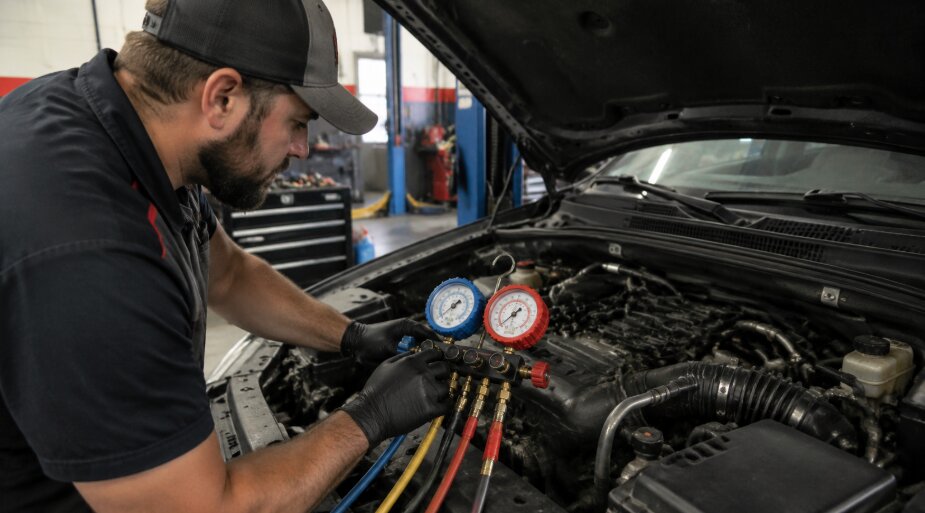
We are currently in what I call the “False Spring” trap. The mornings are mild, but by 2:00 PM, the Marion County humidity spikes. You might think your AC is “fine” because it still feels cool, but if your Thermal Expansion Valve (TXV) is sticking or your refrigerant is low, the compressor is likely “slugging” liquid or over-cycling.
These hidden loads don’t always show up as a warm cabin immediately. Instead, they show up as an engine that feels “heavy” or a fuel needle that drops faster than it did in February. We use Digital Manifold Gauges to see the exact pressure relationship; if those numbers are off, your engine is paying the price in real-time.
The 10 Percent Rule Recovering on Your MPG with a Professional Recharge
Reclaiming your fuel economy starts with a professional evacuation and recharge. This isn’t just “adding a can of Freon” from the auto parts store. Precision is everything in 2026.
When we balance your system to the exact gram, we restore the “Data Handshake” between the AC and the engine.
- Reduced Amperage Draw: The compressor turns with less resistance.
- Optimized Duty Cycles: The clutch disengages when not needed, giving your engine a “rest.”
- Fuel Trim Stabilization: Using our scan tools, we can actually watch the Short Term Fuel Trim improve by 5% to 8% the moment a system is properly charged.
Master Tech Verdict on Stopping a Weak Compressor from Draining Your Wallet
Don’t treat your AC service as an elective repair. In this economy, an AC recharge is a Fuel Defense Strategy. Whether you’re commuting past the Santos Trail or idling on Abshier Blvd, a balanced system ensures that every drop of gas goes toward moving your car, not just fighting a failing compressor.
Come by the bay, and let’s look at your fuel trim. If your AC is stealing your gas money, we’ll find the evidence and fix it before the summer heat makes the problem even more expensive.
Gregg Smith Automotive 6202 SE Abshier Blvd, Belleview, FL 34420
Frequently Asked Questions
Does using the AC always use more gas?
Technically, yes, because it places a load on the engine. However, a healthy system uses very little, while a malfunctioning or undercharged system can increase fuel consumption by 10% to 15%.
Why is my MPG dropping now that it’s getting warmer in Belleview?
As the temperature rises, your AC works harder. If your system is low on refrigerant, the compressor stays engaged longer to fight the Florida humidity, which directly drains your fuel tank faster than usual.
Is a professional AC recharge really worth the investment?
Absolutely. With current fuel prices in Marion County, a system that is 10% more efficient can pay for itself in fuel savings alone within a few months of daily commuting on US-441.
What is “Compressor Slugging”?
This happens when liquid refrigerant enters the compressor instead of gas. It creates massive mechanical resistance, which strains your engine and can eventually lead to a total (and very expensive) compressor failure.
Is it cheaper to drive with my windows down instead of using the AC?
This is a common “Florida myth.” At city speeds around Belleview, windows down can save a little fuel. However, once you hit 70–80 km/h on US-441 or I-75, the “aerodynamic drag” of open windows actually costs you more in fuel than a well-maintained AC system. The most efficient strategy for your wallet is to keep the windows up and ensure your AC is charged to the exact manufacturer specifications.