

Modern cabin humidity sensors prevent windshield fogging by calculating the dew point in real-time. During April’s sudden rain showers on US-301, these LIN-bus integrated modules automatically engage the AC compressor and switch to fresh air intake, ensuring maximum visibility and passenger safety without requiring manual driver intervention.
We’ve all been there. You’re cruising past Belleview City Hall on a sweltering April afternoon when the sky opens up. Within seconds, a thick gray veil of fog crawls up your windshield. In an older car, you’d be fumbling with the fan speeds and temp dials while trying to stay in your lane. But in a 2026 vehicle, you shouldn’t have to touch a thing.
If you find yourself wiping the glass with your sleeve, your car’s “brain” is failing a math test. Visibility isn’t just about having a working defroster anymore; it’s about the precision of your cabin’s dew point sensors.
The Science of the Blindfold: Why Visibility Fails in Seconds
The “10-second blindfold” is a result of pure physics called thermal shock. When an afternoon thunderstorm hits a $95^{\circ}F$ asphalt corridor like US-301, the temperature of your windshield glass drops instantly.
Inside the cabin, your breath and skin are constantly emitting moisture. When that warm, humid air hits the now-cold glass, it reaches its dew point—the exact temperature where air can no longer hold its water vapor. The result is immediate condensation.
- The Surface Tension Problem: Moisture clings to the glass in microscopic droplets that scatter light.
- The Saturation Surge: In Marion County, humidity can jump from 55% to 95% the moment the rain starts, giving your AC system zero margin for error.
The Sensirion SADP Standard: Your Car’s Invisible Safety Shield
To fight this, modern vehicles rely on the Sensirion SADP series sensor. This isn’t just a thermometer; it’s a high-tech probe usually tucked behind your rearview mirror.
- IP6K4 Durability: These sensors carry an IP6K4 rating, meaning their waterproof tips can handle the constant “sweating” and condensation inside a car without short-circuiting.
- The ADS Override: If the sensor detects the cabin humidity is approaching the dew point, it triggers the Automatic Defogging System (ADS).
One thing Belleview drivers often notice is their car suddenly switching off the “Recirculate” button. That’s the ADS at work. It force-disables recirculation because trapping your own breath inside the car is the fastest way to fog the glass. It demands fresh, outside air to flush the moisture out.
LIN-bus Communication: The Speed of Clear Glass
In the bay, we test how fast your car “talks” to itself. Your humidity sensor is a node on the LIN-bus (Local Interconnect Network). It sends data to your HVAC controller at a rate of 19.2 kBd.
- The Millisecond Race: The sensor has to calculate the dew point and tell the AC compressor to engage before the fog is visible to the human eye.
- Digital Accuracy: If the communication on this digital line is sluggish, or if the sensor is “drifting,” the car reacts too late. You’re left driving blind for those critical first 30 seconds of a storm.
Digital Re-Zeroing: Fixing the Drifting Sensor Problem
I often have customers come in complaining about foggy windows even though their AC is “fully charged.” This is the “Smoking Gun” of a lazy sensor. Over time, heat and dust can cause an SADP sensor to “drift” by 10% or more.
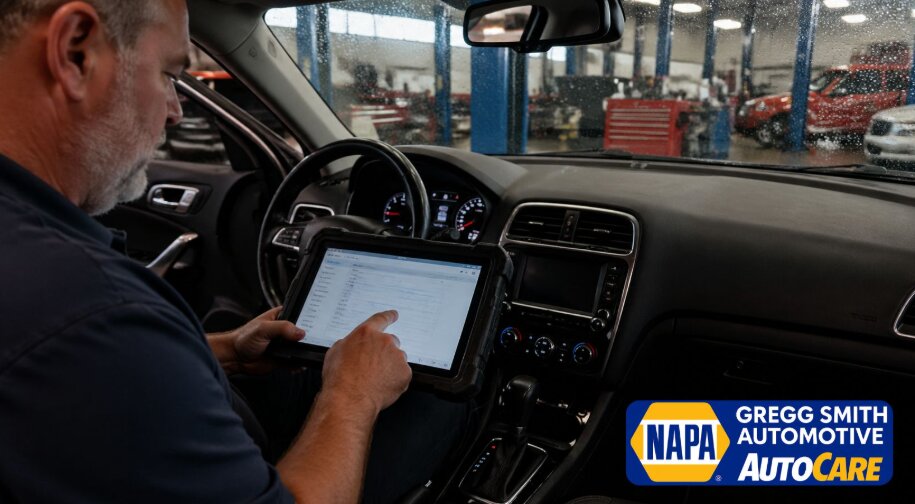
Using our Autel MaxiSYS Ultra, we perform a Digital Re-Zeroing. We compare the sensor’s live data against a calibrated master probe. If your sensor thinks the cabin is 70% humid when it’s actually 85%, the ADS won’t kick in until you’ve already lost visibility. We don’t just “check the gas”; we calibrate the digital eyes of your climate control system.
School Zones and Picnic Safety: Why Accuracy is Non-Negotiable
Think about the Belleview High School pick-up line. You’ve got three or four students piling into the car with wet umbrellas and damp sports gear. That is a “humidity bomb.” Without a perfectly calibrated sensor, that sudden spike in moisture will overwhelm the system instantly.
The same goes for a quick exit from Lake Lillian when a picnic gets rained out. You’re in a rush, the kids are loud, and the rain is heavy. You need to know that the second you put the car in gear, your sensors are already stripping the moisture from the air.
At Gregg Smith Automotive, we treat visibility as the ultimate AC safety metric. We make sure your car is smart enough to see the fog before you do.
Gregg Smith Automotive 6202 SE Abshier Blvd, Belleview, FL 34420
Frequently Asked Questions
Why does my AC turn on by itself when I turn on the defroster?
Yes, this is intentional. The AC compressor acts as a dehumidifier. Even if you want “heat” to clear the windows, the AC must run to strip the moisture out of the air, or you’ll just be blowing warm mist onto the glass.
Can I override the Automatic Defogging System (ADS)?
No, in most 2026 models, the ADS is a hard-coded safety feature. While you can manually adjust fan speeds, the system will override your “Recirculate” setting if the dew point sensor detects a safety risk to your visibility.
Where is the cabin humidity sensor actually located?
In most modern vehicles, it is integrated into the rain sensor housing on the windshield, right behind the rearview mirror. This allows it to measure the temperature of the glass and the humidity of the air directly in your line of sight.
Will a cracked windshield affect my cabin humidity sensor?
Yes, in many 2026 models, the humidity sensor is bonded to the windshield glass behind the rearview mirror. If a crack or chip passes through that mounting area, it can cause the sensor to receive inaccurate glass temperature readings, leading to delayed defogging or the system failing to activate during a Belleview rainstorm.
Does a dirty cabin air filter contribute to foggy windows?
Yes, because a clogged filter restricts the volume of dry air that can be forced against the windshield. Even if your SADP sensor is perfectly calibrated, if the blower motor can’t push enough dehumidified air through a pollen-caked filter, the moisture will remain on the glass, leaving you with poor visibility on US-301.