

Bio-engineered air filters are the 2026 standard for neutralizing May’s high-humidity allergen surges in Belleview. Unlike standard filters that merely trap debris, these bio-active barriers utilize polyphenol coatings to denature pollen and kill mold spores on contact, ensuring maximum airflow and cabin purity during Marion County’s transition into peak summer heat.
By May, the “yellow dust” that covered Belleview in April had settled deep into your car’s HVAC system. In the dry air of early spring, pollen is just an irritant. But once the May humidity hits 85%, that organic matter begins to decay, creating a “bio-film” on standard paper filters. At Gregg Smith Automotive, we’re seeing that the old 2025 filtration technology simply can’t handle the microbial load of a Florida late-spring.
Neutralizing Marion County Allergens with Polyphenol Technology
The Southern Live Oak ($Quercus$ $virginiana$) remains a dominant allergen near the Market of Marion well into May. In a standard filter, these trapped proteins stay active, and every time you hit a bump on Abshier Blvd, they can be shaken loose back into the cabin.
2026 bio-based filters solve this with natural polyphenol coatings.
- Protein Denaturation: This citrus-derived layer chemically deactivates the pollen.
- May Saturation: Because the pollen is neutralized on contact, the filter doesn’t become a “pollen bomb” as the month progresses.
- Neutral Air: This tech ensures that even during a heavy May pollen drift, the air entering your lungs is biologically inert.
The Active Bio-Shield Against May Mold Spores
May in Belleview is the peak season for Cladosporium and Alternaria mold. For residents near Smith Lake or Lake Lillian, the high vapor pressure pushes moisture into the HVAC housing every time the car is parked.
Standard filters are passive; they just sit there while mold spores feed on the trapped organic dust. The 2026 bio-standard utilizes Chitosan-based bio-layers. These layers use a natural positive charge to rupture the cell membranes of mold spores on contact. It doesn’t just “catch” the smell; it kills the source of the “May Must.”
| Feature | 2025 Standard Filter | 2026 Bio-Based Filter |
| May Humidity Response | Absorbs moisture/Supports mold | Active antimicrobial barrier |
| Pollen Load | Passive trapping (Saturation) | Chemical deactivation (Polyphenols) |
| Blower Motor Stress | High (Resistance from moisture) | Ultra-Low (Nanofiber technology) |
| Airflow (CFM) | Restricted by “Bio-film” | Consistent peak performance |
Filtering the US-301 Particulate Soup for Health
The heavy truck traffic on US-301 creates a “particulate soup” of PM2.5 brake dust and tire wear. By May, this inorganic grit mixes with the decaying pollen, creating a heavy, sticky sludge on your filter.
Bio-based filters use electrospun nanofibers that are incredibly thin but structurally dense. They can trap the heavy metallic dust from the US-301 corridor without the “invisible wall” effect that causes your AC to blow weak in the afternoon heat.
Nanofiber Advancements Over Obsolete 2025 Filter Tech
As the Belleview heat climbs toward 90°F in May, your blower motor is under maximum stress. A standard filter that is damp and clogged with pollen forces the motor to pull high amperage. This is the #1 cause of Blower Motor Resistor failure we see in the bay.
The 2026 bio-engineered nanofibers provide:
- Purity: Stopping particles 100x smaller than a human hair.
- Efficiency: Maintaining high CFM (Cubic Feet per Minute) airflow, which keeps the blower motor cool and your cabin crisp.
Transforming Your Cabin into a Spring Allergy Haven
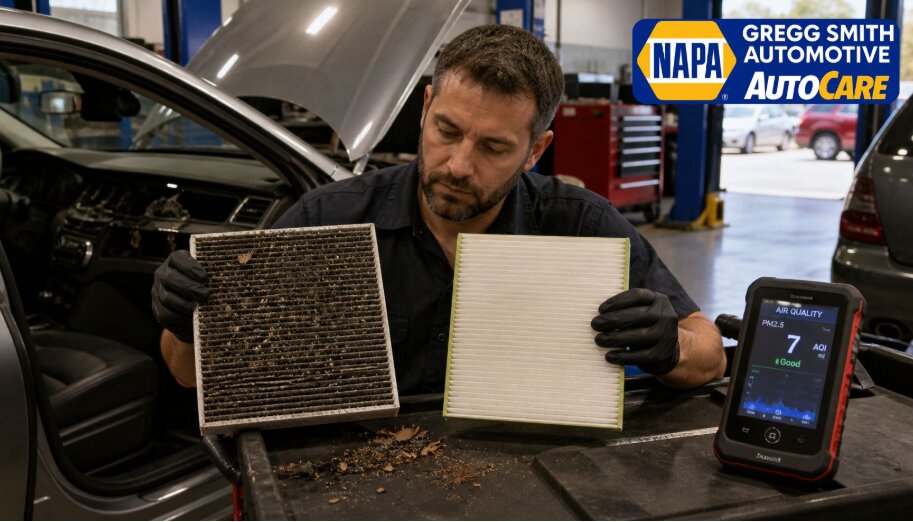
We don’t guess about air quality; we prove it. When we pull a standard filter in May, it’s often heavy, damp, and smells of “sour” organic decay. We then use our Laser Particle Counter to show the difference.
- The Forensic Verdict: Standard filters often show an AQI (Air Quality Index) spike inside the car as the fan turns on.
- The Bio-Result: With a bio-based filter, the AQI drops to near-zero in under a minute, regardless of the yellow haze outside.
Gregg Smith Automotive 6202 SE Abshier Blvd, Belleview, FL 34420
Frequently Asked Questions
Does the bio-active coating wear off in high humidity?
No. The polyphenol and chitosan layers are molecularly bonded to the nanofibers. They are specifically designed to remain effective in Florida’s 90% humidity environments throughout their entire service life.
Why does my AC smell worse in May than it did in March?
In March, the pollen was dry. In May, the rising dew points cause that trapped organic matter to ferment and support mold growth. A bio-based filter neutralizes this organic decay to eliminate the “musty blast” at startup.
How do bio-based filters protect my blower motor?
By using nanofibers instead of thick paper, these filters offer much lower air resistance. This allows the blower motor to move more air with less electrical “effort,” preventing the overheating that leads to resistor and motor failure.
Is there a special “May” service for these filters?
We recommend a “Bio-Purity Check” every May. We use a laser particle counter to verify that your filter is still neutralizing denatured proteins and hasn’t reached its physical holding capacity from the US-301 particulate surge.
Are bio-filters safer for families with asthma?
Yes. Since they deactivate the protein structure of allergens, there is significantly less risk of an “allergy spike” when you first turn on the air, making the cabin a safer environment for sensitive passengers.