

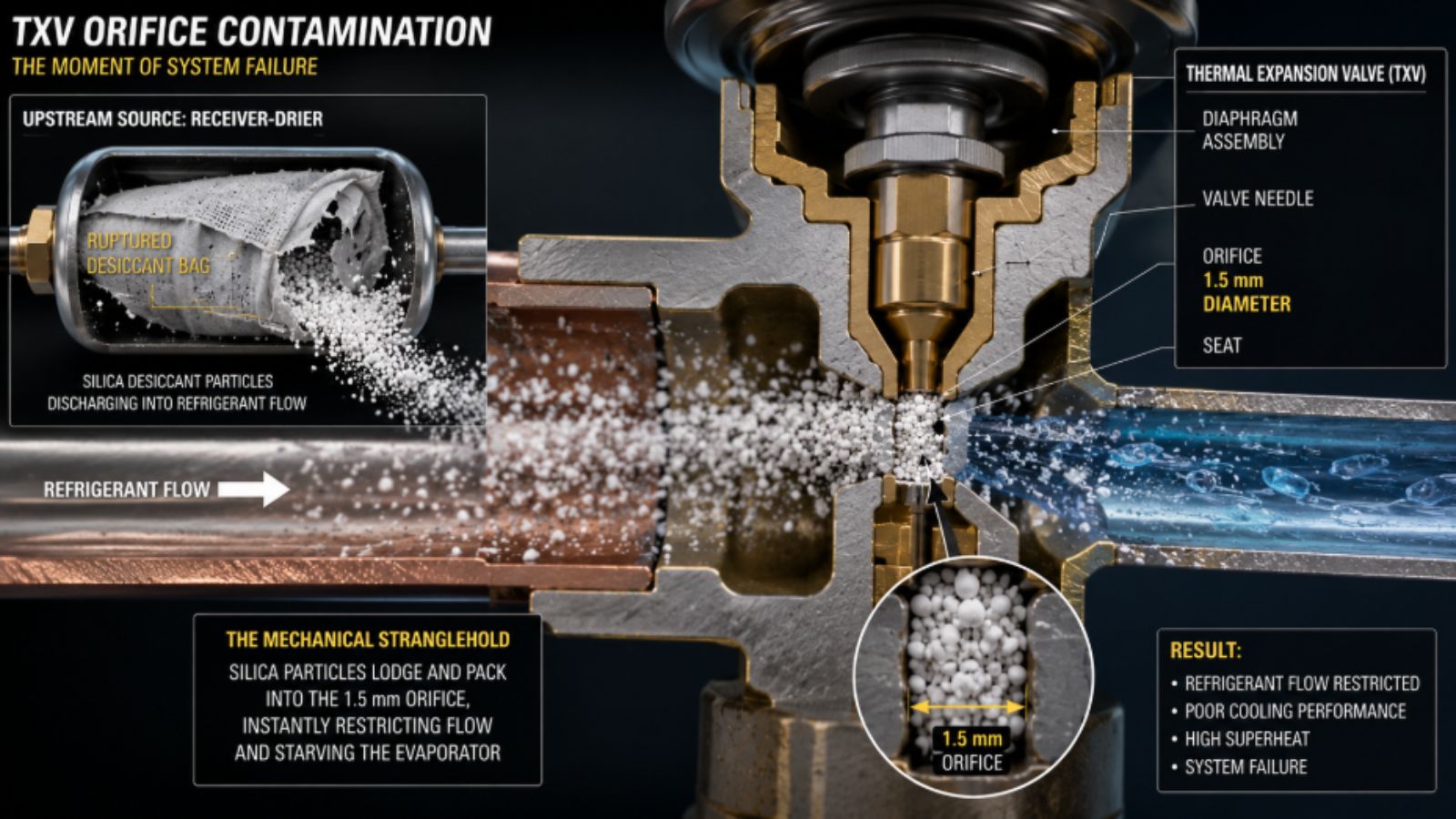
June’s relentless humidity and torrential afternoon storms accelerate receiver-drier saturation in Marion County. When internal desiccant bags rupture from moisture-induced acid wear, they release destructive silica debris that clogs expansion valves and causes cataclysmic compressor failures. Gregg Smith Automotive replaces these critical filters before total system contamination occurs.
When Florida’s wet June cycle hits, intense atmospheric moisture constantly seeks entry into your vehicle’s air conditioning. If your cold air suddenly vanishes into a lukewarm breeze while commuting along CR-484, you may be facing an internal structural failure of the receiver-drier rather than a basic leak.
The Silent Safety Net on What Your Receiver Drier Actually Does
The receiver-drier acts as the kidney of your car’s AC loop, positioned on the high-pressure side to store excess refrigerant and filter out harmful moisture or debris. Inside, a desiccant pouch containing silica gel is designed to absorb tiny amounts of water that enter through microscopic gaps in aged rubber hoses or during routine service.
While this protective shield works effectively in ideal climates, Florida’s intense humidity pushes these components to their physical limit. Once the desiccant bag becomes saturated, it loses its ability to protect the system and transforms into a mechanical liability that can cause significant internal damage.
How Humidity Weaponizes Silica Gel Causing Drier Rupture
When our daily June afternoon thunderstorms roll through Belleview, the outdoor dew points skyrocket. This extreme moisture load speeds up the degradation of older system seals. Once moisture breaches the system loop, it sets off a destructive chemical chain reaction:
- Acid Synthesis: Moisture does not just dilute your refrigerant; it reacts chemically with the universal PAG (polyalkylene glycol) lubricating oil to form highly corrosive hydrofluoric acid.
- Pouch Degradation: As the system runs, internal temperatures cook this acidic fluid mixture, causing the protective fabric lining of the desiccant bag to weaken, fray, and dissolve.
- The Silica Dump: Under high operational system pressure, the compromised bag completely tears open, releasing thousands of tiny, loose abrasive desiccant beads directly into the high-pressure liquid line.
The TXV Stranglehold Traps Abrasive Sand
Once those abrasive silica particles are loose in the system, they follow the path of fluid flow directly toward the Thermal Expansion Valve (TXV) at your vehicle’s firewall. The TXV features a microscopic orifice—often just $1.5\text{ mm}$ wide—designed to meter the flow of liquid refrigerant into a cold mist.
When loose desiccant debris hits this valve, the tiny opening becomes completely choked with white, sand-like powder. This creates an immediate mechanical stranglehold on your system.
To help illustrate what this does to your vehicle’s components, we can look at the stark contrast between a clear system loop and one that has suffered an internal desiccant rupture:
Internal AC System Health Comparison
| Technical Marker | Healthy System Loop | Contaminated System Loop (Ruptured Drier) | Mechanical Consequence |
| High-Side Pressures | Stable 150 – 225 PSI | Erratic spikes exceeding 350+ PSI | Severe compressor head fatigue; safety switch cutouts. |
| TXV Orifice State | Completely clear fluid metering | Blocked by abrasive white silica powder | Refrigerant flow is choked; vents turn immediately warm. |
| Refrigerant Line Interior | Clean, bare aluminum walls | Coated in a grey, gritty metallic sludge | High friction paste scores internal compressor pistons. |
| Drier Canister Status | Solid internal pouch matrix | Internal bag loose (sounds like a maraca when shaken) | Total system breakdown; structural parts replacement required. |
When we hook up our Digital Manifold Gauges in the shop bay, we can diagnose a choked TXV instantly. The high-side needle will begin to seesaw erratically or jump to dangerous peaks while the low-side drops into a vacuum. The system is essentially suffocating on its own internal filter media.
Silica Grinding Paste Causes Total System Seizure
Continuing to operate your AC after a desiccant rupture creates a grey, metallic grinding paste from silica sand and lubricating oil. This paste causes catastrophic failure:
- The grinding paste scours refrigerant lines, picks up metal shavings, and scores the compressor’s internal pistons and reed valves, leading to total mechanical seizure.
- Simply replacing the failed compressor or expansion valve is useless; the residual sand contamination will cause the new parts to fail within days.
- The only solution is an advanced AC System Flush Machine to remove all abrasive paste. If the lines cannot be fully cleared, the entire assembly (compressor, condenser, evaporator, and lines) must be replaced.
Replacing the Filter Before Damage Occurs
In Belleview, many drivers mistakenly believe the receiver-drier is a lifetime component, as it’s often omitted from routine maintenance manuals. However, Florida’s intense humidity makes treating this filter as permanent an expensive risk. Much like an engine’s oil filter, the receiver-drier must be replaced to protect your high-dollar compressor from the destructive effects of a saturated desiccant bag.
At Gregg Smith Automotive, we conduct forensic checks to identify pressure anomalies and fluid contamination before they lead to total system failure. If your AC has been opened for repairs or has leaked through a summer season, your drier is likely on borrowed time. Replacing this canister during routine service is a fraction of the cost of a full system teardown and protects your vehicle from internal seizure.
Protect Your System Before It Fails From Within
Don’t wait for a saturated drier to destroy your entire air conditioning system. Our master techs at Gregg Smith Automotive have the specialized digital gauges, flush machinery, and diagnostic expertise to catch internal failures before they turn into major repair bills.
Secure your summer comfort and protect your wallet today.
Gregg Smith Automotive 6202 SE Abshier Blvd, Belleview, FL 34420
Frequently Asked Questions
Why does a master tech shake a receiver-drier during a diagnostic inspection?
When an internal desiccant bag ruptures, the silica beads break free and rattle against the outer aluminum housing. If we remove a drier canister during an inspection and it sounds exactly like a maraca when shaken, we have clear, undeniable proof that the filter has failed and debris is loose in your lines.
Can I just replace my clogged expansion valve without replacing the receiver-drier?
No. If your expansion valve is clogged with white silica powder, it means the debris came directly from a ruptured receiver-drier bag. If you do not replace the drier at the same time, the remaining debris in the lines will instantly clog your brand-new valve as soon as the system turns back on.
What is the difference between a receiver-drier and an accumulator?
They perform the same basic filtering and drying duties but are located on opposite sides of the system. A receiver-drier is located on the high-pressure side of systems that use an expansion valve. An accumulator is a larger canister located on the low-pressure side of older systems that utilize an orifice tube.
How does moisture manage to enter a completely sealed AC system loop?
While the system is technically sealed against major liquid leaks, automotive AC lines contain flexible rubber sections. Over years of heat cycles, these rubber hoses become slightly porous, allowing ambient atmospheric humidity to slowly migrate inward through a process called molecular permeation.
What does an AC system flush machine do to fix this specific issue?
An AC flush machine hooks directly into your vehicle’s disconnected lines, pumping a specialized chemical solvent backward and forward through the loops under high pressure. This solvent dissolves the contaminated PAG oil and safely extracts any loose silica sand and metal fragments before new parts are installed.