

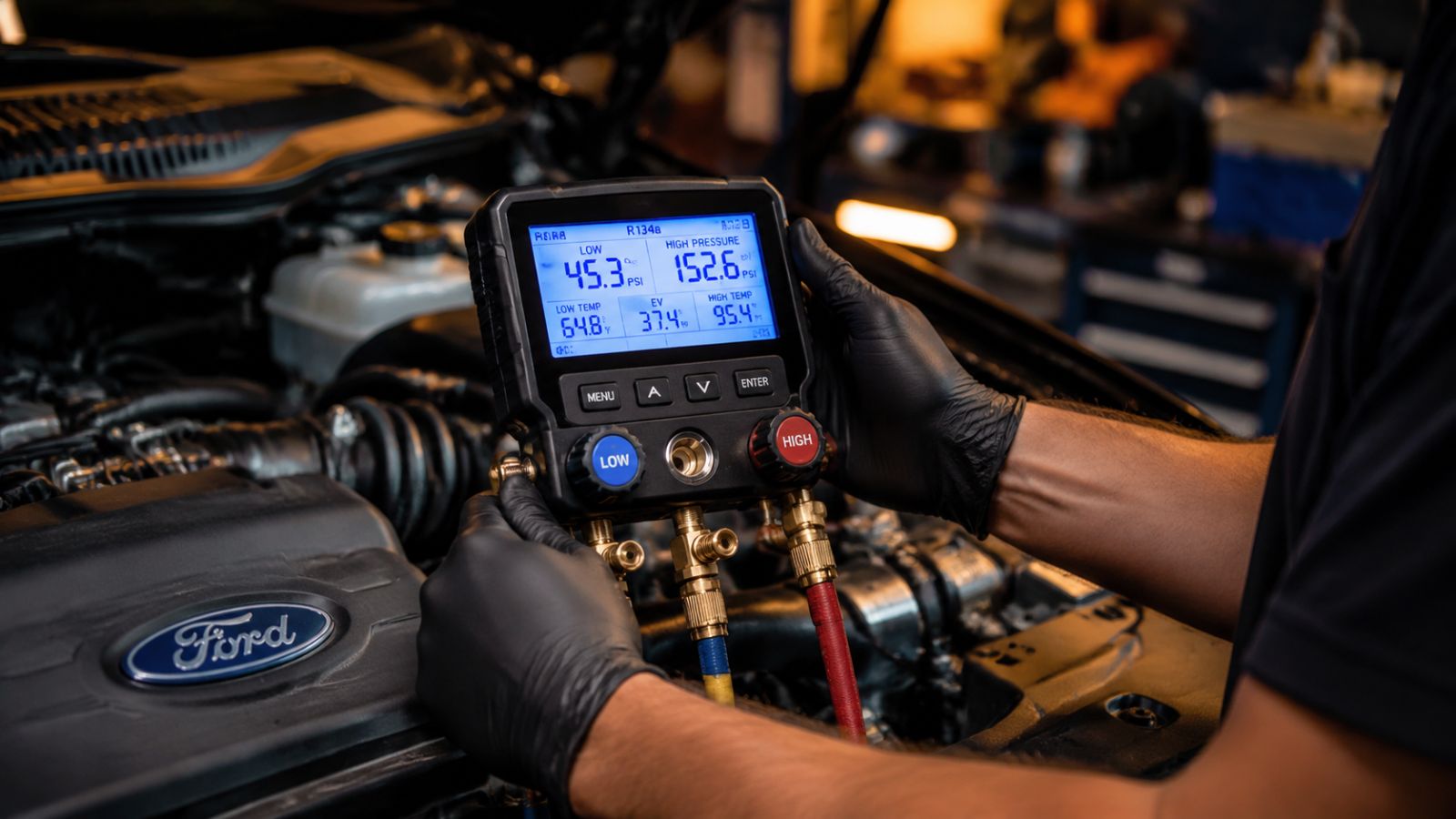
Ford F-150 trucks and Explorer SUVs lose AC cooling capacity during extended summer idling due to severe condenser airflow starvation and high head pressures. Variable displacement compressors and electronic fan clutches fail to dissipate extreme ambient heat when stopped in traffic. Belleview commuters navigating daily humidity face warm vent temperatures and costly A/C system failures.
Ford AC Performance Loss During Belleview Summer Idling
If you drive a Ford F-150, Explorer, or Escape, you might notice your A/C starts to struggle when you’re stuck in traffic along SE Abshier Blvd. This happens because these systems rely on air moving through the front of your car to stay cool. When you’re idling in 95°F heat with high humidity, there isn’t enough airflow to keep the pressure down. To protect itself from breaking under the extreme pressure, your truck’s computer actually dials back the A/C power. This is why you get stuck breathing in 70°F lukewarm air until you finally get moving again down SR 44.
Ford AC Heat-Soak Technical Breakdown
| Diagnostic Metric | Technical Benchmark |
| Primary Symptom | Dashboard air vents blow warm air while stopped at red lights, returning to cold output only after accelerating above 30 MPH. |
| Target Component | Electronic fan clutch motor, electronic A/C compressor control valve (ECV), dual-function high-pressure cutout switch. |
| Specialized Tooling | R-1234yf / R-134a digital manifold gauge set, Mastercool nitro-leak detector, Ford IDS/FORScan HVAC PID monitor. |
| Local Stressor | Heavy traffic congestion along SE Abshier Blvd during 95°F+ Central Florida summer heat-soak conditions. |
| High-Risk Profile | 2015-2023 Ford F-150 3.5L EcoBoost and Explorer 2.3L vehicles equipped with active grille shutters and dual-zone climate control. |
The Thermal Physics Behind Ford Idle Cooling Loss
Normal Refrigerant Cycle Execution Under highway conditions, ram-air velocity forces ambient air through the aluminum condenser, rapidly cooling high-pressure superheated gas into liquid refrigerant.
- Phase Heat Transfer: The compressor forces gaseous refrigerant into the condenser coils where liquid condensation drops latent heat.
- TXV Flow Regulation: The thermal expansion valve metering orifice opens, dropping system pressure to chill the interior evaporator core to 38°F.
Airflow Starvation and Active Shutter Resistance Extended idling eliminates dynamic velocity air across the grill, forcing total cooling reliance on the electric cooling fan assembly.
- Active Shutter Restriction: Sticking or slow-reacting active grille shutter actuators trap stagnant engine heat within the front bumper cavity.
- Thermal Heat-Soaking: High humidity coats the condenser fins in dense moisture barriers, dropping the air heat-dissipation coefficient by 40 percent.
Compressor Destroking and High-Side Pressure Spikes When high-side pressure surges past 320 PSI without sufficient airflow, the PCM intervenes to protect mechanical seals.
- ECV Current Modulation: The PCM reduces pulse-width modulation (PWM) current to the internal electronic control valve inside the compressor.
- Capacity Reduction: The compressor swash-plate flattens out, dropping piston stroke length to zero and instantly killing cabin heat absorption.
Master Tech Warning: Do not simply dump store-bought refrigerant cans into a Ford A/C system that blows warm at idle. Overcharging an electronically stroked compressor locks up the swash plate and destroys the serpentine drive assembly.
Advanced Diagnostic Protocols for Ford AC Performance Loss
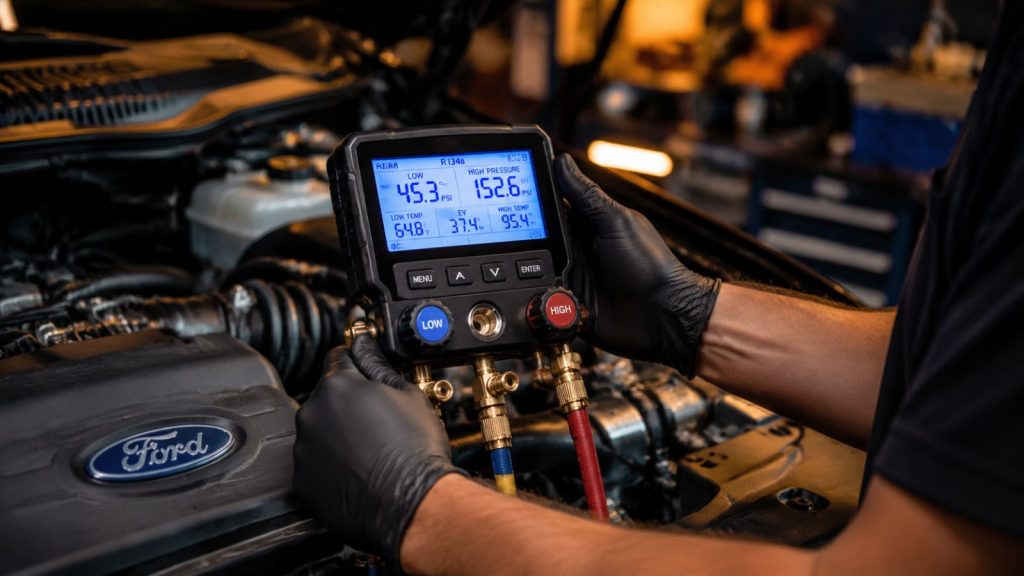
Diagnosing Ford idle cooling failures requires direct measurement of electronic control signals alongside real-time pressure transducers. Standard manifold gauges miss mechanical ECV sticking and variable fan duty cycle lags. Our shop uses a multi-stage physical and digital routine to isolate thermal airflow starvation before mechanical compressor destruction occurs.
Gregg Smith Automotive Diagnostic Verdict: Last week in our Belleview shop, we inspected a 2018 F-150 3.5L EcoBoost blowing 74°F air while waiting in school pickup lines. Our digital gauges logged high-side pressure spiking to 365 PSI within 4 minutes of park, while FORScan showed fan speed stuck at 30% duty cycle due to a degraded fan clutch relay. Replacing the relay and performing a high-pressure condenser wash restored vent temps to 41°F at idle.
- Digital Manifold Pressure and Ambient Delta Logging: Connect digital pressure transducers to low and high-side service ports with the engine running at 750 RPM idle. Monitor pressure rise rates against ambient air temperatures; high-side pressures rising faster than 15 PSI per minute indicate severe condenser fan speed degradation.
- FORScan HVAC Module and PWM Fan Interrogation: Interface FORScan to command 100% cooling fan duty cycle while logging compressor ECV current draw. If fan speed fails to match PCM commands, measure voltage drop across the cooling fan harness to isolate melted connector pins or failed control modules.
- Evaporator Core Temperature Sensor Verification: Probe the raw resistance of the evaporator temperature sensor via OBD-II live data blocks. A miscalibrated sensor reporting 32°F when actual core temperature sits at 50°F causes the PCM to prematurely cut compressor displacement.
Stop Engine Catastrophe at Gregg Smith Automotive
Ignoring Ford A/C performance degradation leads directly to internal compressor galling, black death system contamination, and repair bills. Operating a heat-stressed A/C system under Florida summer loads forces rapid shaft seal failure that leaves your family stranded in extreme heat. Schedule an accurate thermal airflow and refrigerant inspection today with Gregg Smith Automotive located at 6202 SE Abshier Blvd, Belleview, FL 34420.
Frequently Asked Questions
Why does my Ford AC blow cold while driving but warm when idling?
Airflow across the condenser drops when idling in traffic. Without dynamic vehicle speed, a degraded cooling fan or clogged condenser fins cannot dissipate heat, raising high-side refrigerant pressures and forcing the engine computer to reduce compressor output.
Can low refrigerant cause warm air only at idle in a Ford truck?
Yes, minor leaks drop baseline system pressure below working thresholds. At low idle RPM, a undercharged compressor cannot build sufficient pressure differential to chill the evaporator core, whereas higher engine speeds on the highway temporarily mask the loss.
Will a failing cooling fan throw a Check Engine light on a Ford?
No, degraded fan clutch relays and partial electronic fan failures rarely trigger diagnostic trouble codes. The engine computer commands fan operation, but reduced fan RPM goes undetected until rising refrigerant pressure forces an automatic A/C shutdown.
Does running my Ford AC on Max AC prevent idle overheating?
No, Max AC recycles cabin air but does not increase cooling fan speed or fix physical condenser airflow restrictions. Stagnant ambient heat sitting outside the grille still spikes refrigerant pressures if cooling fan airflow remains insufficient.
Can active grille shutters ruin Ford AC cooling performance?
Yes, active grille shutter assemblies that seize closed block ambient air from reaching the A/C condenser. This physical obstruction traps heat inside the front grille cavity, causing warm vent temperatures during Belleview summer traffic stops.