

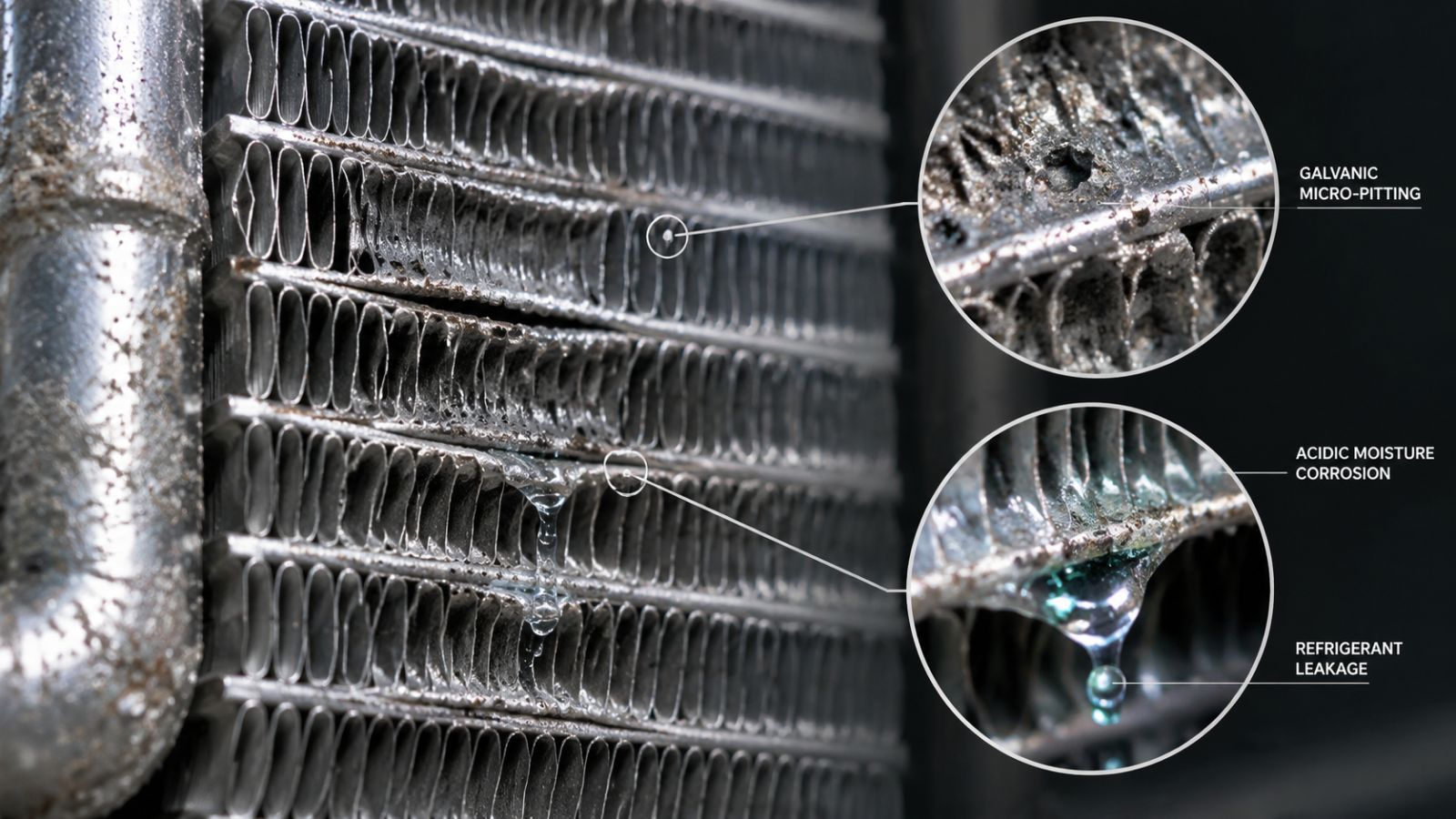
Late-model Ford Explorers and Escapes in Central Florida experience frequent A/C failure caused by galvanic micro-pitting on interior evaporator cores. Extreme regional humidity combines with heat-soaking during idling to turn standing condensation acidic. This moisture corrodes thin-walled aluminum cooling fins, leaking refrigerant and causing warm cabin air.
Galvanic micro-pitting actively destroys late-model Ford Explorer and Escape evaporator cores across Central Florida. Stop-and-go driving along SE Abshier Blvd starves the A/C system of steady airflow, allowing trapped atmospheric moisture to turn highly acidic. This corrosive layer aggressively eats through thin-walled aluminum cooling fins, venting atomized refrigerant and leaving family vehicles without cooling.
Key Technical Performance Indicators
We track specific diagnostic criteria to isolate evaporator micro-pitting before total system lockup occurs. Review the essential baseline metrics and environmental risk factors below for Ford Explorers and Escapes operating in local heat.
| Metric | Specification / Observed Value |
| Primary Symptom | Warm vent air at low RPM, sweet fog on windshield, oily film inside cabin glass |
| Target Component | Micro-extruded aluminum A/C evaporator core (Dash-mounted HVAC box) |
| Specialized Tooling | Mastercool Nitrogen-Hydrogen Trace Gas Sniffer, Snap-on Thermal Imager |
| Local/Environmental Stressor | 90%+ relative humidity, thermal heat-soaking, sulfur-laden airborne dew |
| High-Risk Run / Profile | Daily school carpools, idling at Belleview traffic stops, 50,000+ mile Ford EcoBoost SUVs |
Mechanical Physics Behind Aluminum Evaporator Micro-Pitting
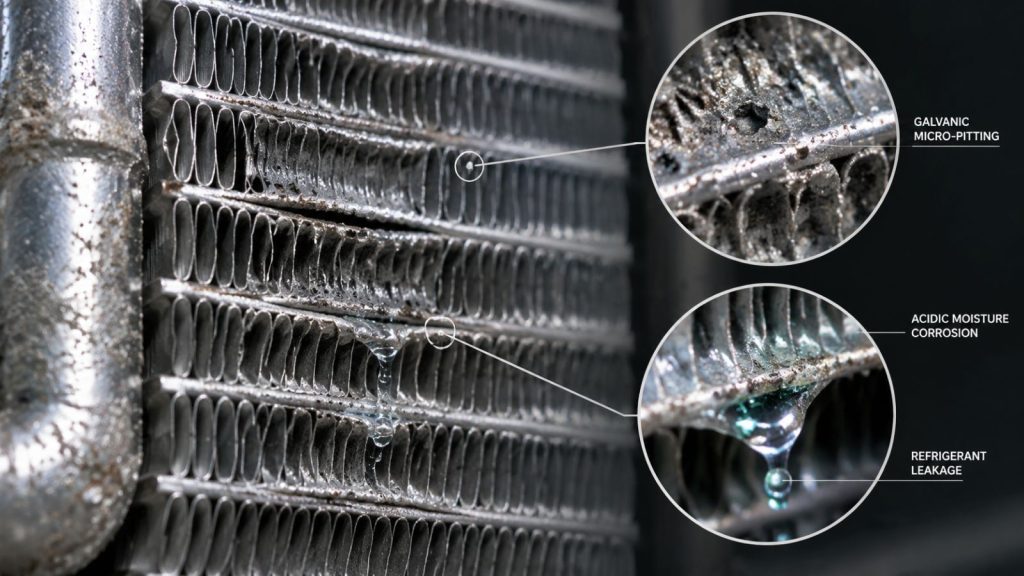
Under baseline conditions, R-134a or R-1234yf refrigerant flashes into a low-pressure liquid inside the evaporator core at approximately 35°F to 40°F. Warm interior cabin air passes over the aluminum fins, dropping its sensible heat into the liquid refrigerant while surface condensation drains harmlessly down the HVAC housing tube.
In Central Florida, high ambient humidity saturates the fin matrix with continuous moisture. When an EcoBoost SUV heat-soaks during traffic idling on SE Abshier Blvd, engine bay temperatures surge past 210°F.
The standing moisture on the evaporator fins absorbs atmospheric sulfur and organic acids from stagnant rain runoff. This acidic dew initiates galvanic micro-pitting along the thin-walled brazed joints of the aluminum tubes.
As the metal pits, high operating pressures force atomized PAG oil and refrigerant through tiny micro-pores. The loss of pressure starves the metering valve, shifting heat dissipation capacity to absolute zero. If you notice symptoms like these, perform an auto engine diagnostic to evaluate system health.
Precision Evaporator Leak Detection Workflow
Catching a pinhole evaporator leak before it starves the compressor of oil requires a precise diagnostic protocol.
- Step 1: Quantitative System Recovery. Connect a dual-refrigerant recovery station to pull the remaining charge. Measure total recovered mass against the factory under-hood placard (e.g., 23 oz spec). A loss greater than 3 oz confirms an active leak.
- Step 2: Trace Gas Pressurization. Charge the empty A/C circuit with a 5% Hydrogen / 95% Nitrogen tracer gas mix up to 150 PSI. Hydrogen molecules are smaller than refrigerant molecules, enabling fast detection through dense dash structures.
- Step 3: Sniffer Sampling at Center Vents. Insert an electronic trace gas sniffer probe directly into the center HVAC ducting and floor evaporator drain tube. Set the sensitivity threshold to 0.10 oz/year leak rates.
- Step 4: Thermal Core Profiling. Run the blower motor on medium speed while monitoring the dash enclosure with a calibrated thermal imaging camera. A failing evaporator displays localized hot spots where air channels bypass un-chilled, pinholed sub-sections.
Shop Note: Never add stop-leak additives to a leaking Ford HVAC system. The chemical hardens inside the expansion valve orifices and variable displacement compressor control valves, turning a single evaporator job into a complete system overhaul.
Stop Evaporator Damage Today at Our Belleview Repair Shop
Ignoring faint sweet odors or intermittent warm air from your Ford Explorer or Escape vents will result in total compressor seizure. Once the system operates without proper oil circulation, metallic debris spreads through the lines, doubling your repair costs. Skip the long waiting lists at corporate dealerships. Our shop delivers direct, specialized diagnostic accuracy to keep your family cool and safe on Florida roads.
Book your specialized Ford A/C inspection directly with Gregg Smith Automotive, located at 6202 SE Abshier Blvd, Belleview, FL 34420. Learn more about our shop, check our current special deals, explore financing options, or view all our auto repair services including oil change services and wheel alignment services.
Frequently Asked Questions
Can low refrigerant cause warm air only at idle in a Ford SUV?
Yes. Minor evaporator leaks lower baseline pressure below critical working thresholds. At low idle RPM, an undercharged compressor cannot maintain the required pressure differential, though higher highway speeds temporarily mask the cooling loss.
Does a sweet smell inside my Ford cabin mean the evaporator is leaking?
No. A sweet smell paired with fogged glass typically indicates a leaking heater core weeping toxic engine coolant, whereas atomized A/C refrigerant and PAG oil produce a faint chemical or oily odor.
Will a clogged cabin air filter cause the Ford evaporator core to freeze?
Yes. Restricting airflow over the evaporator fins drops core temperatures below 32°F. Trapped humidity freezes into a solid block of ice, blocking all vent airflow until the vehicle shuts off and melts the obstruction.
Is dashboard removal required to replace a Ford Explorer evaporator?
Yes. Ford positions the HVAC housing against the interior firewall, requiring complete unbolting of the instrument panel structure, steering column supports, and center console assemblies to access and swap the leaking core.
Can a leaking Ford evaporator core damage the A/C compressor?
Yes. Atomized PAG oil escapes alongside leaking refrigerant through evaporator micro-pores, starving internal compressor components of lubrication. Operating an undercharged system accelerates mechanical friction, causing internal scoring and eventual total compressor lockup.