

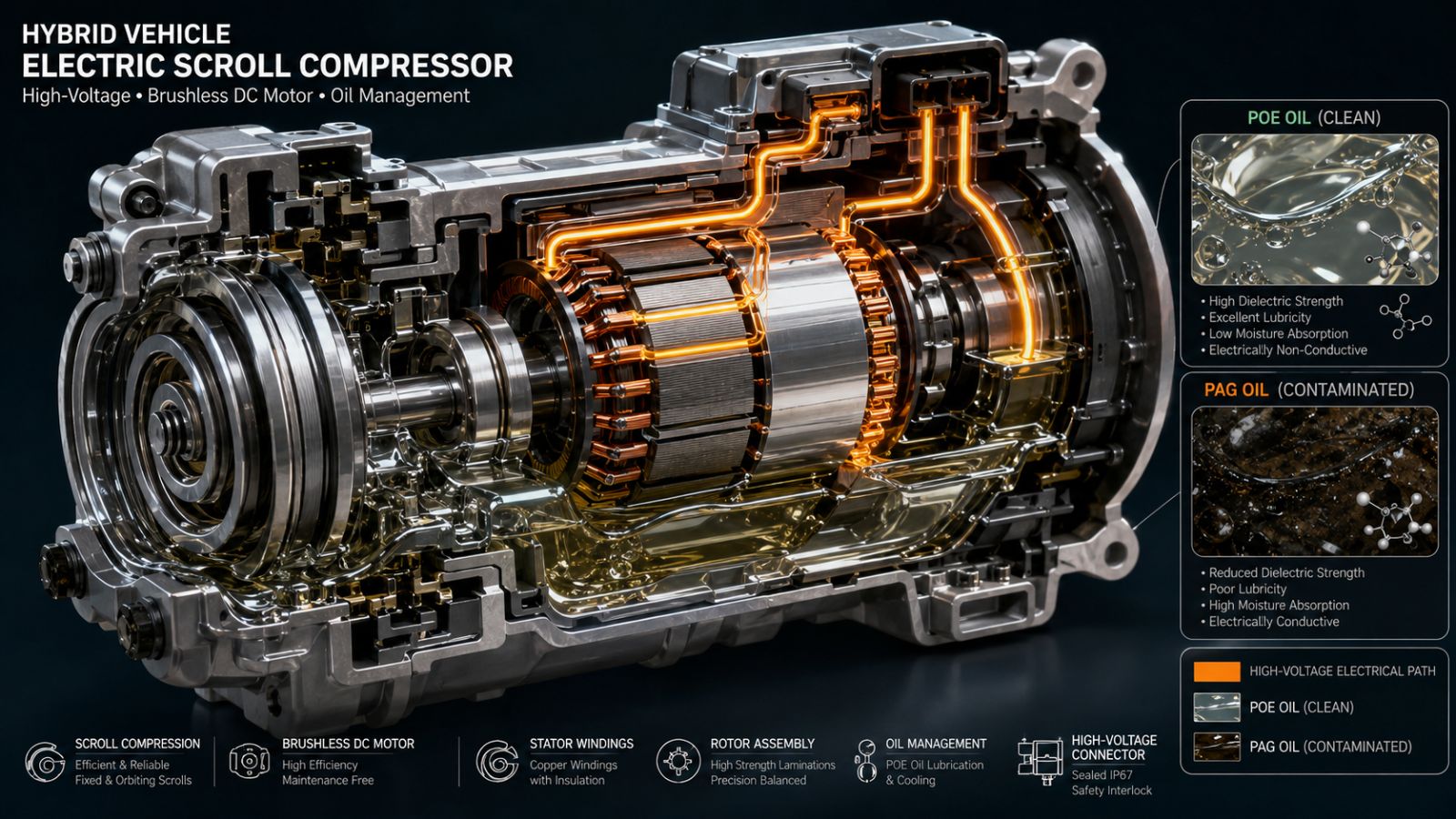
Pumping standard conventional PAG oil into a hybrid vehicle’s high-voltage electric compressor triggers catastrophic insulation breakdowns and sudden powertrain shutdowns. Gregg Smith Automotive utilizes dedicated, isolated recovery equipment and premium non-conductive Polyolester (POE) lubricants, protecting Lady Lake commuters from fatal system-wide electrical isolation shorts.
While AC failure in gasoline vehicles merely causes discomfort, it can be catastrophic for hybrids like the Toyota Prius; these systems require specialized non-conductive POE oil because using standard conductive lubricants can trigger electrical shorts that instantly disable the entire high-voltage powertrain.
The High Voltage Danger inside Your Dashboard Cooling Loop
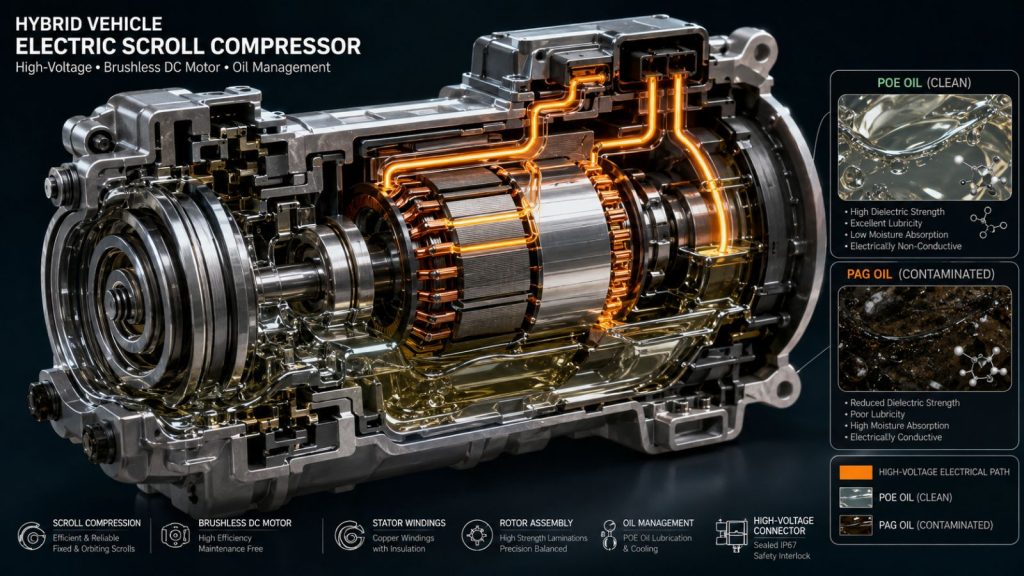
Traditional cars rely on a mechanical compressor driven by a rubber belt connected to the front of the gas engine. A hybrid vehicle handles things entirely differently. Because a hybrid engine frequently shuts off at stoplights to save fuel, the air conditioner must rely on a Hermetic Electric Compressor powered directly by the vehicle’s high-voltage hybrid battery pack.
Inside this specialized scroll compressor sits a high-amperage Brushless DC Motor running on potentials ranging anywhere from 200V to over 600V DC. The liquid refrigerant and the internal compressor lubricating oil circulate directly inside the electric motor casing, making physical contact with the active Stator Windings. This layout presents a unique engineering challenge: the fluid moving through your dashboard vents is actively touching a high-voltage electrical grid.
The Chemistry of POE vs PAG and Why Cross Contamination Is Fatal
To prevent high-voltage short circuits into the chassis, hybrid AC systems require non-conductive lubricants. This necessity drives the use of specialized Polyolester (POE) oils:
- Dielectric Insulation: Pure POE oil acts as an engineered electrical barrier protecting compressor motor windings.
- The PAG Problem: Conventional PAG oil is hygroscopic, absorbing Florida humidity and becoming highly conductive.
- Contamination Risk: Adding just one teaspoon of PAG oil (<1%) destroys the dielectric shield, creating active electrical short paths.
How an Isolation Fault Strands Drivers on the Lady Lake Commute
When an improper fluid choice introduces electrical conductivity into the refrigerant loop, voltage begins to bleed away from the compressor motor stator windings, finding a shortcut straight into the vehicle’s structural aluminum housing.
Your hybrid is constantly monitoring this boundary using a series of sensitive Isolation Sensors. To ensure occupant safety and protect the electronics, the system enforces strict resistance boundaries. The table below outlines how your vehicle responds when those boundaries are compromised by incorrect service fluids:
Compressor Lubricant Electrical & Operational Profiles
| Technical Characteristic | Pure POE Lubricant Environment | Contaminated PAG Oil Environment |
| Electrical Conductivity | Highly restrictive; zero current transfer. | Conductive; allows voltage pathing. |
| System Isolation Status | Safe; measures over 100,000 ohms per volt. | Critical fault; values drop straight to zero. |
| Powertrain Stability | Normal: Powertrain operates seamlessly. | Hard Shutdown: Powertrain is instantly locked out. |
| Compressor Stator Health | Winding insulation coatings remain intact. | Chemical breakdown; internal insulation dissolves. |
The moment your vehicle’s computer registers a current leakage that slips below the mandatory safety threshold, it registers a severe high-voltage isolation fault. This triggers an immediate, automated emergency shutdown of the hybrid powertrain system.
The vehicle instantly turns on the yellow master warning light—frequently called the hybrid “Triangle of Doom” on the dashboard. The hybrid system disconnects its safety relays, completely killing your ability to drive or restart the car until the entire high-voltage loop is entirely decontaminated.
The Dual Machine Requirement for True Non Conductive Servicing
Hybrid isolation failures often stem from un-certified service blunders at general shops, where universal AC recovery machines inadvertently pump conductive, residual PAG oil into a hybrid’s sensitive electric compressor. This cross-contamination compromises the dielectric shield of the system, potentially triggering emergency shutdowns and stranding drivers when the vehicle detects an isolation fault.
Gregg Smith Automotive eliminates these risks by enforcing rigorous high-voltage compliance protocols, including the use of dedicated, isolated recovery stations that never touch conventional vehicles. By deploying high-tech insulation resistance megohmmeters, their technicians can precisely assess compressor stator health and identify electrical leaks before they escalate into catastrophic powertrain failures.
The Master Tech Verdict on Hybrid Climate Management Dynamics
Operating a modern hybrid vehicle requires understanding that lubricating oil functions as both a mechanical fluid and a vital high-voltage safety insulator. If your system is cross-contaminated by a general shop using standard PAG oil, the chemical properties can dissolve internal stator coatings, permanently destroying an expensive electric compressor from the inside out.
Protect your vehicle’s future by relying on certified technicians who utilize specialized equipment, such as dedicated AC recovery machines and precision testing tools. Choosing experts who prioritize high-voltage safety and use correct POE lubricants ensures your hybrid system remains secure, efficient, and protected from catastrophic powertrain shutdowns.
Protect Your Hybrid Assets and Lock In Certified High-Voltage Care
Don’t let a careless fluid mix-up transform a simple air conditioning check into a catastrophic powertrain shutdown. Our high-voltage certified technicians at Gregg Smith Automotive have the isolated recovery machinery, precision megohmmeters, and certified POE lubricants required to keep your hybrid system safe and highly efficient.
Ensure your hybrid vehicle remains completely optimized and secure today.
Gregg Smith Automotive. 6202 SE Abshier Blvd, Belleview, FL 34420
Frequently Asked Questions
Why does my Prius engine keep running continuously when my AC is set to maximum cool?
Under normal operating conditions, your gas engine cycles off when stationary. However, during our extreme July summer afternoons, if your cabin temperature demand is high or if your hybrid battery pack is getting warm, the vehicle will run the gasoline engine continuously to turn the high-voltage generator, ensuring the electric compressor has a steady supply of clean power.
Can an AC isolation fault cause permanent damage to my hybrid battery pack?
No, the isolation fault itself does not damage the battery cells. The fault is an emergency safety measure designed to open the main high-voltage contactor relays, completely isolating the battery pack’s energy from the rest of the car to prevent severe electrical feedback or potential shock hazards to the car’s occupants.
What happens during an AC system decontamination flush at your shop?
If a hybrid loop has been cross-contaminated with conventional PAG oil, we connect our isolated flushing equipment to pass a series of specialized liquid cleaning solvents through every individual line, evaporator, and condenser row. This process strips away every residual drop of conductive oil before we vacuum-dry the loop and introduce fresh, pure POE oil.
Why does my electric AC compressor stay completely silent even when the climate control is turned on?
If your high-voltage electric compressor fails to engage and makes absolutely zero sound, your hybrid control module has likely already detected a low insulation resistance code or a failed internal inverter module. The computer actively locks out the power command signal to the brushless DC motor to prevent a major short circuit.
Is it safe to jump-start a hybrid vehicle if the AC system has an active isolation fault?
Jump-starting the 12-volt auxiliary battery will turn on the vehicle’s accessory screens, but it will not allow the main high-voltage hybrid system to enter the “Ready” driving mode if an isolation fault is active. The safety computers will keep the main high-voltage relays locked out until the electrical leak inside the AC compressor is resolved.