

Navigating high passenger turnover on Abshier Blvd during June’s intense humidity demands peak automotive AC efficiency. Drivers must balance recirculation settings and deep evaporator sanitation to maximize passenger cooling and eliminate lingering trip odors. Gregg Smith Automotive offers professional HVAC system remediation to maintain your five-star rating.
For rideshare operators on the Abshier Blvd and US-441 loop, the car’s AC is critical for securing tips and maintaining a five-star rating, especially given the oppressive “sauna effect” created by high passenger turnover during 95°F June afternoons in Marion County. When the AC is slow to cool or releases stale, musty odors from previous fares, customer satisfaction immediately drops; therefore, maintaining rideshare readiness requires an efficient AC system and an understanding of fluid dynamics and heat transfer.
The Recirculate Dilemma in Solving the Fluid Dynamics of Passenger Comfort
The most common operational question from local gig-economy drivers is whether to run the system on Fresh Air or Recirculate mode. Running an air conditioner on “Fresh Air” during a Florida summer places a massive, unnecessary penalty on your engine and fuel mileage.
- The Fresh Air Penalty: Fresh air mode opens external actuator doors, drawing in raw outside air holding massive relative humidity. Your evaporator core must expend its cooling energy stripping gallons of water from the air rather than lowering the temperature. High-side pressures spike, and your vent speed drops.
- The Recirculate Advantage: Recirculation mode closes the outside air doors, trapping the air already inside the vehicle and running it back through the cooling loop. Because this air is already partially cooled and dehumidified, the thermal load on your compressor drops like a stone. Your vent output stays crisp, and you save gas while idling at long stoplights.
The Master Tech Blueprint for a Fast Cabin Pull Down
If your vehicle sits empty between ride requests, do not blast the AC on maximum recirculation immediately. Trapping hot, stagnant air inside the cabin forces the system to work twice as hard. Use this specialized tech blueprint to clear the heat out of your cabin in under two minutes:
- Step 1 (The Purge): As you pull out from your parking spot, roll down all your windows completely and set your AC system to Fresh Air with the fan speed on high. This uses the natural fluid motion of the car to physically push the trapped 130°F interior air out of the cabin.
- Step 2 (The Transition): Once the interior matches the ambient outdoor temperature, roll all the windows up completely.
- Step 3 (The Seal): Hit the Recirculate button. Your system will immediately grab the cooler air and drop your center vent temperatures down to an icy zone before your next pickup point on Abshier Blvd.
Understanding Intake Efficiency Under Summer Thermal Loads
To maximize your cabin’s cooling efficiency while protecting your components from premature failure, monitor your choice of air intake. The table below contrasts how your vehicle handles the ambient environment based on your dashboard settings:
AC Performance Profile by Intake Mode
| Operating Mode | Head Pressures | Moisture Elimination | Vent Temp Output |
| Fresh Air Intake | 250+ PSI (High Strain) | Continuous heavy draining | 52°F – 58°F (Lukewarm) |
| Recirculation Mode | 160 – 190 PSI (Low Strain) | Drastically reduced moisture | 38°F – 42°F (Icy Cold) |
Trapped Odors and the Mechanics of Evaporator Bio Loading
While Florida’s heat necessitates using recirculation mode, this setting poses a hazard for rideshare vehicles by trapping occupant odors like perfume, rain, and food. These volatile organic compounds (VOCs) dissolve into the evaporator’s condensation. When the car is off, these molecules decay in the dark dashboard housing, forming a foul-smelling biological biofilm.
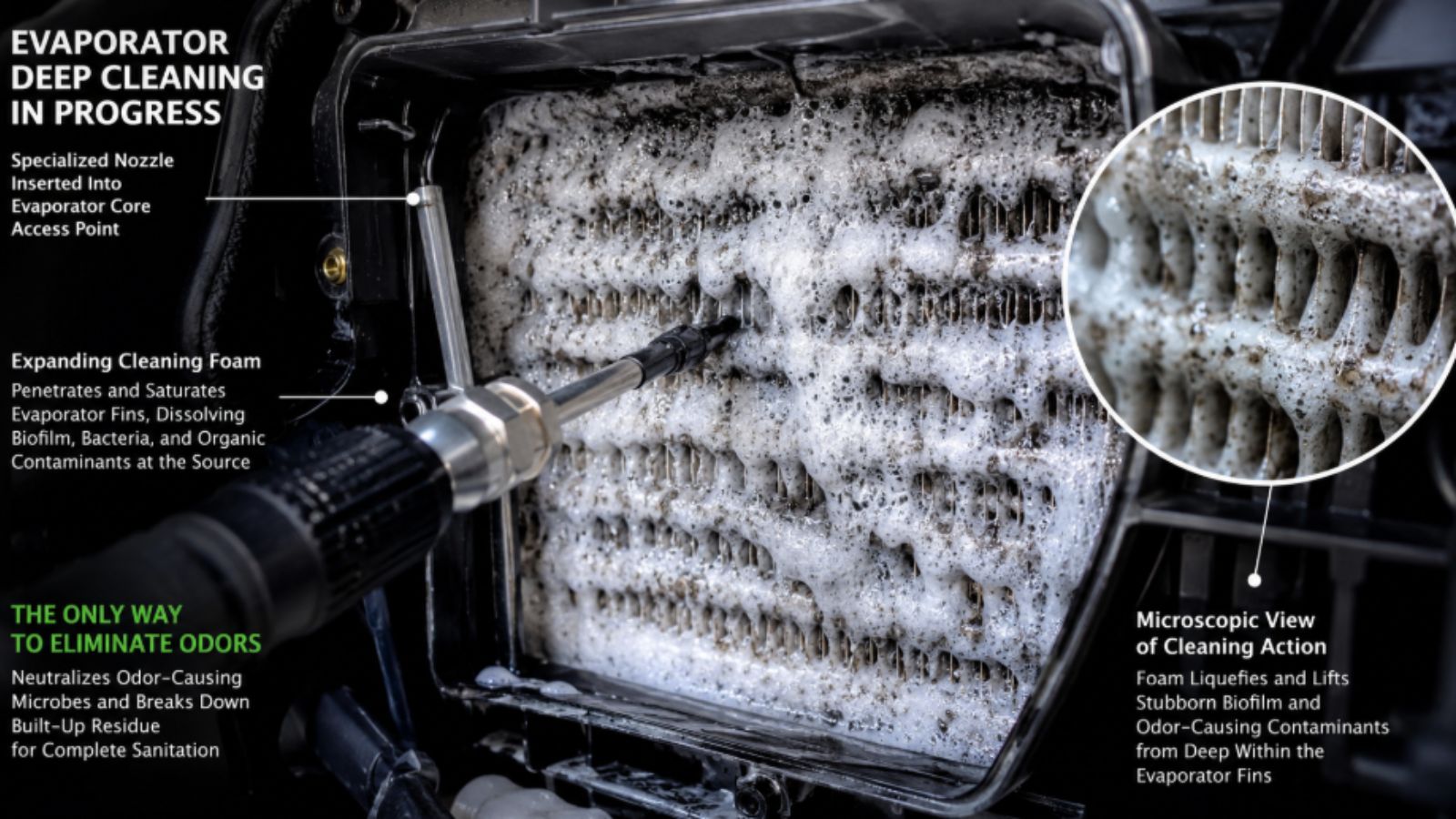
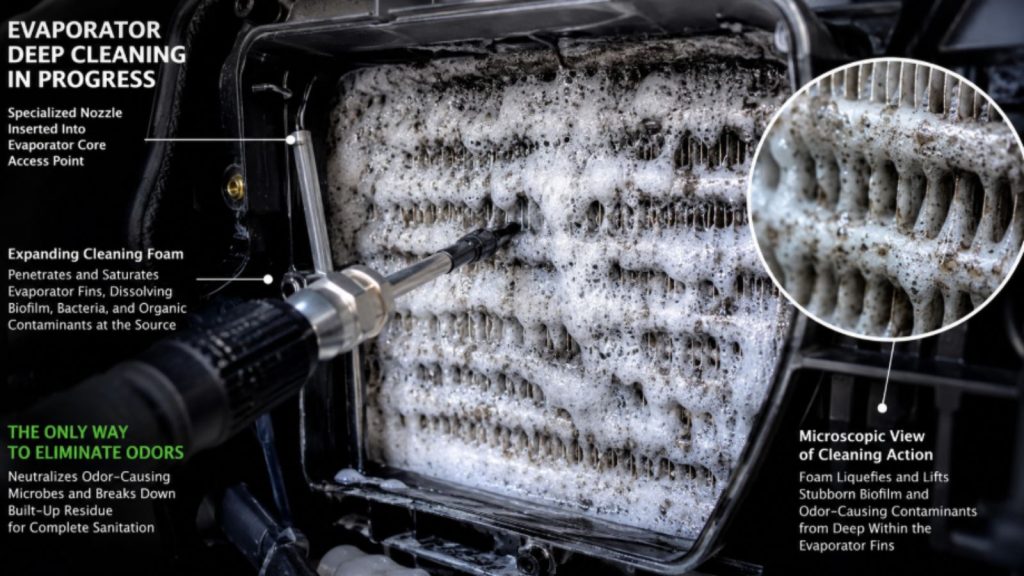
Standard aerosol sprays and air fresheners are ineffective at solving this problem because they merely mask the biological issue with synthetic perfumes, often creating an unpleasant cloying scent. Truly eliminating these odors requires a professional-grade, advanced Evaporator Foaming Disinfectant treatment. This specialized foam expands deep into the inner core geometry to break down the biofilm at a microscopic level, safely flushing the residue out through the evaporator drain tube to restore a neutral and fresh cabin environment.
The Rating Defense Plan and Keeping Your Vents Clear on Abshier Blvd
Your car depends on an Activated Charcoal Cabin Filter to maintain a fresh environment. Unlike basic paper filters that only catch large debris, charcoal filters use a porous layer to sponge up microscopic odors and pollutants before they enter the evaporator core.
In high-demand rideshare vehicles, these filters clog twice as quickly. After just a few months, they often become matted with dust, hair, and moisture. This buildup restricts airflow (CFM), making it impossible to cool passengers effectively, regardless of compressor performance.
The Forensic Verdict for a 5 Star Fleet Cabin Strategy
In the gig economy, your car is a vital business asset. Low airflow or cabin odors negatively impact tips and driver metrics, so viewing your AC as a complete system is essential for business success.
Gregg Smith Automotive provides fleet-level urgency for rideshare vehicles. We verify actuator doors, inspect charcoal filters with digital thermometers, and apply professional sanitizers to ensure your cabin remains a safe, cool refuge from the June heat.
Protect Your Fleet Ratings and Secure Your Comfort
Don’t let a weak or smelly AC system drag down your driver metrics and your income. Our specialized master technicians at Gregg Smith Automotive have the diagnostic tools, specialized foaming sanitizers, and heavy-duty charcoal filters required to keep your rideshare business operational and highly profitable.
Ensure your cabin remains an icy, five-star environment today.
Gregg Smith Automotive 6202 SE Abshier Blvd, Belleview, FL 34420
Frequently Asked Questions
Why does my AC feel weak when I am sitting idle waiting for a ride request?
When your vehicle is stationary, there is zero natural air flowing across your front condenser grille. Your system is entirely dependent on its electric cooling fans to pull heat out of the refrigerant. If your auxiliary fans are aging or if your condenser fins are blocked with highway debris, your AC efficiency drops significantly until the vehicle moves again.
How often should a full-time Uber or Lyft driver change their cabin air filter?
While a normal driver can change their filter once a year, a full-time rideshare driver should inspect and change their cabin filter every 3 to 6 months. The massive passenger volume and extended idling hours introduce far more dust, hair, and odor molecules into the system than a standard commuter car experiences.
Can I run my AC on recirculation mode all day long without any issues?
While recirculation provides the coldest air, running it continuously for hours with multiple passengers can cause the cabin air to become slightly stale. It is a smart fleet strategy to switch your system to “Fresh Air” for 60 seconds between passenger drop-offs to cycle fresh oxygen into the vehicle.
What is an evaporator foaming service and how does it clean my system?
A master tech inserts a specialized nozzle directly into your dashboard’s evaporator housing drain line, injecting a heavy, expanding chemical cleaning foam. This foam expands to completely coat the internal evaporator fins, liquefying any accumulated biological odor film, and then drains out cleanly underneath the car.
Why does my AC compressor make a loud clicking or clattering sound when it turns on?
A loud clicking or clattering sound usually indicates that your compressor’s electromagnetic clutch is slipping, or the internal pistons are struggling against a high-side system restriction. In our June heat, this can be caused by an overcharged system, a failing cooling fan, or a blocked expansion valve that requires immediate professional evaluation.