

Sustained high-speed commuting on US-27 followed by stop-and-go idling creates extreme thermal stress on AC electromagnetic clutches and condenser fins. In May’s 32°C heat, these components often fail due to friction and pressure spikes. Gregg Smith Automotive specializes in hardening AC systems to survive the Florida summer commute.
Driving US-27 in May is a game of two halves. One minute you’re cruising at 60 mph through Lady Lake with a steady stream of ram air keeping your system cool; the next, you’re dead-stopped in traffic entering Belleview. For your car’s air conditioning, that sudden transition is a mechanical heart attack. When the wind stops blowing, your system has to fight for its life against the Florida sun.
Ram Air vs Fan Power and the Physics of the US 27 Red Light
At highway speeds, the air is forced through your condenser fins by the sheer velocity of your car. This “ram air” is the most efficient way to shed heat. But the moment you hit the stop-and-go bottleneck, that free cooling vanishes. Now, your system relies entirely on the electric radiator fan to pull air through.
In 32°C heat, with road-level temperatures on the asphalt often exceeding 38°C, that fan is often overwhelmed. If your fan motor is weak or your condenser is even slightly restricted, the high-side pressure inside your AC lines will skyrocket. This is why your AC might feel like a freezer at 60 mph but turns into a humid hair dryer the second you hit a red light on Abshier Blvd.
Blue Steel Friction and the Heat Death of Your AC Clutch
The heart of your AC system is the electromagnetic clutch. It’s responsible for “grabbing” the compressor and spinning it at engine speed. In May, high head pressures $(\approx 350+ psi)$ mean it takes massive torque to engage that clutch.
If the gap between the clutch plates is too wide—even by a fraction of a millimeter—the clutch will slip instead of grabbing. This friction creates intense heat, turning the steel a tell-tale “blue” color. Once that steel reaches a certain temperature, the internal magnetic coil melts, and your AC is dead. We use Clutch Gap Feelers to catch this before the friction turns your compressor into a boat anchor.
High Side Pressure Spikes and Why Your AC Quits the Moment You Stop Moving
Your car has a built-in self-preservation mode called the High-Pressure Cut-off Switch. When you stop moving and the heat can’t escape the condenser, the pressure inside the system can spike to dangerous levels. To prevent your hoses from literally exploding, the computer cuts power to the compressor.
This is the “Stationary Sweat” every US-27 commuter knows. The air stays cool for a few seconds, then suddenly turns muggy and warm. It’s not necessarily that you’re out of refrigerant; it’s that your system is “choking” on its own heat because it can’t breathe without the ram-air of the highway.
Lovebugs and Airflow Barriers Protecting Your Condenser Fins in May
We are officially in Lovebug season, and for your AC, these bugs are more than a nuisance—they are an insulation blanket. Their remains clog the tiny “V” shaped passages in your condenser fins, which are essential for thermal transfer.
A quick trip to the car wash rarely clears the deep-seated debris. When those fins are blanketed, your AC has to work 20% to 30% harder just to maintain the same cabin temperature. This extra strain is what finally snaps a weak belt or fries a tired clutch coil during your afternoon drive home.
The Master Tech Verdict on Hardening Your AC for the Florida Commute
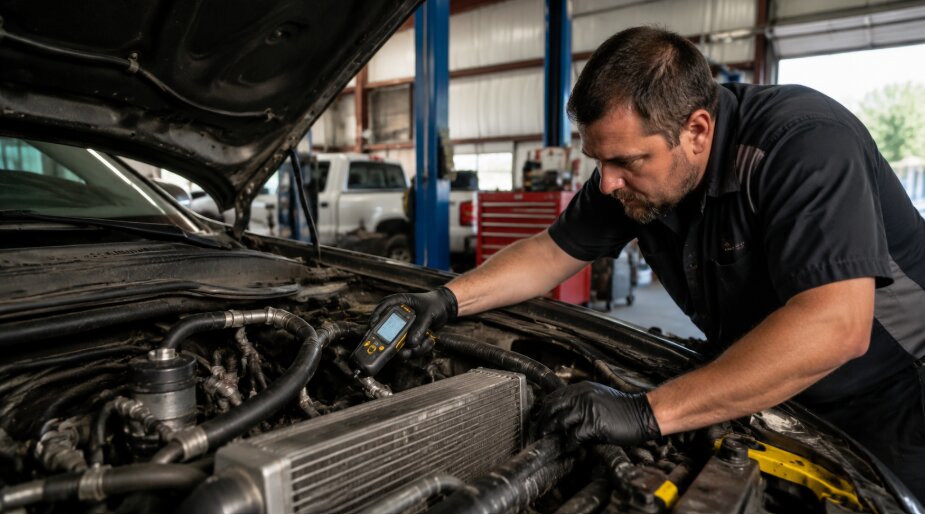
Surviving the US-27 thermal gauntlet requires more than just a recharge. It requires digital forensics. In our bay, we use Infrared Thermometers to measure the “Delta-T” (temperature difference) across your condenser. If that heat isn’t moving, your system is failing.
We check the clutch gap, we clear the bio-load from your fins, and we test your fan’s CFM output. Don’t wait until you’re stuck in the Lady Lake bottleneck with sweat rolling down your back. Let’s harden your system for the 2026 summer surge before the humidity hits its peak.
Gregg Smith Automotive 6202 SE Abshier Blvd, Belleview, FL 34420
Frequently Asked Questions
Why does my AC work fine on the highway but get warm at red lights?
This is usually caused by a lack of airflow. When you stop, the system loses ram air and relies on the cooling fan. If the fan is weak or the condenser fins are clogged with May lovebugs, the system overheats and shuts off to prevent damage.
What is an “AC Clutch” and why does it fail in May?
The clutch is the bridge between your engine and the compressor. In the high heat of May, the pressure in the system is much higher, requiring the clutch to work harder to engage. If it slips, it creates “Blue Steel” friction that destroys the part.
Can lovebugs really break my air conditioning?
Yes. They act as a physical barrier to airflow. If enough bugs (and dust) get trapped in the condenser fins, the system cannot shed heat, causing high-pressure spikes that can lead to total system failure.
What is a “High Side Pressure Spike”?
It is when the refrigerant pressure exceeds the safety limit of your system (usually above 400 psi). This happens most often in stop-and-go traffic when there isn’t enough air moving through the front of the car to cool the refrigerant.
How does the humidity on US 27 affect my AC’s physical workload?
In May, Florida’s humidity often stays above 70%, which makes the air “thicker” and harder to move. More importantly, high humidity means your evaporator core is constantly pulling gallons of water out of the air. This creates a “water curtain” on the fins that restricts airflow even further. If your cabin filter is already slightly dusty, this moisture turns that dust into a thick sludge, forcing your blower motor and compressor to work twice as hard just to keep you dry.