

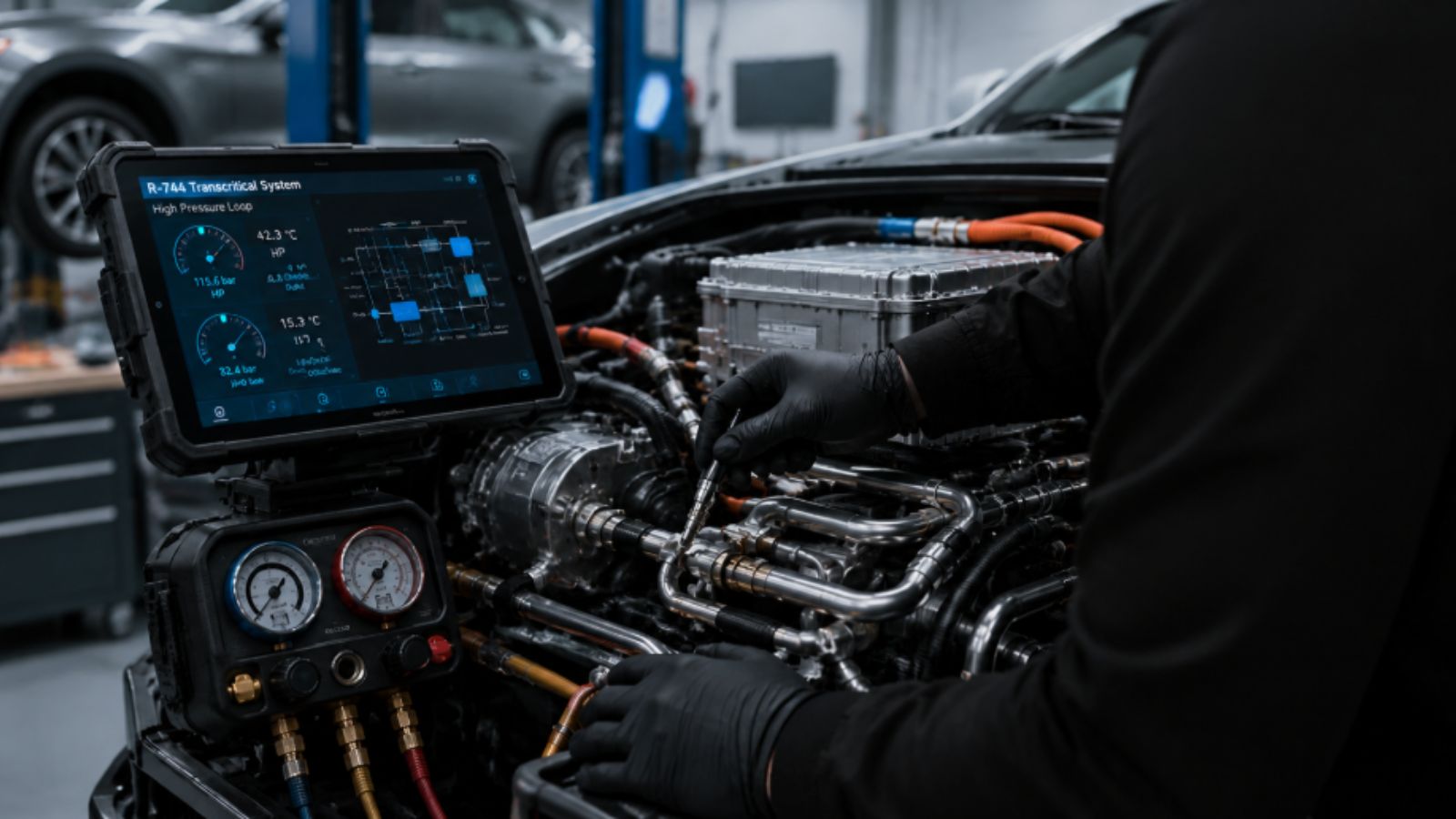
Next-generation electric vehicles are transitioning to R-744 carbon dioxide refrigerants to maximize thermodynamic efficiency and eliminate global warming footprints. Operating at pressures ten times higher than legacy systems, these advanced loops require master-level transcritical training, structural gas coolers, and highly specialized steel-braided recovery equipment during summer maintenance.
The automotive climate control industry is shifting from synthetic fluorocarbon refrigerants like R-134a and R-1234yf to natural, sustainable R-744 (carbon dioxide). While R-744 is non-toxic with a GWP of 1, its unique transcritical properties require advanced hardware capable of managing extreme operating pressures far exceeding legacy automotive cooling systems.
The Thermodynamics of R-744 and the Transcritical Cooling Phase Shift
Carbon dioxide requires a new service approach due to its low critical temperature of 31°C (87.8°F). Unlike standard R-134a, which condenses easily at 102°C (216°F), R-744 often exceeds its critical threshold in high ambient temperatures. This triggers a transcritical state where the refrigerant becomes a supercritical fluid, possessing the density of a liquid but the expansion properties of a gas.
In this state, R-744 cannot condense into a liquid on the high-pressure side, causing operational metrics to soar. While R-1234yf systems peak at 200–250 PSI, R-744 loops operate between 1,500 and 2,000 PSI (100–140 bar). This tenfold increase in mechanical loading creates an ultra-high-pressure environment necessitating absolute structural integrity.
Structural Gas Coolers Replacing the Traditional Air Conditioning Condenser
Because R-744 remains in a supercritical state, traditional condensers are replaced by Transcritical Gas Coolers. Engineered with heavy-walled aluminum to withstand 1,500+ PSI, these components focus on lowering gas temperatures rather than inducing phase changes.
System efficiency is further optimized by an Internal Heat Exchanger:
- Heat Transfer: Transfers heat between hot high-side gas and cold low-side return gas.
- Optimization: Sub-cools the transcritical gas before it reaches the Electronic Expansion Valve (EEV).
- Performance: Enables efficient expansion into the cabin evaporator, ensuring effective cooling without traditional liquid condensation.
The Specialized Ultra-High-Pressure Tooling Required for Next-Gen Electric Vehicles
R-744 systems operate at extreme pressures (1,500+ PSI), rendering standard tools unsafe. Servicing these circuits requires specialized, high-pressure infrastructure to manage transcritical states and prevent catastrophic failure.
- Steel-Braided Lines: Essential for managing 1,500+ PSI loads.
- Burst-Disc Reliefs: Automatically vent excess pressure safely.
- Supercritical Purge Cycles: Safely recover charges without ice formation.
Technical Baseline Matrix on Synthetic vs. Transcritical Refrigerants
To safely evaluate these cutting-edge networks and ensure optimal performance, our service managers meticulously evaluate active system metrics and pressure variables against established historical fluorocarbon benchmarks:
Comparative Refrigerant Thermodynamic Mapping
| Operational System Variable | Legacy R-134a Fluid Circuit | Next-Generation R-744 Loop |
| Primary Chemical Composition | Hydrofluorocarbon (1,1,1,2-Tetrafluoroethane) | Pure Natural Carbon Dioxide (CO2) |
| Global Warming Potential (GWP) | High footprint rating of 1,430 | Absolute baseline rating of 1 |
| Critical Temperature Threshold | Elevated level at 102°C (216°F) | Low physical ceiling at 31°C (87.8°F) |
| Sustained High-Side Pressure | Typical range of 150–250 PSI | Transcritical range of 1,500–2,000 PSI |
| High-Side Cooling Component | Traditional Phase-Change Condenser | Heavy-Walled Structural Gas Cooler |
Servicing Advanced Luxury Electric Platforms Locally in Marion County
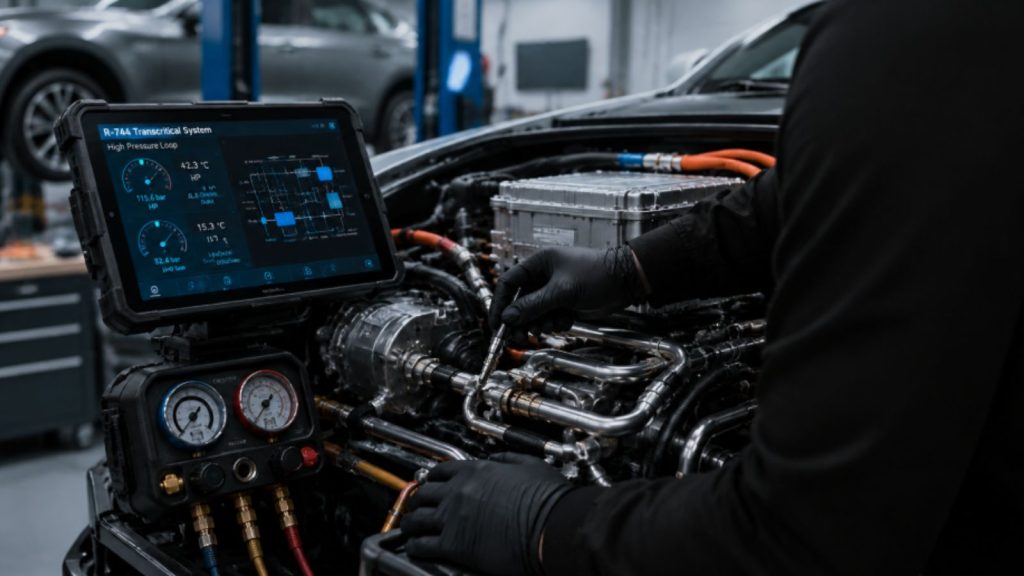
Many local electric vehicle owners mistakenly believe that next-generation luxury EV maintenance requires a trip to a distant metropolitan dealership. This misconception often stems from concerns that independent shops lack the specialized high-pressure safety equipment and technical certifications necessary to service complex transcritical cooling loops.
Gregg Smith Automotive provides these advanced capabilities locally, combining master-level transcritical training with high-voltage expertise and digital diagnostic streaming. By monitoring expansion valve cycles and heat exchanger metrics in real time, our Belleview specialists deliver dealership-level precision and factory-standard safety audits for Marion County commuters.
Trust Your Next-Gen Climate Controls to Factory-Certified Specialists
The future of automotive air conditioning has arrived, and managing it safely requires an advanced level of mechanical expertise and professional tooling. At Gregg Smith Automotive, we maintain the specialized transcritical service stations, high-strength lines, and advanced electronic scanners required to keep your luxury EV cooling flawlessly through the summer months.
Ensure your vehicle’s advanced cooling loop is operating safely and schedule your high-pressure diagnostic audit today.
Gregg Smith Automotive 6202 SE Abshier Blvd, Belleview, FL 34420
Frequently Asked Questions
Why are vehicle manufacturers moving to CO2 if it operates at such high pressures?
Manufacturers prioritize environmental compliance and energy efficiency. R-744 has a Global Warming Potential of 1, far better than synthetics. Additionally, as a heat pump, it delivers superior heating efficiency in cold weather, significantly preserving EV battery range.
Is it dangerous to have a 1,500 PSI carbon dioxide loop running through my car’s dashboard?
It is entirely safe. Manufacturers isolate the high-pressure transcritical loop within the underhood compartment. High-pressure lines terminate before the cabin, utilizing secondary low-pressure loops or indirect liquid chillers to safely cool the interior evaporator.
What happens if a stone punctures the front-mounted gas cooler during a highway commute?
Upon impact, high-side pressure sensors detect the drop and trigger an emergency compressor shutdown. The non-toxic carbon dioxide then vents safely to the atmosphere through the rupture, leaving no harmful chemical residues behind.
Can an R-744 air conditioning system be retrofitted or topped off with standard R-1234yf refrigerant?
Absolutely not. R-744 systems are incompatible with other refrigerants. Line thicknesses, compressor displacements, and expansion valves are specifically engineered for carbon dioxide. Introducing synthetic refrigerants into an R-744 loop would result in total component failure.
How do you test for a refrigerant leak in a system that uses natural carbon dioxide?
Traditional methods fail because CO2 exists in the atmosphere. Our technicians use advanced infrared optical leak detectors. These devices use specialized sensors to identify the light absorption signature of concentrated, leaking R-744 molecules, precisely pinpointing micro-leaks.