

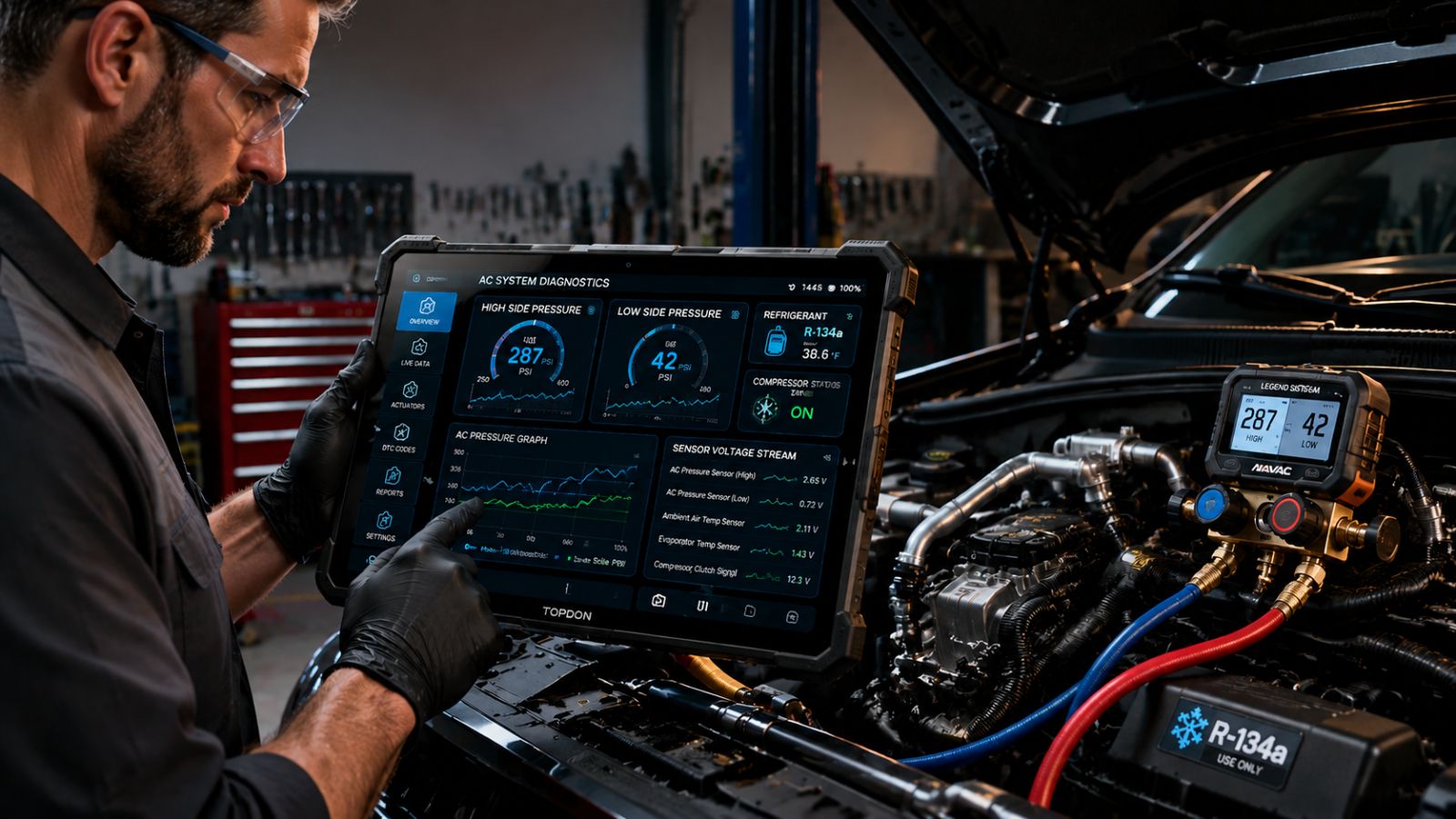
Modern automotive air conditioning systems rely on an intricate digital network of linear transducers and climate module sensors to maintain cabin equilibrium. When hidden electrical resistance anomalies mimic refrigerant loss along the US-441 route, Gregg Smith Automotive utilizes advanced bidirectional scanning infrastructure to isolate electronic faults over blind component swapping.
Modern AC systems are sophisticated digital networks, not just mechanical loops of compressors and refrigerants. Many drivers incorrectly assume warm air simply means they need a recharge. At Gregg Smith Automotive, we use advanced bidirectional scanning to identify hidden electrical faults in these climate modules, ensuring your vehicle stays cool on your daily US-441 commute between Belleview and Ocala, even when the system charge is perfect.
The Digital Nervous System Tracking Modern Automotive Climate Loops
Unlike older mechanical switches, modern cars manage climate control via a central module and sensors streaming data over CAN-bus or LIN-bus networks. If data shifts outside factory parameters, the computer shuts down the system to protect components, turning cooling issues into complex electronic puzzles.
- Legacy vs. Digital: Simple on/off safety switches have been replaced by continuous multiplexed network communication.
- Network Integration: Computers constantly share data on speed, engine load, and cabin solar gains to manage climate decisions.
- Automated Safeguards: Any out-of-spec sensor reading forces the computer to instantly turn off the cooling loop.
Diagnosing “Ghost Leaks” via Voltage and Transducer Data
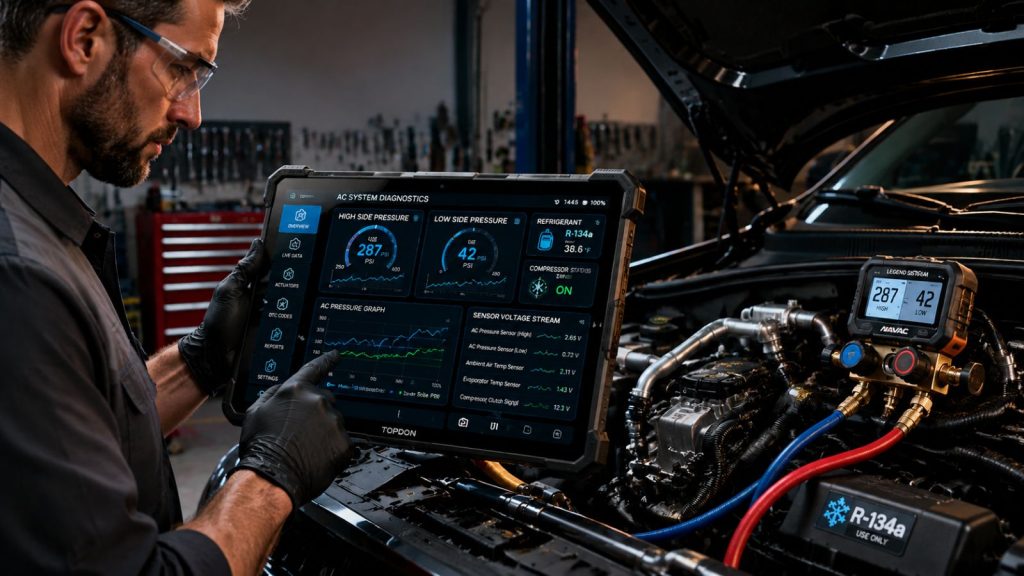
A “ghost leak” mimics refrigerant loss while the system remains completely full. To isolate these phantom electrical failures, our technicians skip the manual wrenches and reach for an advanced OEM-level bidirectional scan tool:
- Pressure Monitoring: We use live PID streams to track the three-wire linear pressure transducer, which converts line pressure into a continuous 0.5–4.5 volt signal.
- Signal Drift Tracking: We monitor precise voltage drop; internal defects can cause false drops that trick the computer into cutting compressor power.
- Command Verification: Bidirectional controls bypass automated software to manually activate fans or compressors, verifying physical wiring integrity.
Analyzing Operational Failures with Mechanical vs. Electronic Diagnostics
When an air conditioner fails on a hot day, a technician must quickly determine whether they are dealing with a traditional mechanical failure or a breakdown within the electronic sensing network.
Climate Control System Failure Characteristic Profiles
| Diagnostic Evaluation Marker | Physical Mechanical Failures | Electronic Sensor & Module Faults |
| Refrigerant Volume Status | Physical loss through a structural leak point. | 100% full; verified by physical recovery weight. |
| Manifold Pressure Signals | Pressures equalize; the compressor fails to pump. | Perfect manual readings; electronic PID reads zero. |
| Diagnostic Tool Protocol | Requires electronic halogen leak sniffers. | Requires bidirectional scanners and scopes. |
| Root Failure Catalyst | Damaged line seals or punctured condenser rows. | Blown transducer circuits or failed thermistors. |
How Local Marion County Thermal Stress Triggers Electronic Glitches
July’s extreme afternoon heat index subjects your vehicle’s electrical infrastructure to severe thermal stress. When parked under direct sunlight, interior dashboard temperatures easily pass 140°F, breaking down protective wiring insulation. As copper wires heat up, their internal electrical resistance naturally increases. If a connection point is slightly worn or corroded, this heat-induced resistance spike causes signal voltages to fluctuate wildly. This explains why your AC blows icy cold in the morning but suddenly transforms the cabin into a humid sauna twenty minutes into your drive once underhood temperatures peak.
Isolating Intermittent Sensor Dropouts Along the US-441 Commute
High-mileage commuters face continuous harmonic road vibration along the US-441 corridor, which causes sub-surface wiring pins to stretch and loosen within their plastic connector housings. During a long drive, these loose pins can intermittently lose contact for a fraction of a second. If your ambient temperature sensor or in-dash evaporator core thermistor drops its signal for a single heartbeat, the computer logs a fault and disables the system. To catch these lightning-fast sensor dropouts, we connect a Digital Storage Oscilloscope (DSO) to view live signal voltage as a continuous wave. Any internal sensor glitch triggers a sharp drop to zero volts on our screens, pinpointing the failure point without a blind dashboard teardown.
The Master Tech Diagnostic Verdict over Trial and Error Parts Swapping
The costliest error when facing an electronic climate glitch is using over-the-counter DIY refrigerant. Adding gas to a full system creates dangerous internal pressures.
In modern Variable-Displacement Compressors, overloading can damage the swash plate or the Variable-Displacement Solenoid. Furthermore, if a Blend Door Actuator Potentiometer is faulty, extra refrigerant will not restore cooling.
Modern repair requires digital troubleshooting rather than guesswork. Gregg Smith Automotive identifies root electronic failures first, ensuring your commuter vehicle is repaired accurately and safely on the first visit.
Secure Your Journey with Digital Diagnostic Precision
Don’t spend time and money guessing on complex, electrical climate control issues. Our certified master technicians at Gregg Smith Automotive possess the factory-level bidirectional scanners, digital oscilloscopes, and precise diagnostic infrastructure needed to locate and repair your vehicle’s sensor bugs accurately.
Restore total cooling accuracy and book your real-time computer analysis today.
Gregg Smith Automotive l 6202 SE Abshier Blvd, Belleview, FL 34420
Frequently Asked Questions
Why does my car’s AC blow freezing cold for a few miles and then suddenly turn completely warm?
This symptom usually points to a failing evaporator core thermistor or a slipping compressor clutch circuit. If the thermistor sends an inaccurate temperature reading to the climate module, the computer will cut power to the compressor, assuming the system is about to freeze up into a block of ice. Once the compressor shuts down, your vents will immediately begin blowing warm, humid cabin air.
What is the purpose of an electronic blend door actuator potentiometer?
The blend door actuator is a small electric motor that physically swings a plastic door inside your dash to mix hot engine coolant air with cold air conditioner air. The internal potentiometer acts as a digital position tracker, sending a continuous feedback voltage to the computer so the climate module knows exactly how far open or closed the door is at any given moment.
Can an ambient air temperature sensor cause my air conditioning to stop working entirely?
Yes. Your climate control computer looks at the ambient air temperature sensor to determine if outdoor conditions actually require cooling. If the sensor fails internally and begins falsely reporting that the outside temperature is -10°F, the computer will automatically disable the compressor circuit to prevent system damage, ignoring your manual dashboard commands completely.
What does it mean when a shop says they need to clear an active HVAC module code?
Modern automotive climate control modules store independent diagnostic trouble codes (DTCs), just like your engine computer does. If a sensor suffers a temporary circuit short or voltage dropout, the module logs the fault and may lock out the compressor clutch as a built-in safety safeguard. Clearing the code resets the module’s operating parameters once the physical wiring repair is complete.
Why can’t you diagnose an electronic AC sensor problem using standard mechanical pressure gauges?
Mechanical pressure gauges can only measure the physical behavior of the refrigerant gas inside the lines. They cannot see the electronic signal voltage passing through your wiring harnesses, read multiplexed CAN-bus communication logs, or track sensor position values. Diagnosing a digital control issue requires digital testing instruments like bidirectional scanners and oscilloscopes.