

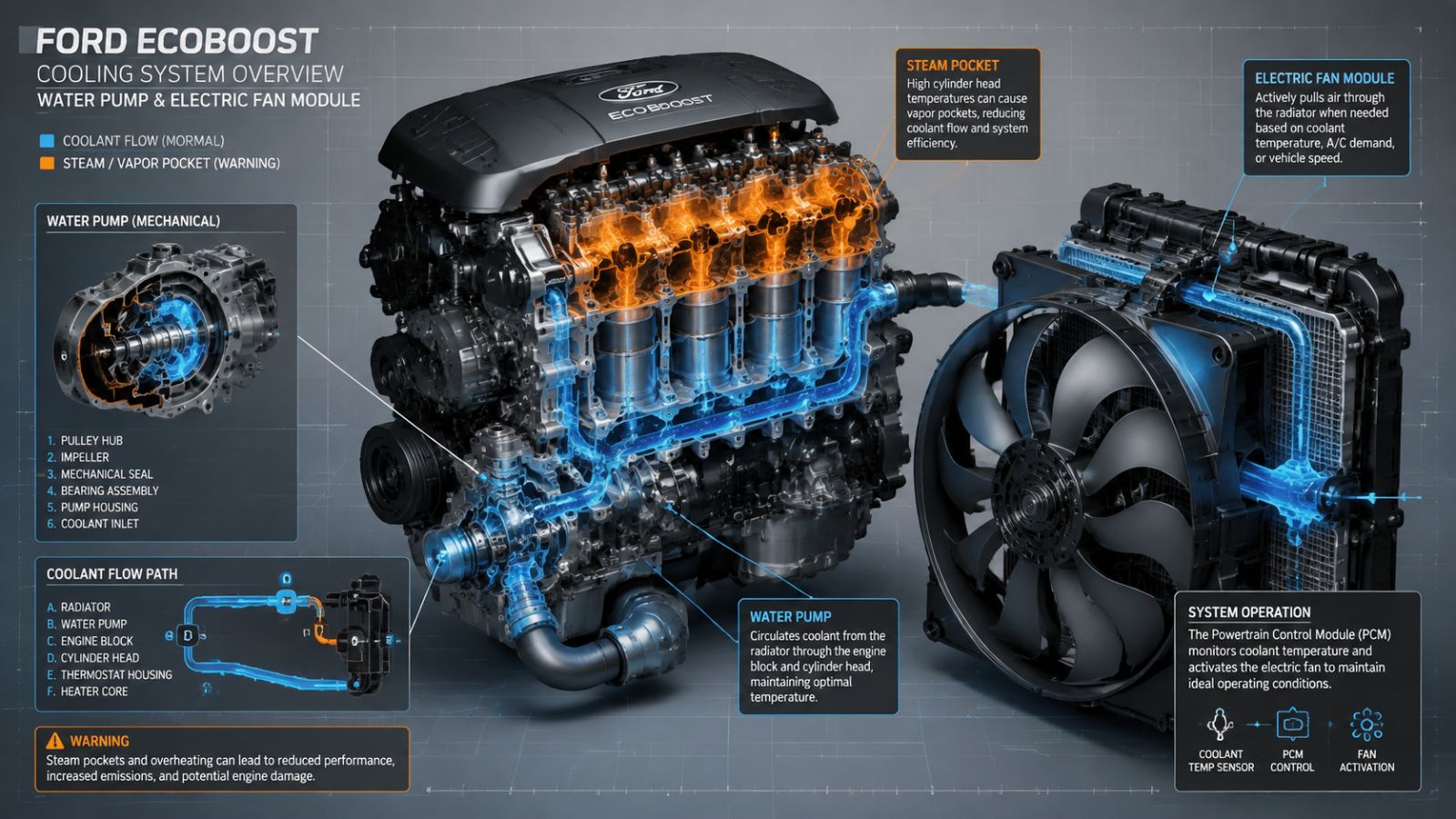
Extreme temperatures on US-27 trap heat under the hood. Ford EcoBoost engines suffer quickly if the water pump or cooling fan stops working. Central Florida traffic combined with humidity causes rapid coolant temperature spikes that warp aluminum cylinder heads. Master scope testing pinpoints thermostat sticking, fan module failure, and combustion gas leaks before catastrophic damage occurs.
US-27 Stop-and-Go Traffic and Cooling Pressure Spikes
Heavy traffic bottlenecks along US-27 and CR-484 force 3.5L EcoBoost and 5.0L Coyote engines to rely entirely on mechanical airflow when vehicle speed drops below 15 mph. Sustained 95-degree ambient temperatures cause cooling system pressure to surge past 16 PSI as coolant temperatures climb toward 230 degrees Fahrenheit. Without high-speed radiator fan engagement, the cooling system loses heat rejection capacity, triggering dashboard temperature gauge spikes and emergency engine guardian modes.
Overheating Diagnostic Baseline
| Failure Parameter | Technical Spec |
| Primary Symptom | Gauge spiking into red zone, steam from reservoir cap, AC cutting out at idle |
| Target Component | Dual Electric Radiator Fan Module / Plastic Impeller Water Pump |
| Specialized Tooling | PicoScope 4425A Pressure Transducer, Combustion Leak Block Tester, Ford IDS |
| Local Stressor | 98°F heat index, asphalt radiant temperatures above 140°F, idling on Abshier Blvd |
| High-Risk Profile | 2013–2022 Ford Explorer 3.5L & F-150 2.7L/3.5L EcoBoost towing or commuting |
Thermal Degradation Mechanics
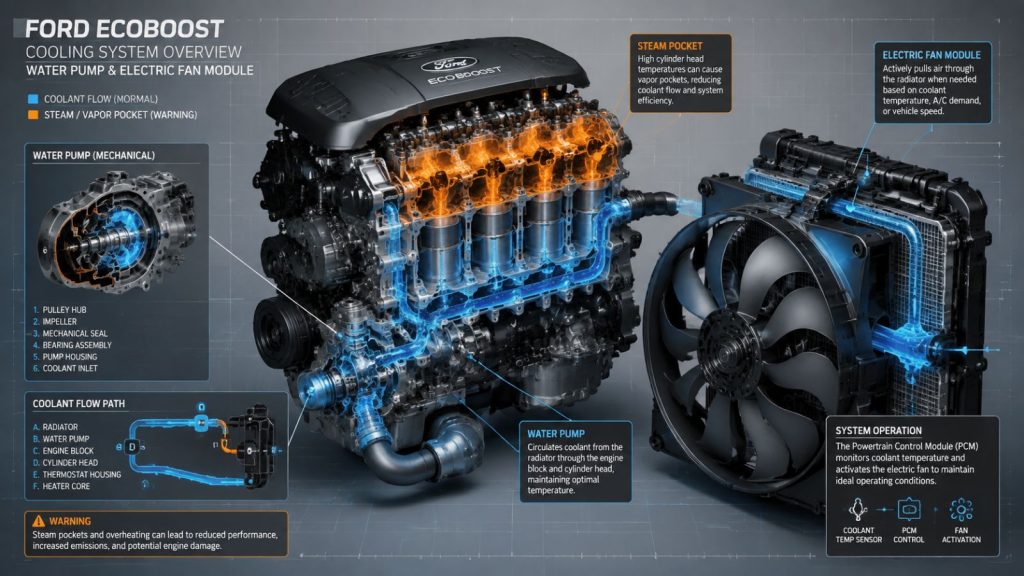
Ford cooling systems maintain operating temperatures between 195 and 215 degrees Fahrenheit using a pressurized 50/50 organic acid technology coolant mixture. Under normal highway driving, ram air pushes through the condenser and radiator core to transfer engine heat into the atmosphere. Internal pump impellers circulate fluid continuously across the cylinder head passages to prevent localized boiling.
Extended idling on Belleview streets stops front-grille airflow, transferring the entire cooling load onto the dual electric fan assembly. High ambient heat combined with A/C head pressures driving past 350 PSI accelerates heat transfer into the radiator fins. Electric fan control modules mounted directly to the fan shroud heat-soak, causing internal pulse-width modulation circuit failures that freeze fan blade rotation.
When airflow drops during high thermal loads, internal cooling performance breaks down rapidly:
- Nucleate Boiling Phase: Coolant static pressure falls below vapor point near combustion chambers, forming localized micro-bubbles along cylinder head water jackets.
- Plastic Impeller Cavitation: High fluid temperatures degrade composite water pump impellers, leading to blade erosion, slipping drive shafts, and complete loss of fluid flow.
- Thermal Cylinder Warpage: Trapped steam pockets prevent heat transfer, causing localized head temps to breach 260 degrees Fahrenheit, which warps aluminum deck surfaces and crushes head gasket fire rings.
Advanced Thermal Isolation and Engine Diagnostics Protocols
Guessing at thermal failures by throwing thermostats or radiators at a hot engine wastes money while leaving structural engine damage unchecked. Our auto engine diagnostics isolate mechanical fluid circulation, electrical airflow commands, and combustion breach points using live pressure analysis.
- PCM Temperature Data Snapshot: Connect Ford IDS to monitor Cylinder Head Temperature sensor voltage outputs alongside engine coolant temperature readings. We verify whether the PCM records genuine fluid overheating or an electrical sensor ground offset.
- Cooling System Dynamic Pressure Test: Install a PicoScope pressure transducer directly onto the degas bottle cap port. Live waveforms showing rapid pressure pulses exceeding 21 PSI during engine reviving indicate combustion gas leakage past the head gasket.
- Pulse-Width Modulation Waveform Testing: Back-probe the cooling fan control module harness with a lab scope while commanding fan speeds from 10% to 100% via IDS. Irregular duty-cycle waveforms confirm control module heat-soak failure rather than a blown fuse or bad motor.
- Infrared Radiance Core Inspection: Scan the radiator core using a thermal imaging camera while the engine idles at operating temperature. Cold spots exceeding 15 degrees Fahrenheit across horizontal tubes reveal internal corrosion scale blockages that restrict coolant volume.
Shop Note: Replacing a thermostat on an EcoBoost motor without pressure-testing the degas tank cap leads to secondary thermal spikes, because weak cap spring relief valves drop system boiling points by 30 degrees.
Precision Repair Action Plan
Driving a Ford while the temperature gauge fluctuates past the midpoint forces the engine computer into power-reduction modes, pulling ignition timing and shutting down fuel cylinders to limit heat buildup. Continued operation under severe overheating distorts aluminum cylinder heads, scores cylinder walls, and leads to multi-thousand-dollar engine replacement bills. Our auto repair services isolate whether your vehicle suffers from electrical fan failure, restricted radiator core flow, or head gasket pressure breaches before any wrench touches a bolt.
Dealership auto repair shop bays in Marion County stay backlogged for weeks while generic shops throw parts at thermal issues without proper diagnostic tools. Visit Gregg Smith Automotive at 6202 SE Abshier Blvd, Belleview, FL 34420 for targeted cooling system diagnostics and precision repairs.
Frequently Asked Questions
Can Florida summer heat cause a Ford engine to overheat without a broken part?
Yes. Extreme ambient heat and asphalt surface temperatures exceeding 140 degrees Fahrenheit can overwhelm cooling systems with minor radiator fin debris or aged coolant. Extended idling along Belleview corridors forces coolant temperatures past boiling thresholds without immediate mechanical component failure.
Will turning on the cabin heater stop a Ford engine from overheating?
Yes. Engaging full cabin heat acts as a secondary heater core radiator, drawing thermal energy directly away from the cylinder heads. This auxiliary heat extraction temporarily lowers internal coolant pressure, allowing drivers to safely pull off busy roadways before severe damage occurs.
Does a stuck Ford thermostat cause sudden pressure loss in the degas bottle?
No. A stuck-closed thermostat blocks fluid circulation through the radiator, forcing internal engine temperatures and system pressure to surge rapidly. Excess pressure eventually forces the expansion cap spring relief valve open, venting steam to prevent catastrophic radiator hose ruptures.
Can a bad water pump cause a Ford EcoBoost to overheat only at idle?
Yes. Eroded composite water pump impellers or slipping drive shafts move sufficient coolant at high engine RPMs but lose circulation capacity completely at idle. Reduced fluid velocity allows localized boiling inside cylinder head water jackets during stop-and-go Belleview commuting.
Is it safe to drive a Ford home if the temperature light flickers intermittently?
No. Intermittent temperature warnings indicate severe localized boiling or heat-soaked cooling fan module failures. Operating an overheating Ford EcoBoost under active thermal stress can warp aluminum deck surfaces and crush cylinder head gasket fire rings within minutes.