

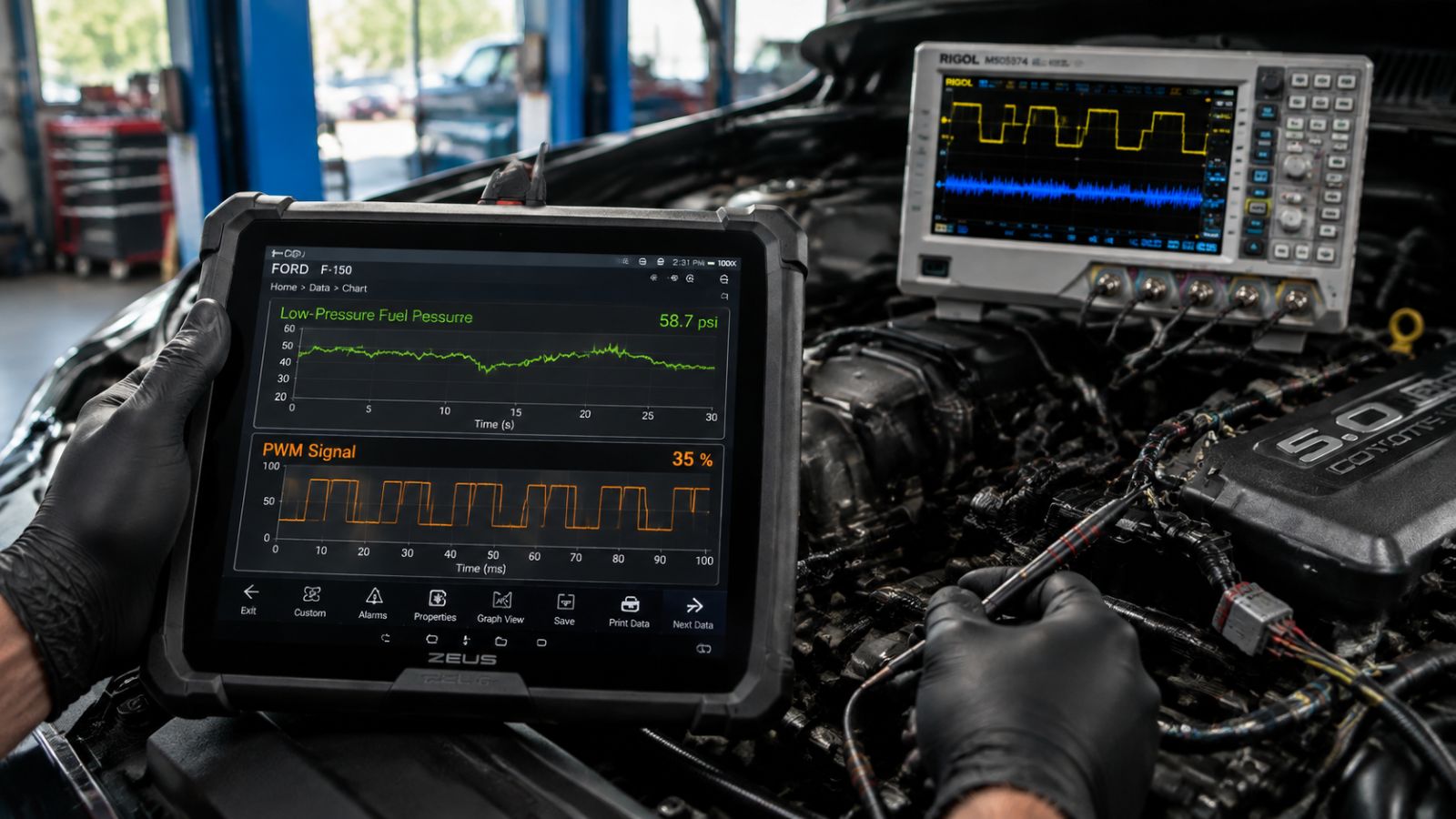
Humid Florida summers subject Ford EcoBoost vehicles to thermal throttling in the fuel pump driver module, causing low pressure, vapor lock, and stalling. Pavement heat and stop-and-go driving trigger in-tank fuel cavitation and HPFP volume starvation before trouble codes appear, leading to engine hesitation, surging, and sudden stalling.
Central Florida Heat and Ford Fuel System Thermal Throttling
When your Ford sits in SE Abshier Blvd traffic, under-hood heat spikes to 160 degrees. These temperatures melt down the fuel delivery system and the frame-mounted driver modules. When summer ambient temperatures pass 95°F with relative humidity topping 85%, gasoline inside the low-pressure supply line reaches its boiling threshold, causing localized vapor lock before the fuel reaches the mechanical HPFP. The Powertrain Control Module (PCM) monitors low-side pressure via the Fuel Rail Pressure (FRP) sensor and commands increased pulse-width modulation (PWM) to the FPDM. Heat-soaked electronics inside the driver module respond by resistance-throttling output voltage, dropping low-side fuel pressure below 45 PSI and starving the high-pressure cam-driven pump during heavy acceleration onto SR 44. Learn more about our auto repair services to keep your fuel system running smoothly.
Ford Fuel System Thermal Failure Technical Matrix
| Diagnostic Metric | Technical Benchmark |
| Primary Symptom | Lean engine misfire under load, severe stuttering above 2,500 RPM, long crank times when hot, sudden engine stalling at traffic lights. |
| Target Component | Low-Pressure Fuel Pump (LPFP) in-tank assembly, Fuel Pump Driver Module (FPDM), direct-injection High-Pressure Fuel Pump (HPFP) cam follower. |
| Specialized Tooling | Ford IDS / FORScan PID data logger, inline mechanical fuel pressure gauge with bleed valve, oscilloscope for PWM signal analysis. |
| Local Stressor | Extreme asphalt heat radiation combined with prolonged idling along SE Abshier Blvd and CR 484 traffic corridors. |
| High-Risk Profile | 2013–2024 Ford F-150 2.7L/3.5L EcoBoost, Explorer 2.3L, and Super Duty 6.2L/7.3L gas trucks driven under heavy payload or towing conditions. |
The Physical Mechanics of Thermal Fuel System Degradation
Normal Direct-Injection Dual-Stage Fuel Delivery Under standard operating conditions, the electronic LPFP delivers 55 to 75 PSI of liquid fuel through the underbody lines to the engine bay.
- High-Pressure Mechanical Compression: The camshaft-driven HPFP compresses incoming liquid fuel up to 2,150 to 3,000 PSI, forcing it through stainless steel fuel rails directly into the combustion chambers.
- Closed-Loop PWM Voltage Regulation: The PCM continuously adjusts the FPDM duty cycle between 10 and 50 percent to maintain target low-side pressure without overheating the pump motor.
Thermal Cavitation and Fuel Vapor Lock Dynamics High ambient pavement heat lowers the boiling point of ethanol-blended summer gasoline inside the underbody fuel lines.
- In-Line Vaporization: Liquid gasoline transitions into gaseous vapor bubbles inside the low-pressure supply line, creating compressible air pockets that the mechanical HPFP cannot compress.
- HPFP Volumetric Cavitation: The mechanical HPFP internal piston cycles against gaseous vapor rather than dense liquid fuel, causing sudden high-side pressure collapse from 2,150 PSI down to 200 PSI during heavy engine load.
FPDM Thermal Resistance and Internal Circuit Breakdown Exposed module mounting locations along the frame rail or rear crossmember subject the FPDM to continuous radiant heat-soaking.
- Semiconductor Resistance Spike: Internal power transistors inside the FPDM build high electrical resistance as temperature spikes, dropping voltage supply to the fuel pump from 12.8V down to less than 9.5V.
- Fuel Starvation Loop: Reduced voltage lowers pump RPM, decreasing fuel volume flow through the lines, which speeds up fuel line heat-soaking and induces complete engine shutoff.
Master Tech Warning: Do not replace a Ford high-pressure fuel pump (HPFP) simply because you pulled a P0087 low rail pressure code. Over 60 percent of EcoBoost low-pressure codes originate from a heat-throttled low-pressure fuel pump driver module (FPDM) or an inline low-side pressure sensor failing under thermal stress.
Advanced Diagnostic Protocols for Ford Fuel Performance Losses
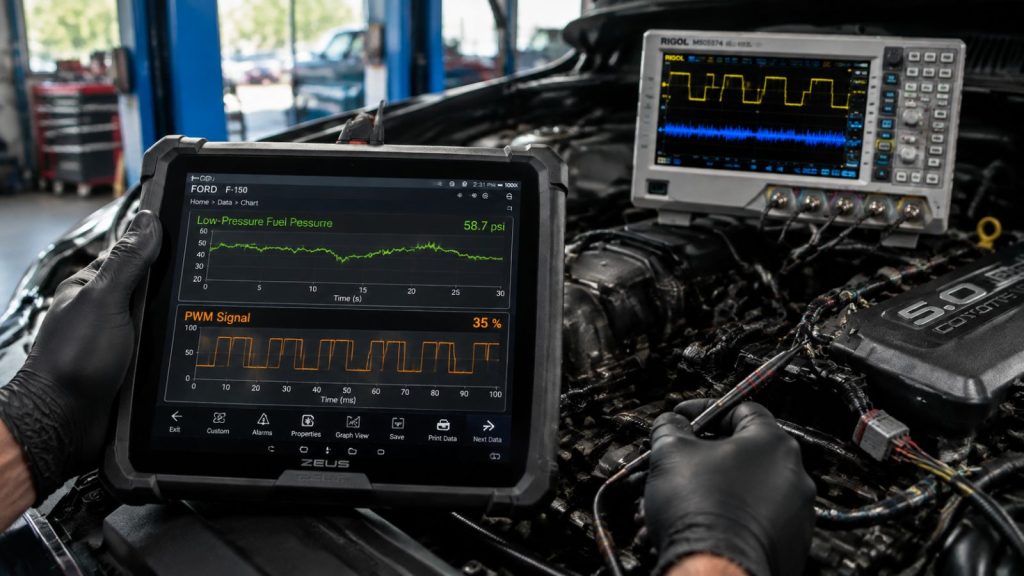
Accurately diagnosing Ford fuel delivery failures requires evaluating electronic control signals under real-world thermal stress. Static pressure tests performed in a cool shop bay miss heat-induced electronic resistance and in-line fuel vaporization. Our technicians utilize high-speed digital PID logging and scope-based signal analysis to isolate fuel delivery restrictions before replacing expensive direct-injection components with our comprehensive auto engine diagnostics.
Gregg Smith Automotive Diagnostic Verdict: Last month in our Belleview shop, we evaluated a 2017 Ford F-150 3.5L EcoBoost that repeatedly lost power and sputtered when accelerating onto CR 484 after idling in 98°F heat. A standard scan tool showed zero permanent DTCs, but our FORScan live log revealed low-side fuel pressure dropping from 68 PSI down to 22 PSI within 5 minutes of hot idling, causing high-side pressure to crash from 2,150 PSI to 340 PSI. Oscilloscope testing at the FPDM harness showed the module cutting output voltage to 8.2V due to thermal overheating; replacing the heat-stressed FPDM with an updated heat-sink isolated unit restored steady 65 PSI low-side delivery and eliminated all acceleration hesitation. Check out our current specials for savings on essential repairs, read more about us, or explore flexible financing options for your service.
- Live FORScan Low-Side and High-Side Pressure Logging: Connect FORScan software to monitor Low-Pressure Fuel Pressure (FLPS) alongside High-Pressure Fuel Rail Pressure (FRP) during a hot road test. Low-side pressure dropping below 45 PSI under load confirms supply-side starvation before diagnosing the mechanical HPFP.
- Fuel Pump Driver Module Oscilloscope Voltage Drop Test: Probe the PWM input signal from the PCM and the high-current power output legs at the FPDM connector using a two-channel digital storage oscilloscope. A voltage drop exceeding 1.0 volt between module input supply and output leads under high duty cycle pinpoints internal thermal transistor failure inside the driver module.
- Mechanical Pressure Gauge Verification and Fuel Aeration Check: Tee a mechanical fuel pressure gauge equipped with a clear sight glass inline at the low-pressure supply line fitting in the engine bay. Run the engine until thermal heat-soaking occurs; visual air bubble streams passing through the sight glass confirm fuel line vapor lock and in-tank pump cavitation.
Stop Engine Catastrophe at Gregg Smith Automotive
Ignoring heat-induced fuel starvation causes severe lean combustion conditions, spiking cylinder temperatures and leading to burned exhaust valves or melted piston crowns. Running a starved direct-injection system strips internal fuel lubrication from the mechanical HPFP, galling internal pistons and pushing metal debris through the high-pressure fuel rails. Be sure to check your auto air conditioning, schedule a wheel alignment service, or get a routine oil change service to keep your vehicle in top condition. We service a wide range of supported vehicles. Schedule a comprehensive fuel delivery system evaluation with Gregg Smith Automotive located at 6202 SE Abshier Blvd, Belleview, FL 34420.
Frequently Asked Questions
Why does my Ford truck lose power and hesitate only in hot weather?
High summer heat causes ethanol-blended fuel to vaporize inside underbody fuel lines, while heat-soaking increases resistance inside the Fuel Pump Driver Module. This drops low-side fuel pressure, starving the high-pressure fuel pump and causing lean engine misfires during acceleration.
Can a bad Fuel Pump Driver Module cause a Ford engine to stall without throwing a code?
Yes, a heat-stressed FPDM often experiences internal voltage drops without completely breaking the circuit. The engine stalls due to sudden fuel starvation, but because the PCM still detects electrical continuity, no diagnostic trouble codes trigger on the dashboard.
What are the symptoms of a failing Ford High-Pressure Fuel Pump?
A failing HPFP causes long engine cranking times, severe power loss under acceleration, engine sputtering above 3,000 RPM, and diagnostic trouble code P0087. Mechanical internal wear or cam follower damage prevents the pump from building 2,000+ PSI rail pressure.
Does running on a low gas tank make Ford fuel system heat problems worse?
Yes, liquid fuel in the tank acts as a coolant for the in-tank low-pressure fuel pump. Running below a quarter tank allows the pump motor to heat-soak rapidly, accelerating internal wear and increasing fuel vapor lock risks on hot Florida days.
How do technicians test Ford EcoBoost fuel pressure?
Technicians connect diagnostic software to log real-time data from low-pressure and high-pressure rail sensors under load. They perform voltage drop tests across the Fuel Pump Driver Module and verify mechanical low-side pressure using inline gauges to isolate electrical failures from mechanical pump wear.