

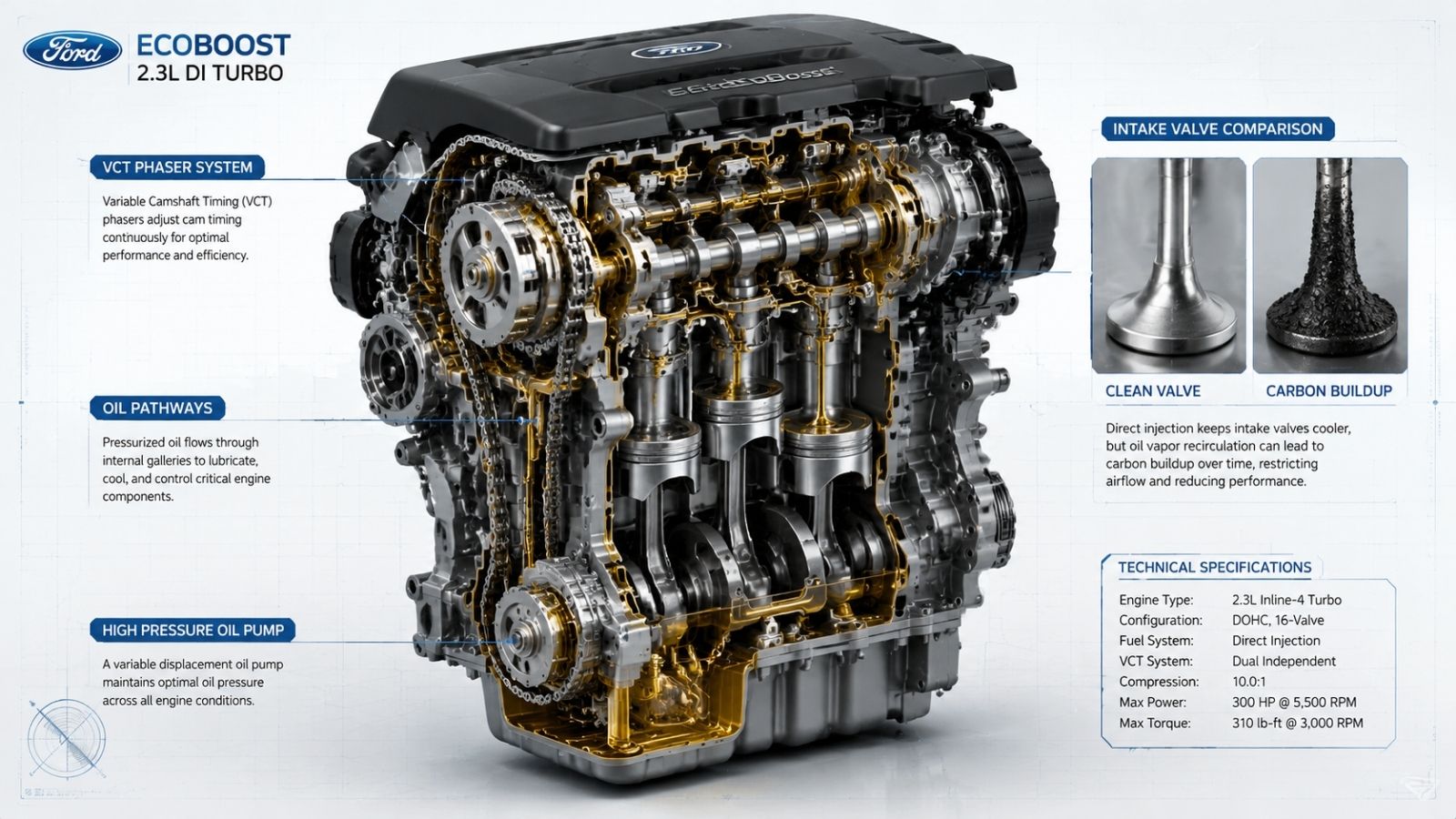
Ford engine maintenance in Belleview, Florida, demands specialized fluid analysis, intake valve carbon removal, and cooling system stress-testing. Driving US-441 in the summer heat leads to thin, fuel-soaked oil. Stay ahead of the 4,000 mile limit to prevent this sludge from grinding down your turbo bearings and ruining the VCT phaser timing.
Your Ford EcoBoost struggles with the slow crawl on SE Abshier Blvd. These conditions soak the engine in heat while fuel ruins the oil and carbon chokes the valves. Don’t let your car idle during a scorching Marion County afternoon. The heat thins the oil and breaks your phasers, forcing expensive repairs much sooner than expected.
Technical Engine Maintenance Reference
| Quick Failure Snapshot | Technical Detail |
| Primary Symptom | Cold-start rattles, loss of low-end torque, erratic idle, elevated engine operating temperatures |
| Target Component | Variable Camshaft Timing (VCT) phasers, intake valves, turbo oil feed lines, engine oil |
| Specialized Tooling | PicoScope 4-channel oscilloscope, digital refractometer, BG intake induction tool, FDRS scan tool |
| Local/Environmental Stressor | 95°F ambient heat-soaking, prolonged idling on SE Abshier Blvd, high humidity, road dust |
| High-Risk Profile | 2.7L/3.5L EcoBoost F-150s, 2.0L Escape/Edge commuters, vehicles towing trailers on US-441 |
Belleview commuters subject their Ford engines to extreme thermal stress every summer. Extended idle periods at red lights prevent adequate airflow across the radiator, causing engine bay heat-soaking that bakes synthetic engine oil right inside the turbocharger oil supply lines.
How Commuter Driving Mechanics Accelerate Engine Wear
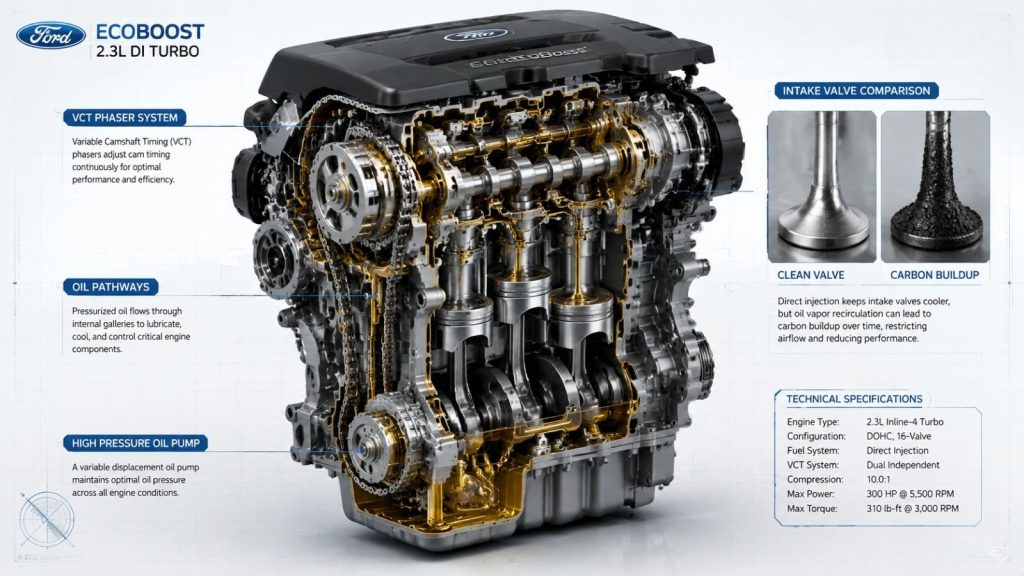
Direct-injection Ford EcoBoost engines inject fuel at up to 2,900 PSI straight into the combustion chamber. During short commuter trips down US-441, cold cylinder walls cause atomized gasoline to condense into liquid form, washing past the piston rings and diluting the engine oil in the crankcase.
Diluted engine oil loses its critical film strength. As oil viscosity drops below specification, hydraulic oil pressure inside the VCT phasers drops below the 25 PSI minimum threshold required to advance or retard camshaft timing smoothly.
The internal locking pins inside the phasers begin to gall against their aluminum housings. Every morning cold start produces a metallic rattling sound as the unpressurized phaser vanes slap violently against the housing stops.
Intake valve carbon accumulation creates a parallel physical failure point:
- Fuel never sprays over the back of the intake valves on direct-injection engines.
- Oil vapors from the positive crankcase ventilation (PCV) system bake onto hot 400°F intake valve stems.
- Hardened carbon deposits restrict intake airflow ports, disturbing cylinder swirl patterns and causing low-speed pre-ignition (LSPI).
The physical reaction escalates quickly. LSPI creates massive cylinder pressure spikes that fracture piston ring lands, score cylinder bores, and destroy spark plug ceramic insulators.
Proactive Diagnostic Workflow For Commuter Ford Engines
Waiting for a dashboard wrench icon means metal-on-metal wear has already occurred inside the engine timing system. We catch oil shear, timing chain stretch, and carbon buildup using advanced digital diagnostics before internal hard parts fail.
1.Analyze Engine Oil Fuel Dilution:Digital refractometer & lab analysis.
We extract a crankcase oil sample to measure fuel contamination percentage, flash point drop, and kinematic viscosity degradation caused by heavy Belleview idle times.
2.Measure Cam-to-Crank Phase Alignment:PicoScope oscilloscope tracking.
Our technicians tap into the camshaft and crankshaft position sensors to map live waveform signals, measuring exact degrees of timing chain slack against Ford OEM limits.
3.Inspect Intake Valve Carbon Deposits:High-definition borescope inspection.
We route an articulated camera probe down the intake runners to photograph carbon buildup height on intake valve stems and check for oil pooling inside the intercooler piping.
4.Review VCT Solenoid Duty Cycles:FDRS diagnostic evaluation.
We stream live PCM data to verify VCT solenoid response times, oil pressure adaptation tables, and misfire counts under simulated acceleration loads.
Shop Floor Insight: A standard dipstick check shows oil level, but it hides fuel dilution. If your oil smells like gas or the level appears to be rising, fuel is thinning your oil and destroying your VCT phasers.
Protecting Your Ford Engine with Gregg Smith Automotive
Delaying repairs for intake carbon buildup, fuel-contaminated oil, or cold-start rattles can result in severe engine damage and costly timing chain overhauls. As an independent shop, we deliver comprehensive intake cleaning and detailed fluid testing without the scheduling bottlenecks common at major dealership service centers.
Safeguard your vehicle and maximize engine durability. Book your routine Ford engine service with Gregg Smith Automotive today. Stop by our location at 6202 SE Abshier Blvd, Belleview, FL 34420, or give us a call.
Frequently Asked Questions
Should Belleview commuters change Ford oil before 5,000 miles?
Yes. Frequent short trips and extended idling along SE Abshier Blvd dilute engine oil with raw fuel, requiring oil changes every 3,000 to 4,000 miles to protect turbochargers and VCT phasers.
Does direct injection cause carbon buildup on Ford engines?
Yes. Direct-injection engines spray fuel straight into the combustion chamber, so gasoline never washes over the back of the intake valves. Oil vapors from the PCV system bake onto valve stems, requiring chemical induction cleaning every 30,000 miles.
What causes the Ford EcoBoost cold-start rattle?
The cold-start rattle is caused by worn VCT phasers locking pins galling inside their housings due to low oil pressure or fuel-diluted oil. If left uncorrected, the timing chain stretches and ruins engine timing.
Can severe heat in Florida damage Ford turbochargers?
Yes. Shutting off a hot engine after heavy driving causes oil trapped inside the turbocharger supply lines to bake and turn into carbon coke, starving the turbo bearings of lubrication during the next startup.
How do technicians test for timing chain stretch on a Ford engine?
Technicians connect a multi-channel oscilloscope to the camshaft and crankshaft position sensors. Comparing the live voltage waveforms against factory spec reveals timing chain stretch down to a fraction of a degree.