

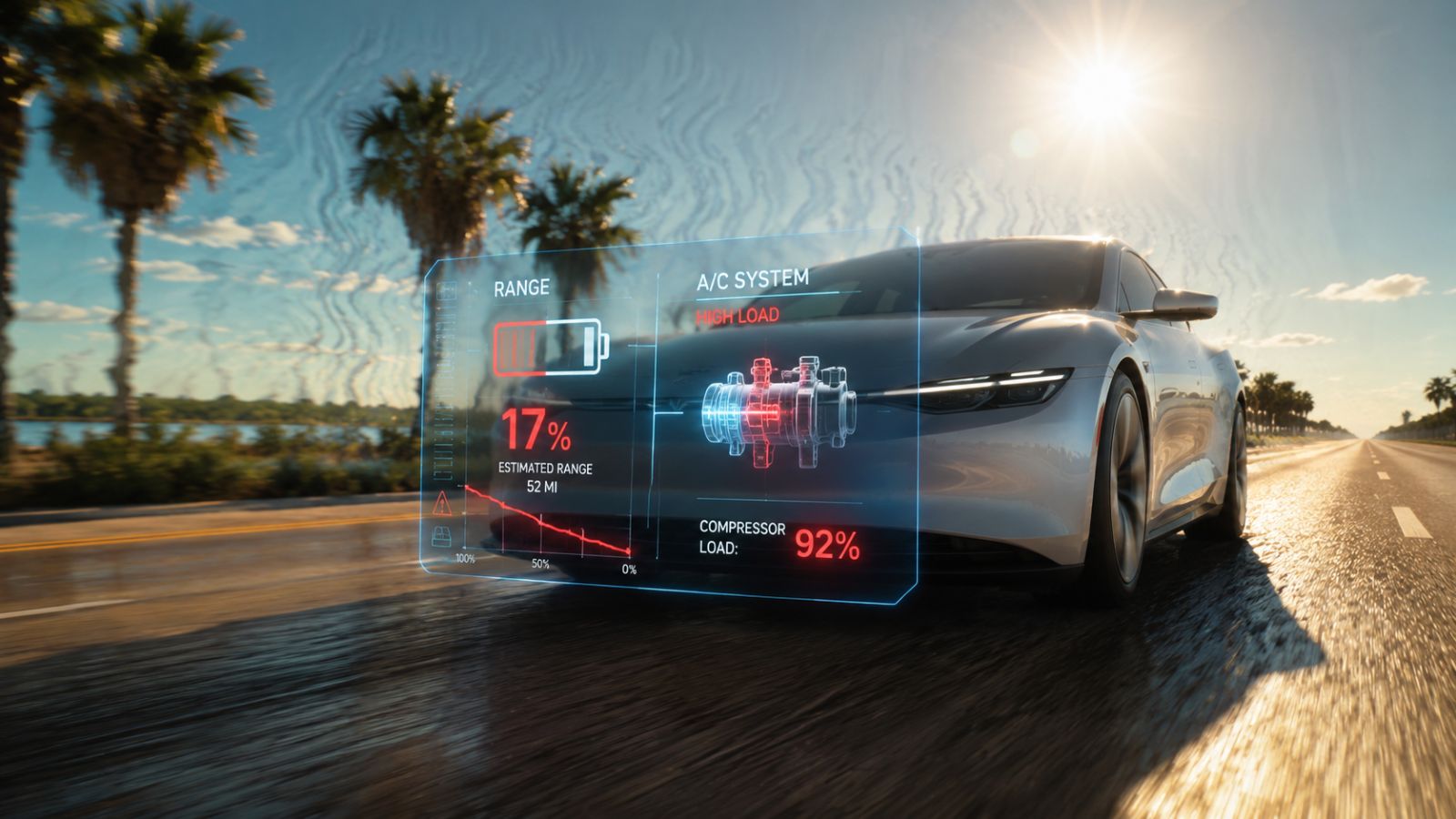
July’s intense thermal loads force electric vehicle air conditioning loops to prioritize high-voltage battery cooling over passenger comfort. When unoptimized thermal components struggle, parasitic compressor draws cut driving range significantly. Gregg Smith Automotive utilizes advanced diagnostic data logging to optimize chiller loops, reclaiming critical mileage for Silver Springs Shores commuters.
In traditional gas cars, a weak AC just means a warm drive. For EV owners in Silver Springs Shores, however, your air conditioning loop is a high-stakes energy asset that directly impacts your driving range. During a brutal July afternoon in Marion County, maxing out your cabin cooling can trigger a massive drop on your range meter. This happens because your car is fighting a complex thermodynamic battle between passenger comfort and high-voltage battery survival.
The Dual Load Challenge Shielding Your Battery and Your Cabin Alike
The biggest misconception is that your cabin AC runs independently from the rest of the car. In reality, modern EVs use an integrated, dual-load climate system where your dashboard vents and your traction battery pack share the exact same refrigeration source.
Lithium-ion cells are highly sensitive to extreme heat. To prevent rapid degradation, the vehicle’s computer must keep the battery pack within a strict window of 68°F to 95°F. When summer pavement temperatures spike, battery preservation legally takes priority over human comfort. If your cooling loop is unoptimized or low on fluid, the software will actively shunt refrigerant away from your dashboard vents to keep the battery cells from cooking, leaving you with lukewarm cabin airflow.
The Mechanics of the Battery Chiller and the Parasitic Range Penalty
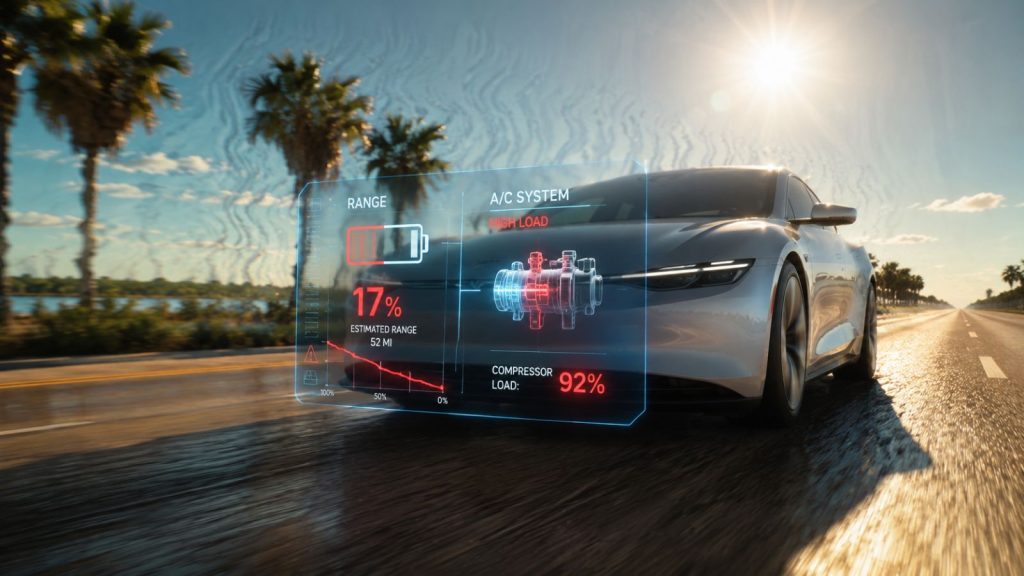
To cool the battery, your EV uses a specialized component called a Battery Chiller. This is a compact, liquid-to-refrigerant heat exchanger where the icy air conditioning fluid passes directly alongside the closed-loop liquid coolant that circulates through the main battery pack.
- The High Amperage Cost: Your AC loop is driven by a heavy-duty, high-voltage electric compressor. When the system is operating cleanly, the compressor pulls a predictable, efficient electrical load from the traction battery.
- The Friction Penalty: If your system is low on refrigerant, or if internal debris creates a restriction, the compressor must spin at maximum velocity, drawing an excessive 5 kW to 7 kW of continuous power just to maintain safe battery thresholds.
- The Extracted Mileage: This heavy electrical consumption acts as a direct parasitic drain on your state of charge (SoC). Instead of using that energy to turn your wheels and extend your commute, your car is burning valuable kilowatts simply trying to keep its internal components from cooking.
Understanding Thermal Efficiency Profiles Under Summer Loads
When your EV’s cooling loops are operating at peak efficiency, the electric compressor can step down its power consumption rapidly once baseline temperatures are achieved. If there is a calibration fault, the system gets stuck in a high-draw state.
The table below contrasts how an electric vehicle manages its energy distribution based on the mechanical health of its underlying thermal loop:
EV Thermal Architecture Performance Comparison
| System Evaluation Marker | Optimized EV Thermal Loop | Restricted EV Thermal Loop |
| Compressor Amperage Draw | Low to moderate 1.5 – 3.0 kW | Continuous peak 5.0 – 7.0 kW |
| Battery Chiller State | Balanced, rapid heat transfer | Choked; forced fluid shunting |
| Cabin Vent Temp Output | Crisp 38°F – 42°F delivery | Warm, sluggish 55°F+ output |
| Predicted Range Impact | Nominal 5% – 10% summer variance | Severe 20% – 30% immediate range drop |
Range Drops on the Silver Springs Shores Commute
Sitting in stop-and-go traffic on a blistering July afternoon forces your EV to combat intense radiant pavement heat. Without the natural airflow of highway speeds, your vehicle must lean heavily on its cooling fans and liquid coolant loops to reject heat. If your system is unoptimized, your range meter will drop faster than your actual driven mileage. The onboard computer flags the massive current draw needed to keep the battery chiller alive and cuts your predicted range. Clearing restrictions and ensuring precise fluid weights instantly lowers this parasitic drag to reclaim your mileage.
Professional Optimization vs Dealership Part Swapping
Dealerships routinely rely on an expensive approach of swapping out major assemblies instead of performing targeted component diagnostics. Our specialized EV bay provides a precise, data-driven alternative. We connect high-voltage OBD-II data loggers to monitor live cell temperatures across individual battery modules in real time. Rather than replacing entire housings, we verify the digital pulse-width modulation signals sent to your electronic expansion valves. Isolating a sticking valve or clearing a faulty coolant isolation valve restores factory thermal balance at a fraction of dealership costs.
The Master Tech Verdict on Modern Electric Car Thermal Stability
An EV’s AC loop is vital for powertrain longevity. Neglecting poor cabin cooling or compressor noise stresses the battery pack. Inefficient thermal management triggers safety protocols that throttle DC fast-charging speeds to protect cells, increasing wait times. Protect your investment with expert care. Our high-voltage technicians use specialized diagnostics to inspect cooling loops, ensuring optimal comfort and peak driving range.
Protect Your Range and Optimize Your Thermal Efficiency
Don’t let a sluggish thermal loop reduce your battery life and sap your driving range. Our advanced technicians at Gregg Smith Automotive possess the high-voltage data loggers, electronic valve diagnostic tools, and specialized equipment needed to keep your electric car running at peak factory performance.
Secure your summer range and lock in your specialized EV checkup today.
Visit the EV Service Bay: 6202 SE Abshier Blvd, Belleview, FL 34420. Gregg Smith Automotive
Frequently Asked Questions
Why does my EV charge much slower at a DC fast charger on a hot summer afternoon?
DC fast charging creates significant heat in lithium-ion cells. During high ambient temperatures, the thermal management system runs the AC compressor at full capacity for chilled-liquid battery cooling. If the system is low on fluid or struggling, the vehicle will throttle charging speeds to maintain safe cell temperatures.
What is an electronic expansion valve (EXV) and how does it differ from a standard valve?
Standard cars use slow mechanical expansion valves, but EVs employ advanced Electronic Expansion Valves (EXVs) driven by stepper motors. Managed by a central thermal computer, these valves adjust precisely to balance refrigerant flow between the battery chiller and cabin evaporator.
Can an internal leak inside the battery chiller contaminate our vehicle’s battery cells?
No. The battery chiller keeps the high-voltage liquid coolant and the chemical refrigerant completely isolated in separate internal aluminum channels. While an internal structural failure can cause the fluids to mix inside the closed loop—requiring a full system flush—the fluid never makes direct physical contact with the interior of the sealed lithium-ion battery cells.
Why does my electric AC compressor make a loud, distinct whining noise when it turns on?
While a mild hum is normal for high-voltage scroll compressors, loud whining or grinding suggests the unit is overworked or under-lubricated. In July, this often stems from system restrictions or low refrigerant, forcing the compressor to its 6,000+ RPM limit to meet battery cooling needs.
Will a failing cabin air filter have any negative impact on our vehicle’s high-voltage battery cooling?
No. While a clogged filter restricts airflow and makes the cabin uncomfortably warm, it does not affect the battery chiller’s liquid-to-refrigerant loop. However, the thermal computer will still run the high-voltage compressor harder to meet cooling demands against that restricted airflow.