

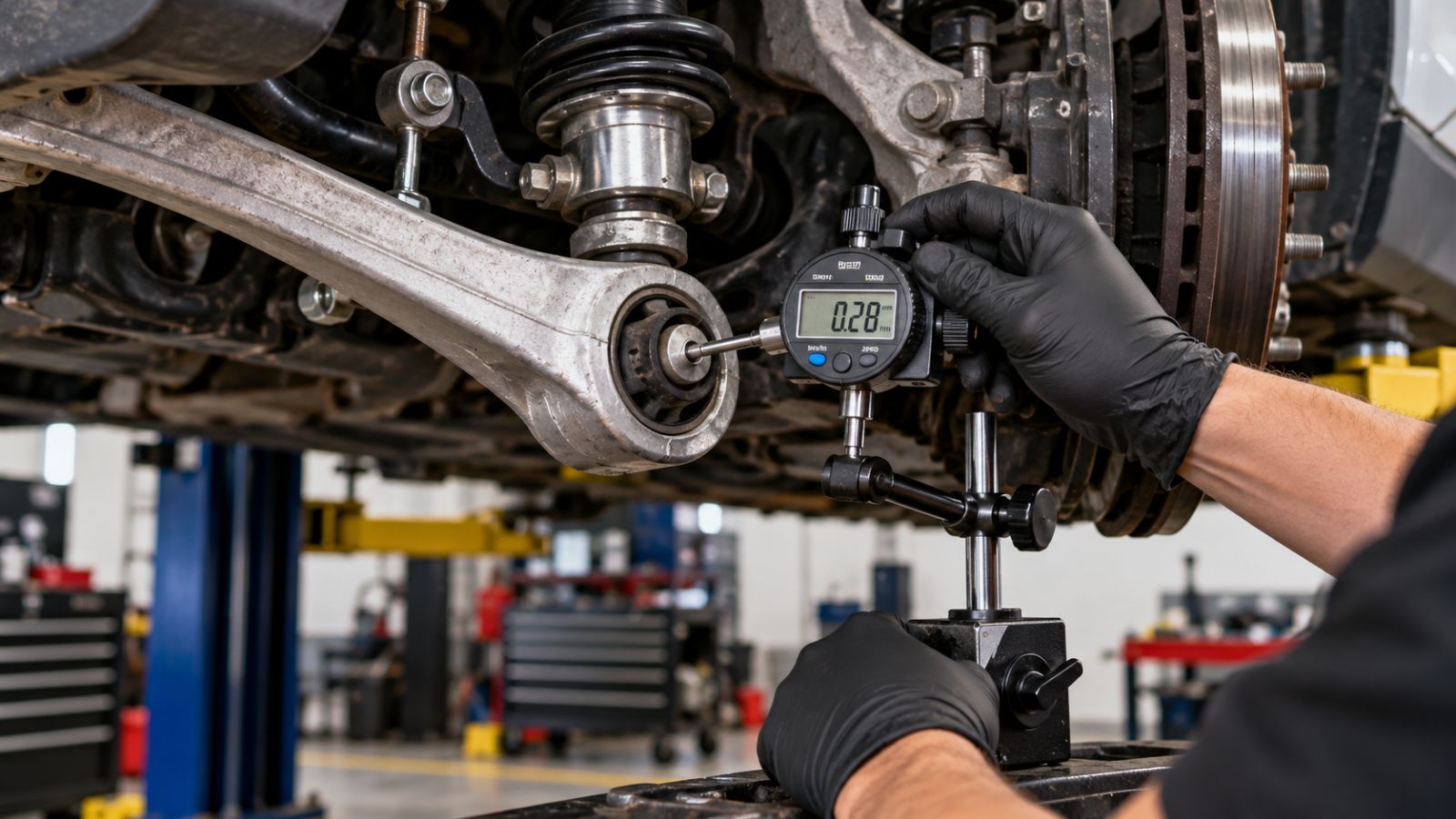
Submerging Ford trucks in Belleview floodwaters pulls abrasive silt past hydrabushing dust seals. Vacuum pressure drops force rainwater into control arm assemblies along County Road 484, causing rubber delamination, joint scoring, and steering instability. Gregg Smith Automotive performs precision dial-indicator and PicoScope NVH diagnostics to catch wear early.
Lower control arm bushings on Ford F-150s and Super Dutys delaminate after submerged passes through high-water spots along County Road 484 and SE 110th Street. Standing rainwater washes factory grease from the knurled ball joint studs, driving silt directly into the elastomer seals during sudden summer downpours in Belleview.
Rapid Shop Specifications & Diagnostic Inspection Metrics
| Failure Indicator | Inspection Standard |
| Primary Symptom | Metal-on-metal clunk during low-speed braking, steering wander on uneven asphalt |
| Target Component | Lower Control Arm Hydrabushings & Sealed Outer Ball Joints |
| Specialized Tooling | PicoScope 4425A 4-Channel Oscilloscope with NVH Accelerometer, Electronic Dial Indicator |
| Local Stressor | Silt-laden runoff pools along low-lying Belleview intersections during storm season |
| High-Risk Profile | Ford trucks routinely traversing flooded rural routes or hauling heavy loads over wet washboard clay |
Mechanical Forces Driving Component Breakdown
Factory elastomer hydrabushings maintain alignment angle by dampening longitudinal shock forces. Submerging hot suspension components creates a vacuum pressure differential as air pockets rapidly cool inside the housing. This pressure drop draws standing floodwater across outer dust seals, carrying fine silica sand past the primary lip.
Silt particles score internal mirror-finished ball joint cups, accelerating mechanical friction during suspension cycling. Fluid leaks from hydraulic bushing chambers, leading to dry metal-to-metal contact under heavy torque loads. Exposed steel sleeves form galvanic corrosion bonds with aluminum control arm housings, forcing rubber isolated rings to shear loose from metal sleeves under load.
Shop Warning: Dry steering on pavement with delaminated control arm bushings bends tierod ends by transferring unchecked lateral forces straight to the rack.
Precision Diagnostic Protocol
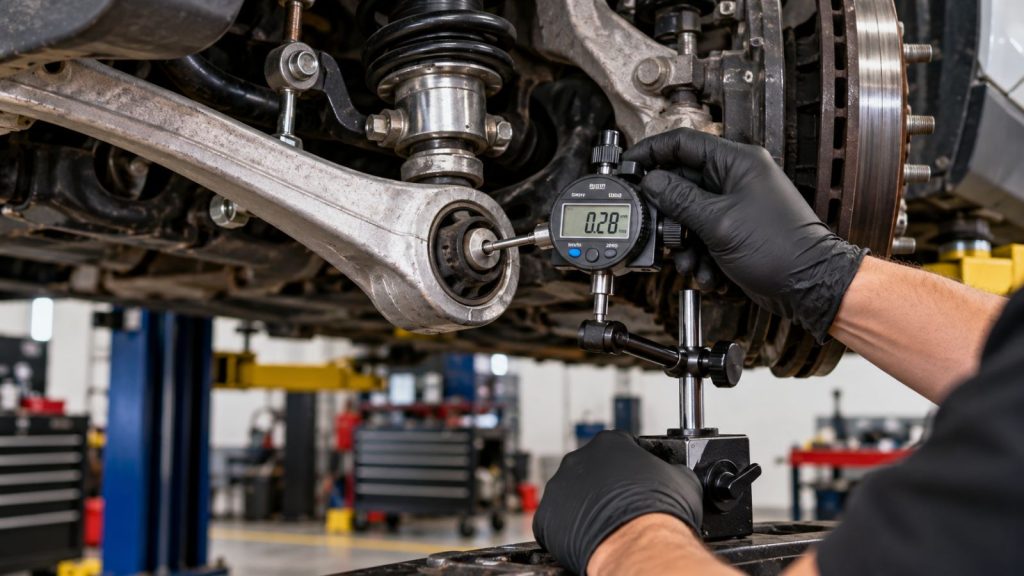
- Static Visual & Torque Inspection:
Position vehicle on a two-post lift to unload suspension tension. Check for tear witness marks along control arm hydrabushing perimeters, verify factory torque specs (111ft-lbs+90), and trace rust water trails near joint pinch bolts. - Deflection Measurement:
Attach a digital dial indicator with a magnetic base directly to the steering knuckle. Force lower arm movement with a heavy pry bar; deflection exceeding 0.050 inches signals internal elastomeric breakdown. - NVH Frequency Analysis:
Mount triaxial accelerometers to lower control arm mounting brackets. Drive the truck over simulated bumps while streaming vibration frequencies via PicoScope software to isolate exact mechanical play.
Diagnostic Verdict (Shop Bay 3): A 2022 F-150 presented with an intermittent 35-mph front-end shimmy after crossing flooded standing water on CR 484. Digital dial indicator reading showed 0.082 inches of lower arm deflection; PicoScope captured a distinct 14 Hz vibration spike during pedal application. Teardown confirmed fluid evacuation from the rear hydrabushing and severe internal sand scoring.
Schedule Your Precision Inspection
Our team catches minor bushing play before it destroys expensive radial tires or twists steering knuckles out of alignment. Avoid long main-dealer backlogs by letting local independent specialists restore your vehicle’s factory ride height and handling precision today with flexible auto repair financing options.
Contact Gregg Smith Automotive for precision suspension repair and alignment services. Visit our shop at 6202 SE Abshier Blvd, Belleview, FL 34420.
Frequently Asked Questions
Can flooded roads destroy Ford lower control arm bushings?
Yes. Submerging hot lower control arm bushings in standing road water creates a vacuum effect that pulls silt and moisture past rubber dust seals, accelerating internal friction, corrosion, and rubber delamination across the assembly.
Will driving through deep water throw off my truck’s wheel alignment?
Yes. Water intrusion rapidly deteriorates internal rubber mounts, shifting lower control arm alignment specs out of factory tolerance and causing aggressive, uneven tire edge wear across tread shoulders within weeks of initial fluid exposure.
Can a worn ball joint cause a clunking noise when braking?
Yes. Excessive internal clearance inside a water-damaged ball joint allows the control arm to shift violently forward and backward against heavy steering knuckle mounts whenever brake calipers clamp down under vehicle load.
Is it safe to drive a Ford truck with leaking hydrabushings?
No. Complete hydraulic fluid loss severely compromises overall suspension stability, increasing stopping distances, causing unexpected steering wander, and triggering unsafe lateral lane drift during high-speed highway emergency maneuvers.
How does silt affect internal ball joint lifespan after deep water exposure?
Silica sand particles act as an aggressive abrasive compound once inside the protective dust boot, rapidly scoring mirror-finished steel ball cups and creating severe internal play within just a few hundred miles.
Do independent repair shops fix Ford suspension issues faster than dealerships?
Yes. Local independent specialists maintain direct access to OEM specification components without forcing fleet or retail vehicles into lengthy main-dealer service backlog queues, eliminating costly multi-week scheduling delays for truck owners.