

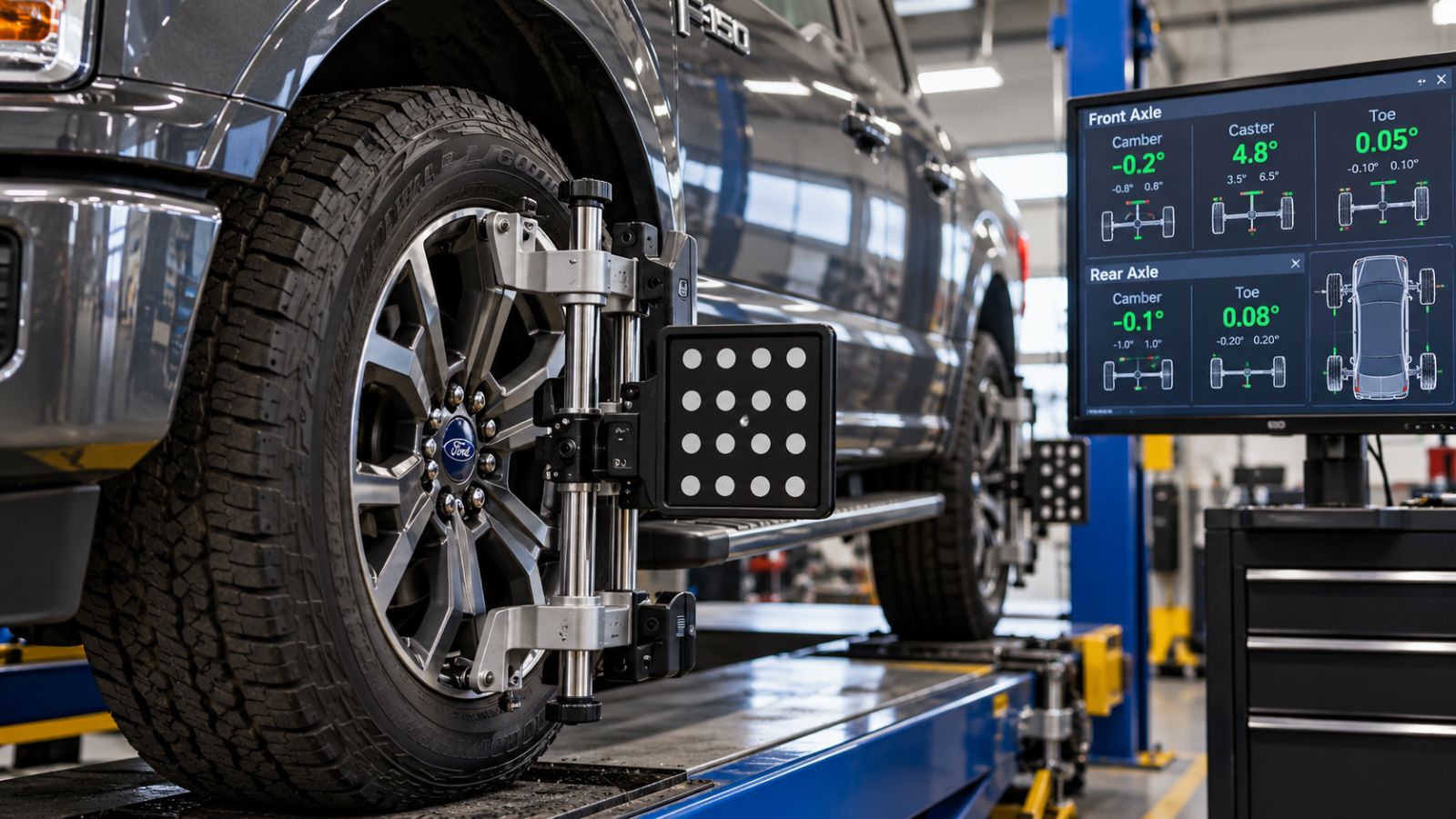
Ford truck and SUV suspension geometry suffers heavy stress from high heat and uneven pavement on Central Florida roadways. Deflected control arm bushings cause toe and camber drift, accelerating tire scrubbing and shoulder wear. Precision wheel alignment service resets thrust angle and steering position, preserving tread life and handling safety.
Florida Heat Meets Ford Geometry
Driving a Ford F-150 through Belleview on SE Abshier Blvd or US-441 often leads to rapid tire wear. The uneven road surfaces specifically scrub away the inner tread of your front suspension tires. Repeated impacts from sunken asphalt patches combined with extreme Florida road heat stretch soft lower control arm bushings, shifting toe angle out of factory tolerance. Our auto repair shop corrects this geometry daily to stop uneven tread wipeout before it ruins a full set of tires.
Quick Specs & Failure Profile
| Diagnostic Parameter | Specific Field Value |
| Primary Symptom | Steering wheel off-center, vehicle pulling right, rapid feathering or inner shoulder tire wear |
| Target Component | Lower control arm eccentric alignment bolts, tie rod ends, and strut mount plates |
| Specialized Tooling | Hunter Hawkeye Elite HD digital alignment system with target clamps |
| Local/Environmental Stressor | Micro-potholes, thermal road expansion joints, and rutted asphalt on SE Abshier Blvd |
| High-Risk Profile | Daily commuter Ford F-150s, Explorers, and Super Duty trucks hauling heavy payloads |
Mechanical Breakdown & Physics
Factory Baseline & Normal Operation
Ford front suspension systems use tuned rubber bushings at the control arm pivot points to dampen road feedback. Under normal operating conditions, these bushings maintain precise alignment geometry:
- Pivot Control: Elastomeric bushings hold the steering knuckle at precise factory angles.
- Tire Contact Patch: Keeps the tread completely flat against the road surface for even wear.
Thermal Expansion & Mechanical Failure Points
When a vehicle hits deep pavement ruts or railroad crossings at speed, dynamic energy transfers through the spindle directly into the tie rods and adjustment cams. High ambient heat combined with physical impacts triggers mechanical displacement:
- Bushing Degradation: High Florida heat softens rubber compounds, causing them to yield under force.
- Hardware Shift: Impact force slips the eccentric camber bolts off position.
- Tie Rod Deflection: Bends outer tie rod threads off the primary alignment axis.
Friction Vectors & Compound Destruction
Once shifted, the tire no longer rolls straight forward; it drags sideways across the hot road surface. A misalignment of just 1/16inch The total toe creates a scrub vector equivalent to dragging the tire sideways across asphalt for 80 miles every thousand driven miles. This relentless friction shreds rubber compounds off the inner or outer blocks, causing sharp feathering edges and uneven tread depth.
Shop Warning: Running misaligned steering geometry on heavy Ford trucks increases rolling resistance, elevates tire temperatures past safe operational thresholds, and causes premature fatigue in power steering racks.
The Master Diagnostic Protocol
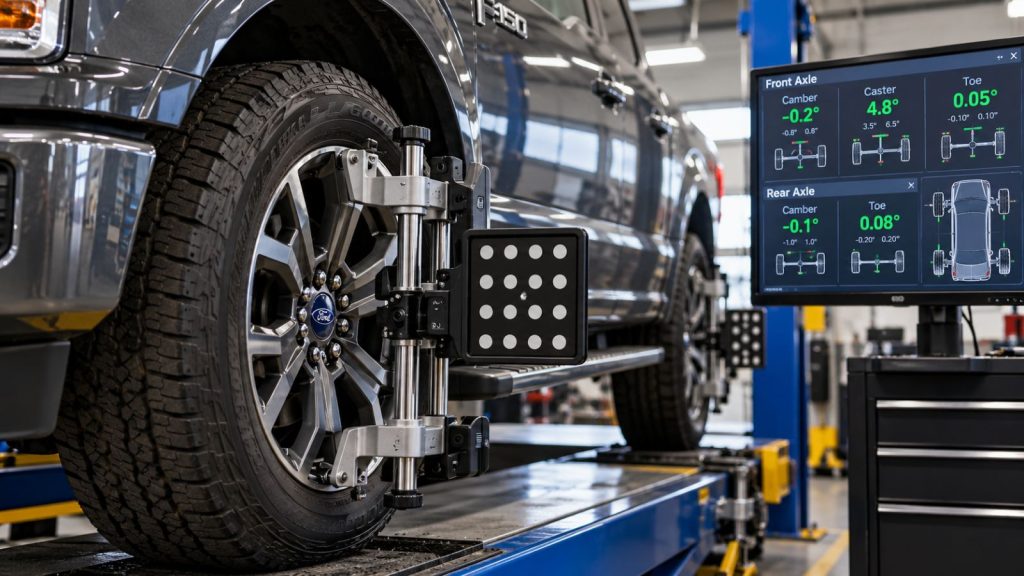
Precision electronic measurement catches subtle suspension geometry shifts before visual edge-wear becomes irreversible. We run every Ford through a strict digital testing sequence under load, using our advanced auto engine diagnostics tooling.
- Step-by-Step Technical Inspection
- Pneumatic Pressure and Wear Inspection: Set cold tire inflation to door-jamb placard specifications. Measure tread depth at three points across each tire carcass using a digital depth gauge during routine maintenance like an oil change service.
- Suspension Stress Test: Raise the vehicle on a two-post lift. Shake down the front end using steering play levers to measure radial play in ball joints and tie rod sockets.
- Target Mounting & Baseline Sweep: Mount Hunter target heads to outer rim edges. Lower vehicle onto turnplates, lock the steering wheel, and execute a rolling compensation sweep to record initial caster, camber, and toe specs.
- Subframe & Camber Adjustment: Loosen frame mounting bolts and adjust lower control arm eccentric cams to bring camber within target limits (0.5).
- Toe Setting and Steering Centering: Lock the steering wheel at dead center. Thread inner tie rod adjusters until toe reads dead-center on live screen readouts.
Shop Case Note: Last week, a 2021 F-150 came into our shop pulling hard right with severe inner edge feathering after daily commuting on US-441. Visual checks showed tight ball joints, but our Hunter Hawkeye sweep revealed -0.8 camber and +0.42 total toe caused by slipped lower control arm eccentric cams. Resetting torque to 150ft-lbs with a blue threadlocker permanently locked the adjustment in place.
Protect Your Tires Today
Ignoring suspension alignment problems shortens tire lifespan by thousands of miles and forces expensive, premature replacements. While local dealership service desks keep drivers waiting on backlogs for weeks, our independent shop delivers rapid, master-level dynamic alignments using high-end alignment technology. Protect your truck investment and keep your steering solid on Florida roads.
Book your alignment service at Gregg Smith Automotive today. Visit us in person at 6202 SE Abshier Blvd, Belleview, FL 34420 or call (352) 347-2222.
Frequently Asked Questions
Does a bad wheel alignment cause tires to wear down fast on Ford trucks?
Yes. Incorrect toe settings force tires to drag sideways across hot pavement, scrubbing tread away rapidly. A misaligned wheel angle of just a fraction of an inch creates severe friction vectors that strip rubber compounds, ruining tire shoulders and shortening overall tread life within a few thousand miles.
Should I get an alignment every time I buy new tires?
Yes. Installing fresh tires on a vehicle with altered suspension geometry rapidly degrades the brand-new rubber compound. Misaligned angles start uneven wear patterns immediately on fresh tread blocks, which ruins ride comfort, compromises handling safety on wet roads, and instantly voids the tire manufacturer’s official treadwear warranty coverage.
Can a single deep pothole knock a Ford steering wheel out of alignment?
Yes. Hitting a severe road defect transfers high dynamic forces through the steering spindle directly into suspension hardware. This impact slips lower control arm eccentric adjustment cams off center, bends outer tie rod shafts, and damages mounting bushings, causing the vehicle to pull sideways and throwing the steering wheel off.
Does a wheel alignment correct a steering wheel vibration at high speeds?
No. High-speed steering wheel vibration stems from out-of-balance tire assemblies or uneven wheel mass distribution rather than misaligned angles. Wheel alignment resets precise suspension geometry to prevent severe tire scrubbing and directional vehicle drifting, whereas dynamic balancing machinery corrects high-speed rotating mass vibrations across the wheel hub assembly.
Can worn suspension shocks cause alignment specs to drift out of tolerance?
Yes. Failed shock absorbers allow excessive wheel bounce and violent suspension cycling over highway bumps. This constant un-damped vertical motion causes intense mechanical stress on lower control arm pivot bushings and tie rod joints, forcing alignment adjustment cams to slip and steering angles to drift out of factory specification.