

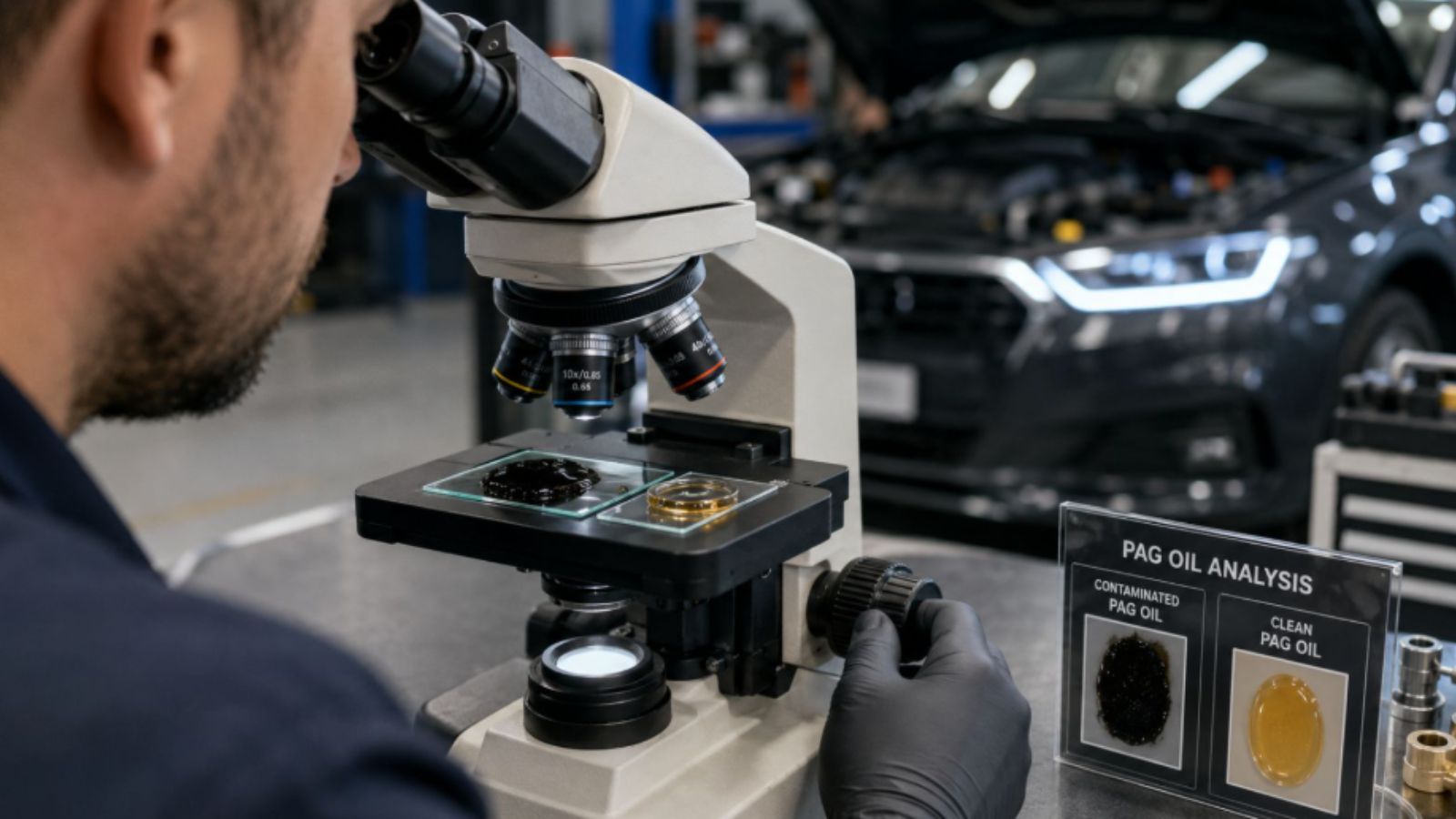
Microscopic aluminum shredding inside a failing compressor creates a destructive, tar-like sludge known as Black Death. When internal oil breakdown bypasses the protective orifice tube screen, modern micro-channel systems require complete mechanical replacement. Gregg Smith Automotive utilizes advanced fluid analysis to detect internal contamination before total component destruction occurs.
“Black Death” begins with a brief, ominous rattling noise under the hood, followed by the loss of cold air from your vents. This signals a catastrophic failure where the compressor physically shreds itself internally. This isn’t a simple repair; the resulting toxic debris weaponizes your entire air conditioning infrastructure, forcing a mandatory, expensive, multi-thousand-dollar system rebuild to ensure long-term operation.
Understanding Black Death and the Science of Internal Compressor Shredding
Internal cooling loop failure stems from lubrication breakdown. Precision-engineered scroll and piston compressors require specific volumes of Polyalkylene Glycol (PAG) Lubricants to protect metal parts under high stress. However, pinhole leaks or extreme July heat can degrade this oil.
Without sufficient refrigerant cooling, PAG oil loses viscosity and “cooks,” leading to aluminum components carving into housing walls. This destruction progresses through three stages:
- Microscopic Scuffing: Lack of film strength causes internal aluminum components to make raw, high-friction contact.
- Mechanical Shredding: High frictional heat shears microscopic aluminum flakes, slivers, and razor-sharp dust off the internal pistons.
- Sludge Synthesis: The suspended aluminum particles mix with the cooked, carbonized PAG oil, turning a vital clear lubricant into a thick, tarry, charcoal-black grinding paste.
Once this abrasive sludge is created, it is aggressively pumped out of the compressor’s high-side discharge muffler and pushed straight down the line toward the rest of your vehicle’s air conditioning components.
The Fixed Restriction Barrier and How the Orifice Tube Shields Your System
In vehicles with a high-side metering network, the inline plastic fixed-orifice tube serves as a critical thermodynamic component and a protective diagnostic shield. Positioned upstream of the evaporator core, it uses a precision brass tube to restrict high-pressure liquid refrigerant so it can expand into a cold gas. When a compressor begins to shred internally, its fine micro-mesh inlet screen acts as a forensic barrier, trapping traveling metallic debris and thick sludge before the toxic mixture can migrate deep into your dashboard’s internal plumbing.
- Thermodynamic Flow: The brass tube forces high-pressure liquid refrigerant to rapidly expand into a low-pressure, cabin-cooling gas.
- Debris Containment: The micro-mesh inlet screen catches migrating aluminum shards, keeping systemic sludge out of the delicate evaporator core.
- Forensic Troubleshooting: Connecting a four-valve manifold gauge set reveals a telling anomaly where the high-side pressure reads normal or high while the low-side drops into a vacuum.
- Mechanical Record: While the resulting physical blockage completely kills cabin cooling
AC Black Death and Why a Full System Rebuild Is Necessary
Severe Black Death contamination demands more than just replacing the compressor and orifice tube. Modern Micro-Channel Condensers have tiny paths that permanently trap abrasive aluminum sludge, making traditional flushes ineffective. Any remaining debris in the condenser or High-Side Discharge Mufflers will immediately destroy a new pump’s pistons.
A permanent fix demands discarding the compressor, condenser, desiccant bags, and orifice tube. Remaining lines must undergo an intensive AC System Solvent Flush until clear. This comprehensive hardware replacement and chemical cleansing drive verified Black Death repair costs to approximately $2,500.
Fluid Stream Comparison on System Integrity Metrics
To determine whether an air conditioning loop can be safely serviced or requires a full mechanical overhaul, our technicians benchmark the physical state of the refrigerant fluid stream against strict factory baselines.
The matrix below illustrates the stark technical differences between a healthy system and a contaminated Black Death loop:
Automotive Climate Control Contamination Evaluation
| Diagnostic System Marker | Clean Factory Operational Circuit | Contaminated Black Death Loop |
| PAG Lubricant Clarity | Water-clear or light amber, uniform viscosity | Opaque charcoal-black, thick, tar-like consistency |
| Orifice Inlet Screen State | Open, free of restrictions or surface debris | Fully matted with thick sludge and metallic flakes |
| Micro-Channel Condenser Flow | Unrestricted, balanced cross-core heat dump | Irreversibly plugged, localized cold spots |
| Low-Side Gauge Telemetry | Stable pressure reading between 30–35 PSI | Drops straight into a negative vacuum pressure |
| Downline Evaporator Status | Protected by clean, open metering flow | Blocked or contaminated by fine metallic dust |
Protecting Oxford Commuters from the Nightmare of a Secondary Failure
Oxford commuters on CR-466A or US-301 must avoid low-quality garages that perform superficial parts-swapping. Rushed, incomplete repairs often leave toxic metal debris in the system, causing replacement compressors to fail within days. This results in voided warranties and redundant, expensive repair bills.
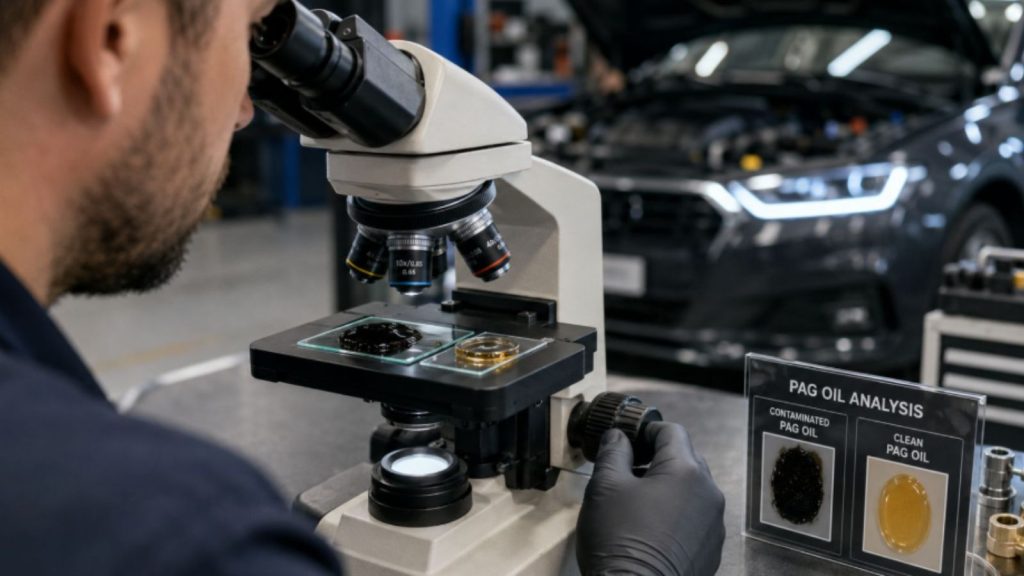
Gregg Smith Automotive utilizes diagnostic discipline to protect your budget. We use advanced extraction tools to sample PAG oil, examining it under a Shop Microscope for metallic sheen. If contamination is detected, we provide the technical steps for a proper, first-time rebuild. We prioritize data-driven precision over cheap shortcuts to ensure your vehicle is repaired accurately.
Secure Your Climate Infrastructure with Laboratory Precision
Don’t let a hidden contamination failure destroy your replacement hardware or inflate your repair budget. Our certified master technicians at Gregg Smith Automotive carry the precision fluid sampling tools, specialized solvent flushes, and microscopic analysis infrastructure required to identify internal contamination and rebuild your system accurately and safely.
Protect your vehicle’s cooling longevity and request your comprehensive fluid audit today.
Gregg Smith Automotive 6202 SE Abshier Blvd, Belleview, FL 34420
Frequently Asked Questions
Why can’t a technician just flush out a micro-channel condenser to save me money?
Micro-channel condensers feature microscopic internal paths that trap metallic sludge and debris. Flushing cannot effectively clear these blocked channels; trapped residue will eventually dislodge and destroy any new compressor, making full component replacement necessary.
What is the purpose of a liquid-line desiccant bag, and does it need to be replaced after a compressor failure?
The desiccant bag, a silica-filled pouch in the condenser or receiver-drier, absorbs system moisture. If a compressor shreds internally, this bag traps metallic sludge and requires replacement to stop further contamination.
Can a system run perfectly normal for months while Black Death is actively forming?
Yes. Low or degraded oil can cause silent compressor scuffing for weeks. If refrigerant pressure is maintained and the orifice tube is clear, the system will continue blowing cold air. Listen for a brief metallic rattling or chattering when the compressor clutch first engages as a primary warning sign.
Does a vehicle with a Thermal Expansion Valve get Black Death the same way an orifice tube system does?
Yes. Despite design differences, compressor self-destruction follows identical physics. Metallic sludge pumps into the Thermal Expansion Valve (TXV) pinhole rather than an orifice screen. This instantly locks the mechanism, halting cooling and creating a system bottleneck.
Why is driving a car with an undercharged AC system a primary cause of compressor self-destruction?
Automotive AC systems depend on refrigerant gas to circulate suspended PAG lubricant back to the compressor. When refrigerant levels are significantly low, oil fails to travel properly and instead pools within the evaporator core. This leaves compressor pistons without vital lubrication, leading to mechanical failure under high-heat operating conditions.